

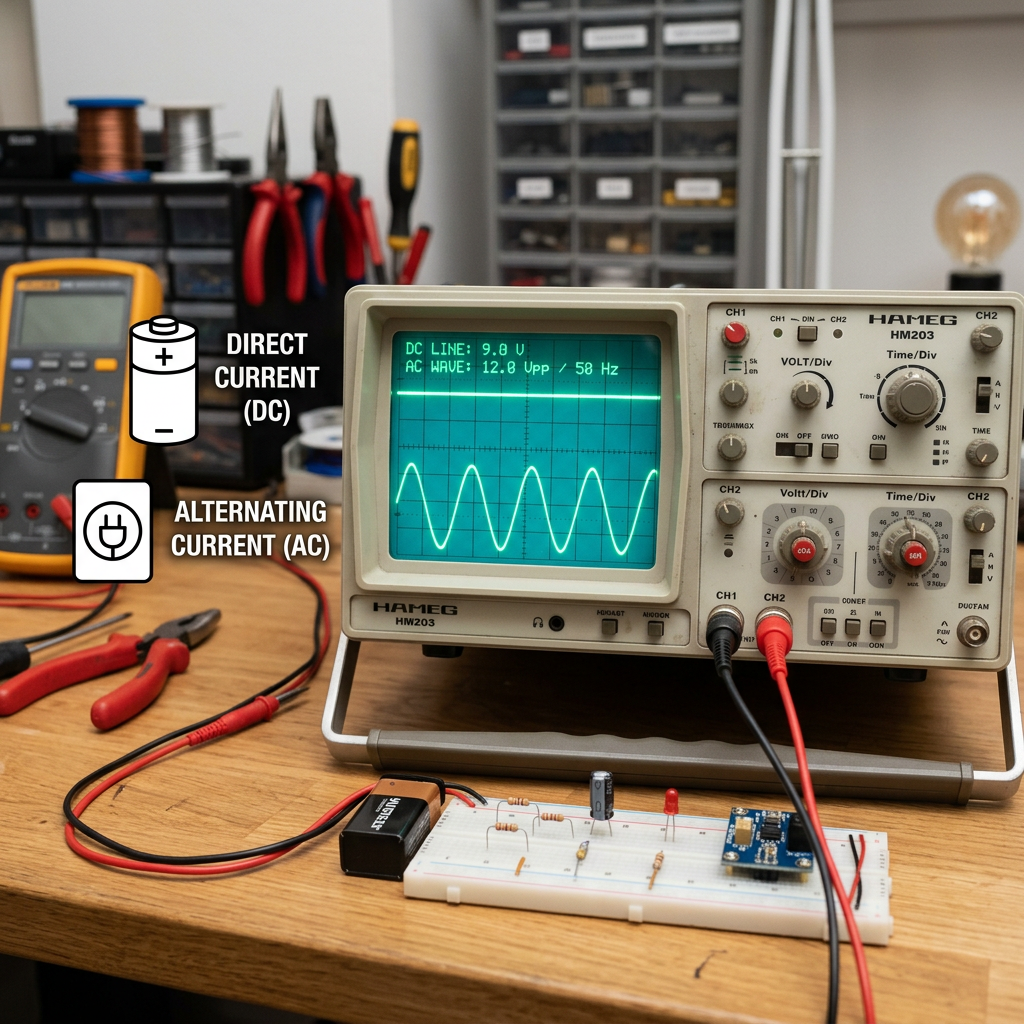
The skills you need to understand AC/DC, mains electricity, power ratings, fuses, energy cost, and the National Grid in GCSE Physics.
P10 is one of the most real‑world, safety‑focused, and calculation‑heavy topics in GCSE Physics. Students learn how mains electricity works, how appliances are rated, how fuses protect circuits, and how the National Grid transmits electricity efficiently across the country.
The P‑Series version teaches students to think in power and safety: how electricity behaves in homes, how devices are protected, and how energy is delivered nationwide.
What P10 Helps You Master
1. AC vs DC (Core)
Students learn:
Direct Current (DC)
- Flows in one direction
- Produced by batteries and cells
Alternating Current (AC)
- Repeatedly changes direction
- Produced by the mains supply
- UK mains frequency = 50 Hz
- UK mains potential difference = 230 V
2. Mains Electricity (Core)
A three‑core cable contains:
- Live wire (brown) – carries alternating potential difference
- Neutral wire (blue) – completes the circuit
- Earth wire (green/yellow) – safety wire to prevent electric shock
Students learn:
- Live wire is the most dangerous
- Touching a live wire completes a circuit through your body
3. Power Ratings (Core)
Appliances have power ratings showing how much energy they transfer per second.

Higher power = faster energy transfer.
4. Energy Transfer & Cost (Core)
Energy transferred:

Cost:
Students convert:
- Watts → kilowatts
- Seconds → hours
5. Fuses & Circuit Breakers (Core)
Fuses:
- Contain a thin wire
- Melt when the current is too high
- Break the circuit
Circuit breakers:
- Detect high current
- Switch off automatically
- Can be reset
Students choose the correct fuse rating (always slightly above normal current).
6. The National Grid (Core)
The National Grid transfers electricity from power stations to homes.
Key components:
- Power stations
- Step‑up transformers
- Transmission cables
- Step‑down transformers
- Homes and industry
7. Why the National Grid Uses High Voltage (Core)
To reduce energy loss:
- High voltage → low current
- Low current → less heating in cables
- Less energy wasted
This is a major exam favourite.
Higher Tier Extensions (P10 – HT)
1. Transformer Equations (HT)

Where:
- = primary voltage
- = secondary voltage
- = primary turns
- = secondary turns
Used in the transformer equation:
Students calculate:
- Step‑up transformers
- Step‑down transformers
- Turns ratios
2. Transformer Efficiency (HT)
Students explain:
- Why soft iron cores are used
- How heating causes energy loss
- Why high voltage reduces current
- How efficiency is improved
3. Power Transmission (HT Reasoning)
Students link:

to:
- High voltage
- Low current
- Reduced heating losses
4. AC Requirement for Transformers (HT)
Transformers only work with AC because:
- Changing current → changing magnetic field
- Changing field → induces a potential difference
5. Safety Analysis (HT)
Students evaluate:
- Why a live wire is dangerous
- Why an earth wire prevents shock
- Why double insulation removes the need for an earth wire
Mastery Tier (P10 – Grade 8–9 Reasoning)
Mastery pushes students into:
- Multi‑step transformer calculations
- Evaluating National Grid efficiency
- Analysing appliance power ratings
- Explaining fuse selection
- Calculating energy cost in real‑world scenarios
Examples include:
- Why high‑voltage transmission reduces losses
- How transformer turns affect voltage
- Why circuit breakers are safer than fuses
- How energy companies calculate bills
Why P10 Matters
Electricity in the home underpins safety, appliances, energy bills, and national infrastructure. P10 gives students the skills to:
- Calculate power and energy cost
- Explain AC/DC
- Analyse transformer behaviour
- Understand the National Grid
- Write high‑quality, long answers
It turns household electricity from “facts to memorise” into a predictable, logical system.
GCSE Physics Complete Exam Pack Coming Soon
The full GCSE Physics Complete Exam Pack (300+ exam questions, full mark schemes, worked solutions, higher‑tier questions, and printable worksheets) will be released once all Physics exam‑question posts are complete.
This ensures:
- Every topic is fully covered
- Every question is aligned with the final structure
- Every mark scheme is consistent
- The pack is complete, polished, and exam‑ready
Updates will be posted on the Physics Hub.