

The Story of Greenhouse Gases
Paper Reference: Ritchie, H., & Roser, M. (2020). CO₂ and Greenhouse Gas Emissions. Our World in Data.
1. A World in Invisible Motion
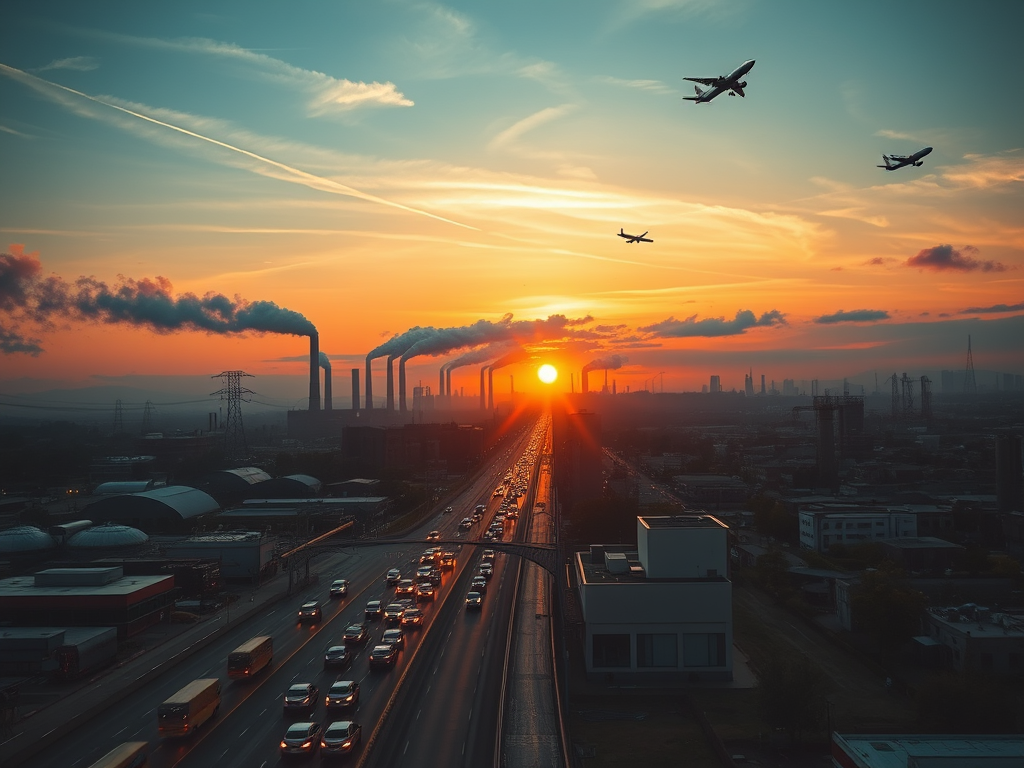
Imagine walking through a dense urban landscape at sunset. Traffic streams past; factory chimneys release wisps of smoke; planes streak overhead. Invisible to the eye, greenhouse gases mingle in the air around you, warming the planet imperceptibly but inexorably.
These gases, carbon dioxide (CO₂), methane (CH₄), and nitrous oxide (N₂O), are the byproducts of human activity. They linger in the atmosphere, trapping heat and altering Earth’s energy balance. Their presence is silent, their impact profound.
Ritchie and Roser confront a central question: How have human activities altered the balance of greenhouse gases, and what does this mean for the health of our planet and societies?
Their work is not just a dataset; it’s a mirror. It reflects our industrial past, our present choices, and the futures we might still shape.
2. The Bigger Picture
Greenhouse gases trap solar energy in Earth’s atmosphere. This process, known as the greenhouse effect, is natural and necessary. Without it, Earth would be too cold to sustain life. But human activity has intensified this effect, tipping the balance.
The consequences are global:
- Rising temperatures
- Melting ice caps and glaciers
- Sea level rise threatens coastal cities
- Shifts in rainfall patterns and agricultural productivity
- Increased frequency of extreme weather events
Ritchie and Roser’s research quantifies these emissions historically and geographically. It reveals disparities: high-income countries have contributed disproportionately to cumulative emissions, while low-income nations face the brunt of climate impacts.
This framing matters. It transforms climate change from a technical challenge into a moral and geopolitical one. It asks: Who is responsible? Who is vulnerable? And how can we act collectively?
3. Enter the Researchers
Hannah Ritchie and Max Roser are the architects behind Our World in Data, a platform that transforms complex global datasets into accessible, interactive insights.
Their motivation is clear: empower people with knowledge. They believe that data, when presented clearly, can inform better decisions, whether by policymakers, educators, journalists, or citizens.
The challenge they faced was immense. Greenhouse gas data is scattered across national inventories, scientific publications, and international agencies. It spans centuries, varies in methodology, and is often incomplete.
Ritchie and Roser undertook the task of harmonising this data. They reconciled conflicting sources, filled gaps, and created visualisations that make trends legible. Their work is not just technical; it’s translational. It bridges the gap between climate science and public understanding.
4. The Investigation
The researchers compiled emissions data from:
- National greenhouse gas inventories
- Satellite observations
- Scientific literature
- International bodies like the UNFCCC, IPCC, and World Bank
They scrutinised each dataset for:
- Consistency across years and regions
- Methodological transparency
- Biases in reporting
- Gaps in historical coverage
Where data was missing, they used proxies such as fuel consumption records or industrial output to estimate emissions. They cross-validated satellite data with ground-based measurements to ensure accuracy.
To explain this to a general audience: imagine assembling a jigsaw puzzle of Earth’s atmospheric history. Some pieces are crisp photographs (modern data); others are faded sketches (older records). Ritchie and Roser filled in the blanks, creating a coherent, detailed picture of global greenhouse gas emissions over time.
5. The Breakthrough
The defining insight of this research is scale and distribution.
- Global CO₂ emissions have surged from near-zero levels in the pre-industrial era to over 36 billion tonnes per year.
- Methane and nitrous oxide, though emitted in smaller quantities, have far greater warming potential per molecule.
- A small fraction of the global population, primarily in high-income countries, is responsible for the majority of cumulative emissions.
This reframes the narrative. Climate change is not just a scientific phenomenon; it’s a story of inequality, legacy, and responsibility.
The data also reveals sectoral contributions:
- Energy production (coal, oil, gas)
- Transport (cars, aviation, shipping)
- Agriculture (livestock, fertilisers)
- Industry (cement, steel, chemicals)
- Land use change (deforestation, urbanisation)
Understanding these patterns enables targeted action. It shifts the conversation from blame to strategy.
6. What It Means
The implications are profound:
- For policymakers: The data identifies high-impact sectors and regions, guiding legislation and investment.
- For industries: It highlights opportunities for innovation in clean energy, low-carbon materials, and regenerative agriculture.
- For individuals: It underscores that lifestyle choices, diet, travel, and energy use accumulate into global outcomes.
- For scientists: It provides a benchmark for climate models, scenario planning, and mitigation assessment.
Beyond numbers, the research invites reflection. It shows that emissions are not abstract; they are the fingerprints of our collective choices. And they shape everything from biodiversity to public health to geopolitical stability.
7. The Road Ahead
Despite its depth, the research leaves open questions:
- How can emerging economies grow without replicating high-emission pathways?
- What role will carbon capture, renewable energy, and behavioural change play?
- How can international cooperation be strengthened to meet climate targets?
Ritchie and Roser emphasise that the challenge is dynamic. Emissions are still rising. Climate impacts are accelerating. The window for action is narrowing.
Future research must integrate:
- Real-time monitoring
- Predictive modelling
- Policy evaluation
- Equity and justice frameworks
The road ahead is steep, but it is navigable. With data, dialogue, and determination, humanity can chart a lower-carbon future.
8. Final Note
Returning to the opening scene, the invisible gases swirling around us are not mere abstractions; they are the breath of civilisation. They carry the imprint of our industries, our economies, our habits.
Ritchie and Roser remind us that knowledge is power. By understanding the scale, sources, and history of greenhouse gas emissions, we can act with intention. Climate change is not inevitable; it is shaped by human action. And every decision matters.
Their work is a call to clarity, courage, and care.
Summary
Ritchie and Roser’s 2020 study provides a comprehensive overview of global greenhouse gas emissions, including CO₂, methane, and nitrous oxide. By synthesising historical and contemporary data, the research reveals not only the growth of emissions over time but also the uneven contributions of different countries, regions, and sectors.
This understanding is crucial: global warming is driven by human activity, but the responsibility is distributed unevenly. High-income countries have contributed most to cumulative emissions, while low-income nations face disproportionate climate impacts.
The study highlights that energy production, transport, and agriculture are the largest sources of emissions. This information empowers governments, industries, and citizens to target mitigation efforts where they can have the greatest impact. It also provides essential context for climate policy, illustrating how historical emissions influence current responsibilities and guiding equitable climate action.
In short, Ritchie and Roser transform abstract numbers into actionable insight, making clear that addressing climate change requires both global coordination and local responsibility. Their work equips society with the knowledge needed to make informed decisions for a sustainable future.