

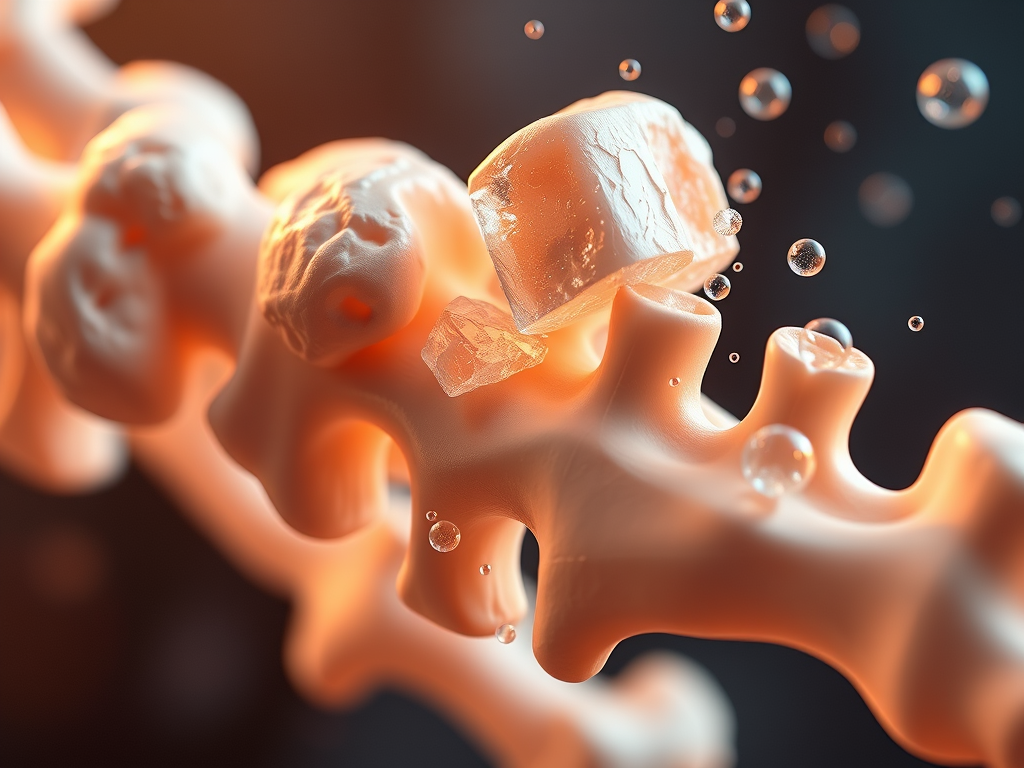
A companionable guide to skeletal strength, cellular messaging, and the hormonal choreography of calcium in human physiology
1. Why calcium matters
Calcium is the most abundant mineral in the human body, accounting for ~1.5% of body mass. About 99% of it is stored in bones and teeth, where it provides rigidity and structure. The remaining 1% circulates in the blood and resides in cells, where it performs vital signalling functions.
Calcium is essential for:
- Bone and tooth formation
- Muscle contraction
- Nerve impulse transmission
- Blood clotting
- Enzyme activation
- Hormonal secretion
2. Calcium in bones and teeth
Calcium forms hydroxyapatite, a crystalline compound of calcium phosphate, which gives bones and teeth their hardness. These crystals are embedded in a collagen matrix, creating a composite material that is both strong and flexible.
Bone is a dynamic tissue. It undergoes constant remodelling:
- Osteoclasts break down bone, releasing calcium
- Osteoblasts rebuild bone, incorporating calcium
This process maintains skeletal integrity and regulates calcium availability.
For a deeper dive into bone chemistry, see calcium’s importance.
3. Calcium as a cellular messenger
Calcium ions (Ca²⁺) act as second messengers in cells, transmitting signals that regulate:
- Muscle contraction
- Neurotransmitter release
- Hormone secretion
- Enzyme activation
- Cell division and death
Calcium’s concentration inside cells is tightly controlled. Resting levels are low, but influx through channels triggers rapid responses.
This gradient, a 1:10,000 ratio between extracellular and intracellular calcium, is essential for responsiveness and regulation.
4. Muscle contraction and nerve signalling
In muscle cells, calcium binds to troponin, initiating contraction by allowing actin and myosin to interact. In neurons, calcium influx triggers the release of neurotransmitters at synapses.
These processes are essential for:
- Heartbeat regulation
- Voluntary movement
- Reflexes and coordination
- Smooth muscle function (e.g., digestion, blood vessels)
Calcium’s role in excitation–contraction coupling makes it indispensable for mobility and circulation.
5. Blood clotting and enzyme activation
Calcium is required for coagulation, the process that stops bleeding. It activates clotting factors and helps form fibrin, the protein mesh that stabilises clots.
Calcium also activates enzymes involved in:
- Digestion
- Energy metabolism
- Cell signalling
- DNA replication
Its presence enables conformational changes and catalytic activity.
6. Hormonal regulation of calcium
Calcium levels in blood are tightly regulated by two hormones:
- Parathyroid hormone (PTH) increases blood calcium
- Calcitonin decreases blood calcium
PTH is released when calcium levels drop. It:
- Stimulates bone resorption
- Enhances calcium reabsorption in the kidneys
- Activates vitamin D to increase intestinal absorption
Calcitonin, produced by the thyroid, opposes PTH, slowing bone breakdown and promoting calcium storage.
Vitamin D is essential for calcium absorption. Without it, dietary calcium cannot be effectively used.
7. Dietary sources and requirements
Adults need 1,000–1,300 mg of calcium per day, depending on age and sex. Sources include:
- Dairy products (milk, cheese, yoghurt)
- Leafy greens (kale, broccoli)
- Fortified foods (cereals, plant milks)
- Fish with bones (sardines, salmon)
Vitamin D intake should be 600–800 IU daily to support absorption.
Calcium supplements may be recommended for those at risk of deficiency, especially postmenopausal women, older adults, and people with restricted diets.
8. Deficiency and excess
Hypocalcaemia (low calcium) causes:
- Muscle cramps and spasms
- Numbness and tingling
- Cardiac arrhythmias
- Osteoporosis and fractures
Hypercalcaemia (high calcium) causes:
- Fatigue and confusion
- Kidney stones
- Constipation
- Bone pain
Both conditions require medical evaluation and management.
9. Clinical applications
Calcium compounds are used in:
- Antacids (e.g. calcium carbonate)
- IV therapy (e.g. calcium gluconate)
- Bone health supplements
- Emergency treatment for hyperkalaemia or magnesium toxicity
Calcium also plays a role in imaging, diagnostics, and dental care.
10. Summary and what’s next
Calcium is the mineral of stability anchoring bones, transmitting signals, and regulating life’s rhythms. Its abundance and versatility make it foundational to human biology.
We’ve explored:
- Calcium’s structural and cellular roles
- Muscle, nerve, and clotting functions
- Hormonal regulation and dietary needs
- Deficiency, excess, and clinical relevance
In Lecture 7, we’ll explore Phosphorus: Energy, DNA, and Membranes, including its role in ATP, nucleic acids, and phospholipid bilayers.
Support the Archive
This archive is freely shared as a communal act of care.
If you’d like to support its continuation, consider purchasing a companion PDF set for £1 per lecture via Payhip, with the final price depending on the number of lectures in the set, available only once the full series is complete.