

What atoms are made of, how models of the atom have changed, and how nuclear radiation works
Atomic structure explains the building blocks of matter and the processes that occur inside the nucleus. It connects directly to the particle model, energy, and radiation, and it’s one of the most exam‑heavy topics in GCSE Physics.
GCSE Exam Essentials
Students must be able to:
- Describe the structure of the atom (protons, neutrons, electrons)
- Explain how atomic models have changed over time
- Define atomic number, mass number, and isotopes
- Describe ionisation and radioactive decay
- Compare alpha, beta, and gamma radiation
- Understand half‑life and interpret decay graphs
- Explain hazards and uses of radiation
- Understand nuclear equations
These appear across AQA, Edexcel, and OCR GCSE Physics specifications.
1. The Structure of the Atom
Atoms consist of:
- Nucleus: contains protons and neutrons
- Electrons: orbit the nucleus in shells
Subatomic particles
| Particle | Charge | Relative Mass |
| Proton | +1 | 1 |
| Neutron | 0 | 1 |
| Electron | –1 | ~0 |
“Atoms contain a tiny nucleus surrounded by electrons.”
Atomic number (Z)
Number of protons.
Mass number (A)
Number of protons + neutrons.
Isotopes
Atoms of the same element with different numbers of neutrons.
2. Development of the Atomic Model
GCSE students must know the historical progression:
Dalton (solid sphere model)
Atoms are tiny, indivisible spheres.
Thomson (plum pudding model)
Electrons embedded in a positive sphere.
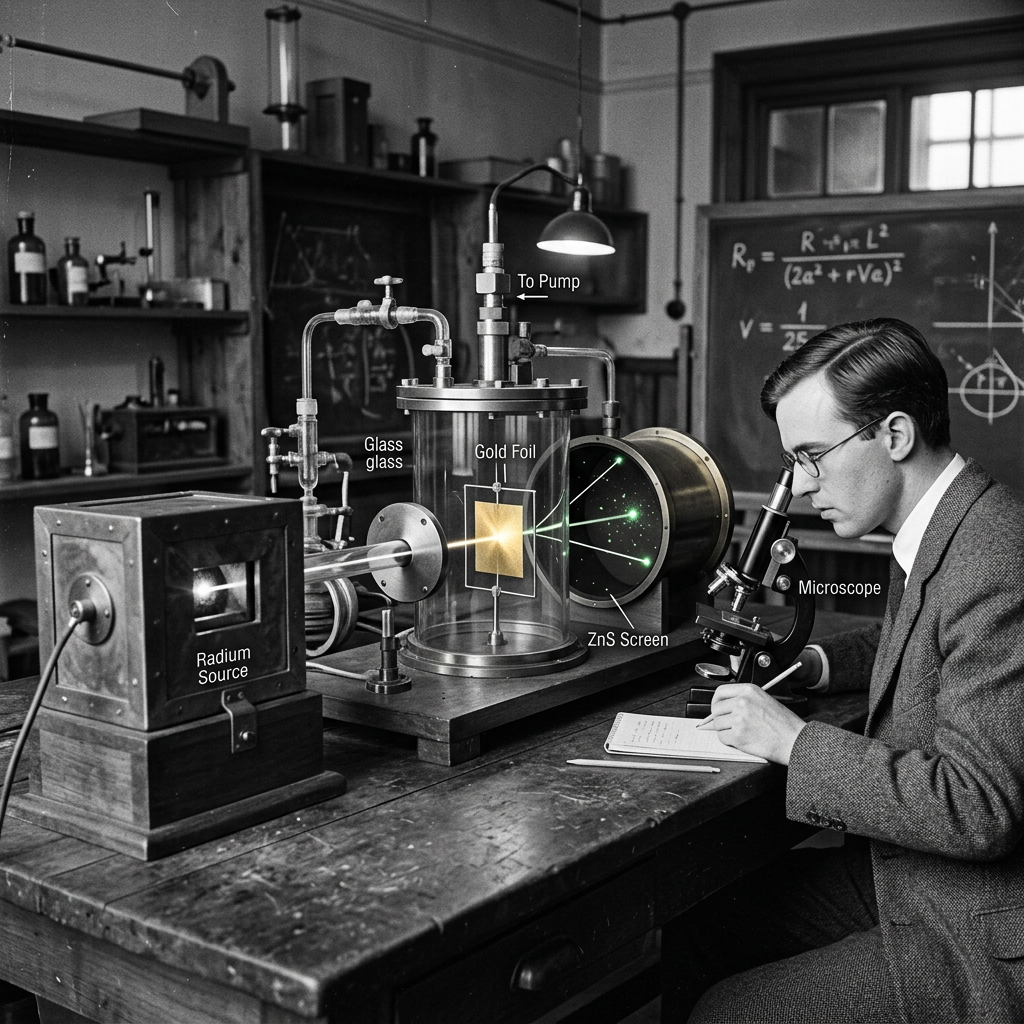
Rutherford (nuclear model)
Gold foil experiment → atoms are mostly empty space with a dense nucleus.
Bohr (energy levels)
Electrons orbit in fixed shells.
Modern model
Electrons in probability clouds; the nucleus contains protons and neutrons.
This is a common 6‑mark question.
3. Radioactivity and Nuclear Decay
Unstable nuclei emit radiation to become more stable.
Types of radiation
| Type | What it is | Penetration | Ionising power | Stopped by |
| Alpha (α) | 2 protons + 2 neutrons | Low | High | Paper |
| Beta (β) | Fast electron | Medium | Medium | Aluminium |
| Gamma (γ) | Electromagnetic wave | High | Low | Thick lead |
Ionisation
Radiation can knock electrons off atoms → creates ions → causes damage to cells.
4. Nuclear Equations
Students must balance nuclear equations.
Alpha decay
Mass number decreases by 4. Atomic number decreases by 2
Beta decay
Neutron → proton + electron. The Mass number stays the same; the atomic number increases by 1
5. Half‑Life
Half‑life = time for the activity of a radioactive sample to fall to half its original value.
Key points:
- Cannot be predicted for individual atoms
- Always constant for a given isotope
- Graphs show exponential decay
Students must interpret half‑life graphs and calculate half‑life from data.
6. Hazards and Uses of Radiation
Hazards
- Ionising radiation can damage DNA
- Can cause mutations and cancer
- Alpha is most dangerous inside the body
- Gamma is most dangerous outside the body
Uses
- Medical tracers
- Radiotherapy
- Sterilising equipment
- Thickness control in industry
7. Background Radiation
Sources include:
- Radon gas
- Cosmic rays
- Rocks and soil
- Medical procedures
- Nuclear industry
Students must understand variation in background radiation levels.
8. Common Misconceptions (GCSE‑specific)
Students often:
- Think atoms are mostly solid (they are mostly empty space)
- Confuse atomic number and mass number
- Believe radiation makes objects radioactive (only neutron radiation can)
- Think half‑life means “half the substance disappears”
- Mix up alpha, beta, and gamma properties
“Confusing atomic number and mass number” “Thinking radiation makes things radioactive”
9. Quick Check Questions
Use these for active recall:
- What is an isotope?
- What did Rutherford’s experiment show?
- Compare alpha, beta, and gamma radiation.
- What happens to the atomic number during beta decay?
- What is half‑life?
10. Summary
Atomic structure explains the nature of matter and the behaviour of unstable nuclei. Understanding radiation, decay, and half‑life provides the foundation for nuclear physics, medical imaging, and environmental science.