

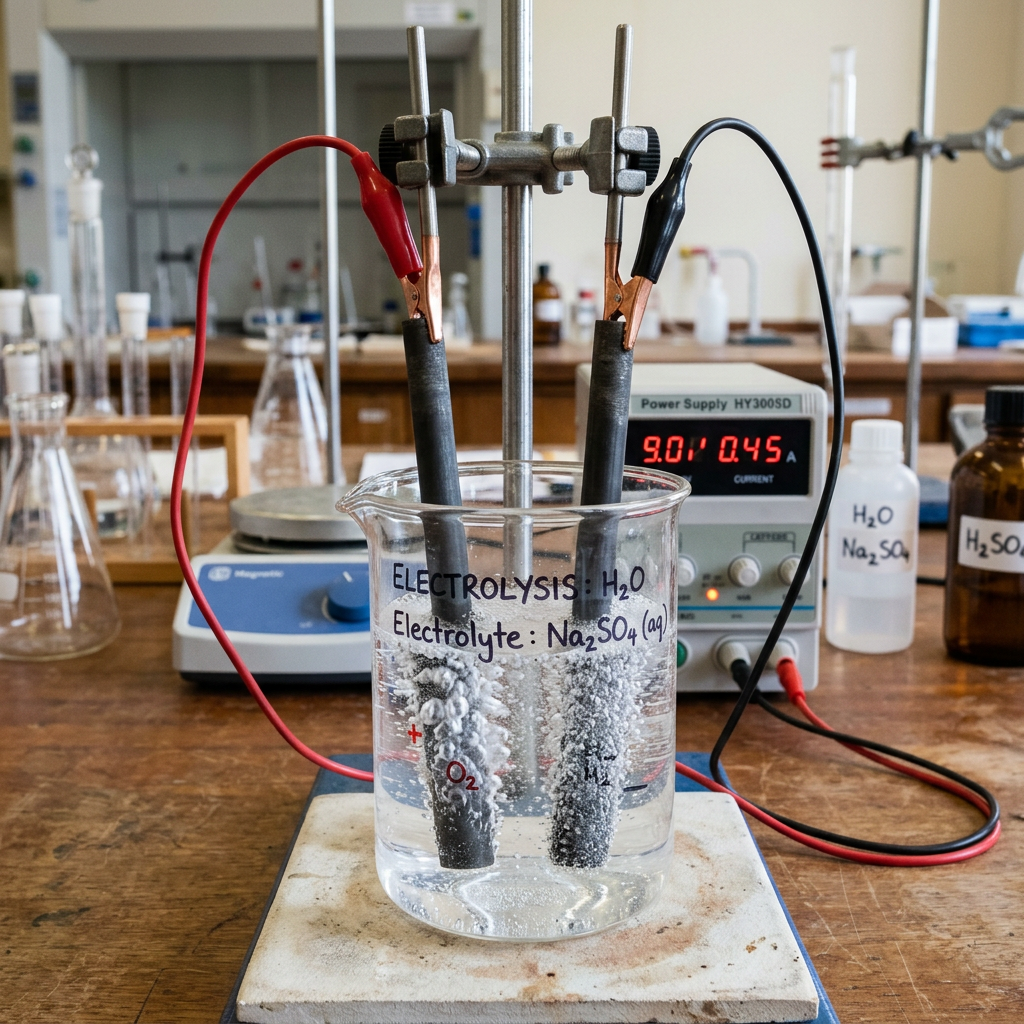
The skills you need to understand, explain, and apply electrolysis with confidence.
C6 is one of the most application‑heavy and calculation‑linked topics in GCSE Chemistry. Students learn how electricity breaks down ionic substances, how ions move, how to predict products, and how industrial processes like aluminium extraction work. The C‑Series version teaches students to think in ions: how charge, movement, and electrode reactions explain every electrolysis outcome.
What C6 Helps You, Master
1. What Electrolysis Is & When It Happens
Students learn:
- Electrolysis = breaking down a substance using electricity
- Only works when ions are free to move
- Molten ionic compounds
- Aqueous solutions
Higher Tier adds:
- Why solids cannot conduct
- Why water complicates aqueous electrolysis
Mastery teaches students to explain electrolysis using charge, mobility, and energy.
2. Electrodes, Ions & Movement
Students learn:
- Cations (positive) move to the cathode (negative)
- Anions (negative) move to the anode (positive)
- Opposite charges attract
Higher Tier adds:
- Electron transfer at electrodes
- Oxidation and reduction definitions
- Half‑equations
Mastery links ion movement → electron flow → electrode products.
3. Electrolysis of Molten Ionic Compounds
Students learn:
- Molten NaCl → sodium at cathode, chlorine at anode
- Molten PbBr₂ → lead at cathode, bromine at anode
Higher Tier adds:
- Predicting products using ion charges
- Writing half‑equations for molten electrolysis
Mastery teaches students to justify electrode products using electron transfer.
4. Electrolysis of Aqueous Solutions (More Complex)
Students learn:
- Water provides H⁺ and OH⁻ ions
- Competition between ions
- General rules:
- Cathode: hydrogen is produced unless the metal is very low in the reactivity series
- Anode: oxygen is produced unless halide ions are present
Higher Tier adds:
- Full reasoning using electrode potentials (GCSE‑level simplified)
- Half‑equations for hydrogen and oxygen production
Mastery teaches students to predict products in multi‑ion systems with justification.
5. Extraction of Aluminium (Industrial Electrolysis)
Students learn:
- Aluminium oxide dissolved in cryolite
- A molten mixture lowers the melting point
- Aluminium forms at the cathode
- Oxygen forms at the anode
- Carbon anodes burn away (CO₂ produced)
Higher Tier adds:
- Cost considerations
- Energy requirements
- Why cryolite is essential
Mastery links industrial design → energy → electrode reactions.
6. Half‑Equations & Redox (Higher Tier)
Students learn:
- Reduction = gain of electrons
- Oxidation = loss of electrons
- Cathode = reduction
- Anode = oxidation
Higher Tier adds:
- Writing balanced half‑equations
- Combining half‑equations
- Identifying oxidising/reducing agents
Mastery teaches students to explain electrode reactions using electron flow.
7. Avoiding Common Misconceptions
C6 highlights the mistakes examiners see every year:
- “Electrons move through the solution” (ions move in solution; electrons move in wires)
- “Solids conduct electrolysis” (they don’t, ions are fixed)
- “Hydrogen always forms at the cathode” (only if the metal is more reactive than hydrogen)
- “Oxygen always forms at the anode” (halides override this)
- “Electrolysis is the same as displacement” (completely different processes)
Fixing these earns easy marks.
8. Building Exam‑Ready Explanations
Mastery Tier teaches students how to:
- Predict electrode products
- Justify outcomes using ion reactivity
- Write half‑equations correctly
- Explain industrial electrolysis
- Write full, structured 4–6 mark answers
This is where Grades 8–9 are earned.
Why C6 Matters
Electrolysis underpins industrial chemistry, metal extraction, and redox processes. C6 gives students the skills to:
- Predict products from ionic substances
- Explain oxidation and reduction
- Write half‑equations
- Understand industrial extraction
- Write high‑quality, long answers
It turns electrolysis from “mysterious diagrams” into a clear, logical process.
What Comes Next
C6 is the sixth block in the C‑Series. Next, you’ll move into:
- C7 – Energy Changes
- C8 – Rates of Reaction
- C9 – Crude Oil & Organic Chemistry
- …all the way to C12.
Each one builds the exam‑ready reasoning students need across the whole course.
GCSE Chemistry Complete Exam Pack Coming Soon
The full GCSE Chemistry Complete Exam Pack (300+ exam questions, full mark schemes, worked solutions, higher‑tier questions, and printable worksheets) will be released once all Chemistry exam‑question posts are complete.
This ensures:
- Every topic is fully covered
- Every question matches the final structure
- Every mark scheme is consistent
- The pack is complete, polished, and exam‑ready
Updates will be posted on the Chemistry hub.