

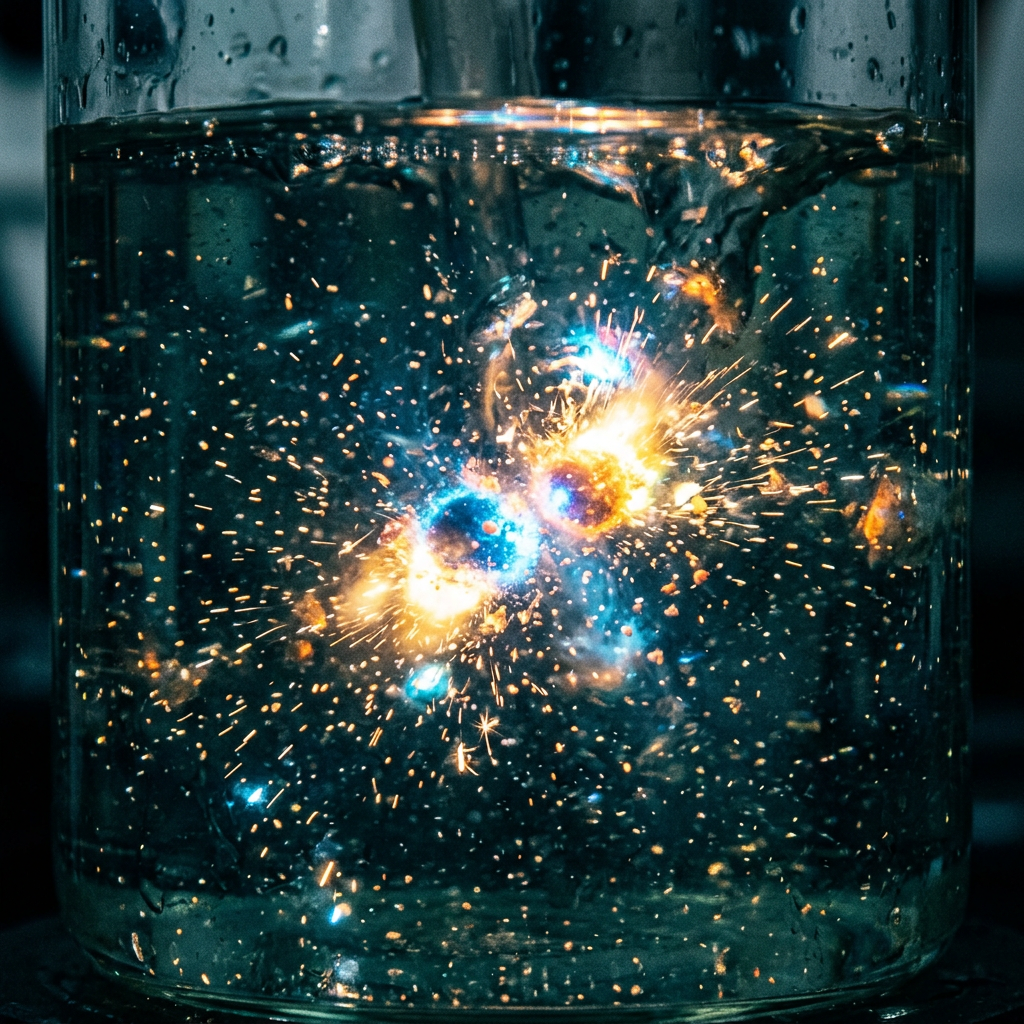
Core idea
Reaction rates are controlled by how often particles collide with enough energy and the correct orientation. Chemical reactions speed up when collision frequency and collision energy increase, and slow down when these conditions decrease.
Experiment: Reaction Rate Comparison System
Materials:
- Effervescent tablet (e.g., vitamin tablet)
- 3 glasses of water
- Cold water
- Room temperature water
- Hot water (not boiling)
- Optional: whole vs crushed tablet
Method:
1. Temperature comparison
Drop identical tablets into cold, room temperature, and hot water.
Observe:
- Cold water reacts slowly
- Hot water reacts rapidly
2. Surface area test
Compare:
- Whole tablet
- Crushed tablet
Observe:
- Crushed tablet reacts faster
3. Concentration-style extension
Add multiple tablets in the same volume.
Observe:
- Faster overall reaction intensity
What is actually happening (pre-A-level explanation)
Chemical reactions occur when particles:
- Move randomly in the solution
- Collide with each other
- Have sufficient energy during a collision
Not all collisions lead to reactions.
Only effective collisions do.
What is a successful collision?
A reaction occurs only if:
- Particles collideTheThe
- collision energy is high enough
- Particles are correctly oriented
So, the reaction rate depends on:
Number of successful collisions per second.
Why does temperature increase the reaction speed
When the temperature increases:
- Particles move faster
- Collisions happen more frequently
- Collisions carry more energy
So:
More effective collisions occur per unit time.
Why surface area matters
Breaking a solid into smaller pieces:
- Increases exposed surface
- Increases collision points
- Increases interaction probability
So, surface area controls:
How much of a substance is available for reaction at once.
Why concentration affects reaction rate
Higher concentration means:
- More particles in the same volume
- More frequent collisions
- Higher probability of successful interactions
So:
Reaction probability increases with particle density.
Collision theory (system view)
Collision theory states:
Reactions occur only when particles collide with sufficient energy and correct orientation.
So chemical reactions are:
Statistical interaction systems, not continuous transformations.
System interpretation
Reaction rate systems can be understood as:
probabilistic molecular interaction systems where reaction speed is determined by collision frequency, energy distribution, and spatial accessibility of reactant particles within a dynamic medium
Key properties:
- Probabilistic event-based transformation
- Energy threshold dependence
- Spatial interaction constraints
- Time-dependent system evolution
Real-world systems: this explains
Industrial chemistry
Faster reactions increase production efficiency.
Cooking processes
Heat speeds up chemical transformations in food.
Cleaning products
Surface area and concentration determine effectiveness.
Medicine dissolution and reaction rates
Drug absorption depends on reaction kinetics.
Natural chemical weathering
Temperature and exposure affect rock breakdown.
Extension experiments
1. Crushed vs whole comparison
Measure the time difference in gas production.
2. Temperature gradient test
Plot reaction speed changes across temperatures.
3. Stirring effect test
Compare stirred vs unstirred systems.
Common misunderstanding
❌ “Heat makes reactions happen”
Incorrect.
✔ Correct interpretation:
Heat increases particle energy and collision frequency, which increases the probability of successful reactions.
Key conceptual takeaway
Reaction rate is not fixed.
It is:
A dynamic collision-based system where chemical transformations depend on the frequency and energy of particle interactions within a constrained environment.