

A Chemistry Breakthrough
Paper Reference: Wallace, S., et al. (2025). A biocompatible Lossen rearrangement in Escherichia coli. Nature Chemistry, 17(7), 1020–1026.
1. The Plastic Dilemma Meets Human Health
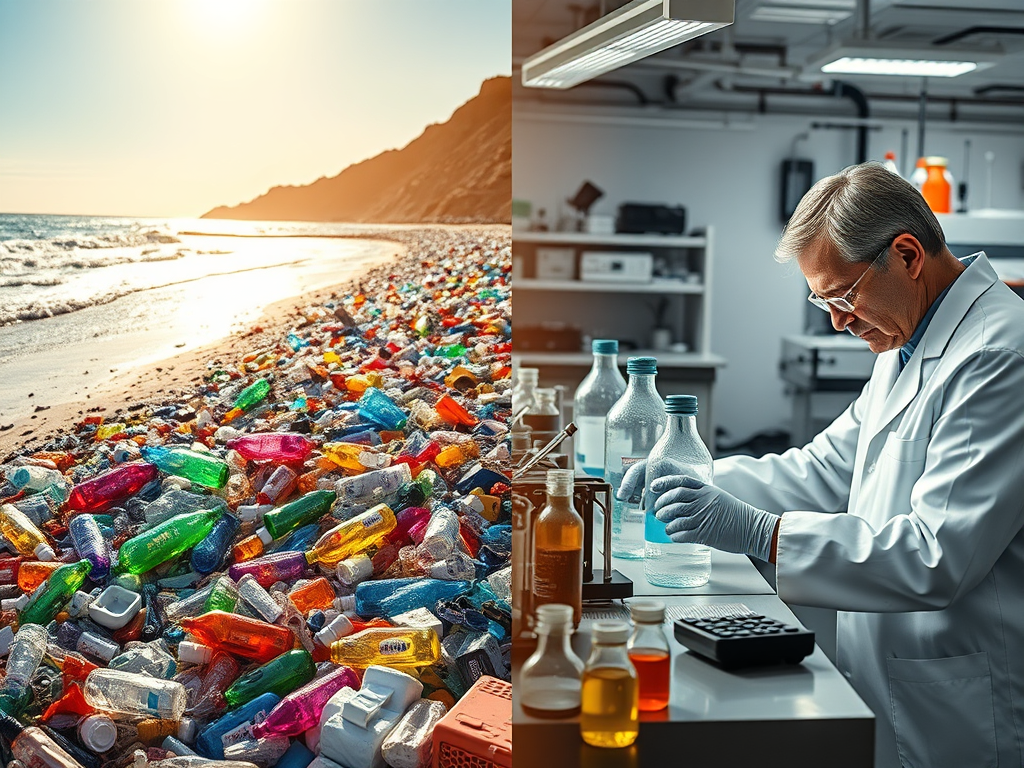
Imagine walking along a beach littered with plastic bottles, fragments glinting in the sun, their silent presence a reminder of humanity’s consumption habits. Simultaneously, hospitals around the world rely on pharmaceuticals produced using energy-intensive chemical reactions derived from fossil fuels. The research asks a compelling question: what if we could transform plastic pollution, the bane of our environment, into something life-saving?
This challenge is urgent. Millions of tonnes of PET, the plastic used in water bottles and packaging, enter landfills or oceans every year. Meanwhile, acetaminophen (paracetamol) is produced in factories with high carbon emissions and complex chemical pathways. The Edinburgh team envisioned a radical solution: repurpose PET waste directly into a pharmaceutical through the marvels of synthetic biology.
2. The Bigger Picture: Environmental and Societal Implications
The environmental stakes are enormous. PET plastic does not degrade naturally for centuries. Current recycling methods are limited in scope and often result in downcycling, where plastics are converted into lower-value products. This research offers a radical alternative: upcycling plastic into something of higher societal value.
Societally, the implications are equally profound. Sustainable drug production is a growing necessity in a world facing climate crises. By creating a method that turns waste into essential medication, this approach addresses both global environmental challenges and public health needs, highlighting a new paradigm where chemistry and biotechnology serve the planet directly.
3. Enter the Researchers: Visionaries at the Intersection of Chemistry and Biology
Dr. Stephen Wallace and his interdisciplinary team at the University of Edinburgh combined expertise in synthetic biology, chemical engineering, and environmental chemistry. Motivated by the dual crises of plastic pollution and unsustainable drug synthesis, they set out to find a solution that could be both practical and transformative.
The team faced numerous obstacles: teaching a bacterium to perform a complex chemical reaction naturally catalysed only under harsh industrial conditions, ensuring the process was safe and efficient, and creating a protocol that could theoretically scale to industrial production. Their vision was not just to demonstrate a scientific feat but to establish a blueprint for sustainable chemistry in the 21st century.
4. The Investigation: Engineering a Bacterial Factory
At the heart of this innovation is Escherichia coli, a bacterium familiar to microbiologists. Using advanced genetic engineering, the researchers enabled E. coli to convert terephthalic acid, a component of PET, into acetaminophen through a naturally biocompatible Lossen rearrangement.
The team painstakingly optimised conditions: pH, nutrient supply, fermentation temperature, and time. They overcame initial setbacks, including bacterial toxicity from intermediates and incomplete reactions. By leveraging the bacterium’s natural phosphate chemistry, they facilitated a reaction that previously required high temperatures and external catalysts, demonstrating a convergence of biology and chemistry that is rare in industrial applications.
5. The Breakthrough: From Waste to Medication
The result was spectacular. In under 24 hours, engineered E. coli converted PET-derived terephthalic acid into acetaminophen with a purity exceeding 90%. Unlike traditional methods that consume large amounts of energy and generate chemical waste, this process is almost carbon-neutral, using the bacterium’s innate metabolic machinery to catalyse the reaction.
This breakthrough represents more than efficiency; it is a conceptual shift. Here, a molecule discarded as waste becomes a substance that alleviates human suffering, symbolising a marriage of environmental stewardship and healthcare.
6. What It Means: Transforming Industries and Lifestyles
The practical applications of this research are vast:
- Pharmaceutical Industry: Traditional drug synthesis could be supplemented with bio-based routes, reducing reliance on fossil fuels.
- Environmental Impact: This method could incentivise PET collection and recycling, reducing landfill and ocean pollution.
- Economic Implications: Producing acetaminophen from waste could lower costs and democratise access to medicine in developing regions.
This work exemplifies how scientific ingenuity can tackle multiple global crises simultaneously: environmental degradation, climate change, and public health challenges.
7. The Road Ahead: Scaling and Diversifying
Despite the breakthrough, challenges remain:
- Scaling: Industrial-scale bacterial fermentation requires careful optimisation to ensure consistency, yield, and safety.
- Regulation: Pharmaceutical production must meet stringent safety standards, necessitating rigorous testing of bio-derived acetaminophen.
- Diversification: Could other drugs or high-value chemicals be produced using similar methods? Early indications suggest yes, but each compound presents unique biological and chemical challenges.
Future research will focus on creating modular microbial systems capable of transforming various waste streams into multiple pharmaceuticals, further enhancing sustainability.
8. Final Note: A Vision for Circular Chemistry
By converting plastic pollution into essential medicine, this research demonstrates that solutions to seemingly unrelated crises, environmental and medical, can intersect in elegant, actionable ways. It inspires a vision of a future where human ingenuity, guided by ethics and sustainability, transforms waste into wellbeing.
Summary
Plastic bottles pollute our oceans while medicines continue to require energy-intensive production. Researchers at the University of Edinburgh have engineered bacteria to turn PET plastic into acetaminophen, a common painkiller. This method works at room temperature, produces high-purity acetaminophen, and avoids harmful chemical waste. Beyond recycling, it offers a sustainable approach to pharmaceutical manufacturing, potentially reducing costs, emissions, and pollution simultaneously. In essence, trash becomes therapy, showing the transformative power of chemistry and biology working hand in hand. Future applications could expand to other drugs, creating a more sustainable and health-conscious world.
Further Reading