

The skills you need to understand, explain, and apply chemical reactions with confidence.
C5 is one of the most practical, experiment‑heavy, and high‑yield topics in GCSE Chemistry. Students learn how acids, alkalis, metals, ions, and redox processes behave and, more importantly, how to explain these reactions using particles, ions, and equations. The C‑Series version teaches students to think in reactions: how to predict products, interpret observations, and justify chemical behaviour.
What C5 Helps You Master
1. Acids, Alkalis & Indicators
Students learn:
- Acids = pH < 7
- Alkalis = pH > 7
- Indicators (litmus, universal indicator, pH scale)
- Neutralisation → acid + alkali → salt + water
Higher Tier adds:
- Ionic equations for neutralisation
- Identifying spectator ions
Mastery teaches students to explain neutralisation using H⁺ and OH⁻ ions.
2. Metal Reactions & the Reactivity Series
Students learn:
- Metals + acids → salt + hydrogen
- Metals + oxygen → metal oxides
- Metals + water → metal hydroxide + hydrogen
- Reactivity series (K → Na → Ca → Mg → Zn → Fe → Cu)
Higher Tier adds:
- Redox reasoning (oxidation = loss of electrons)
- Displacement reactions
- Predicting products using reactivity
Mastery links electron transfer → reactivity → observations.
3. Displacement Reactions
Students learn:
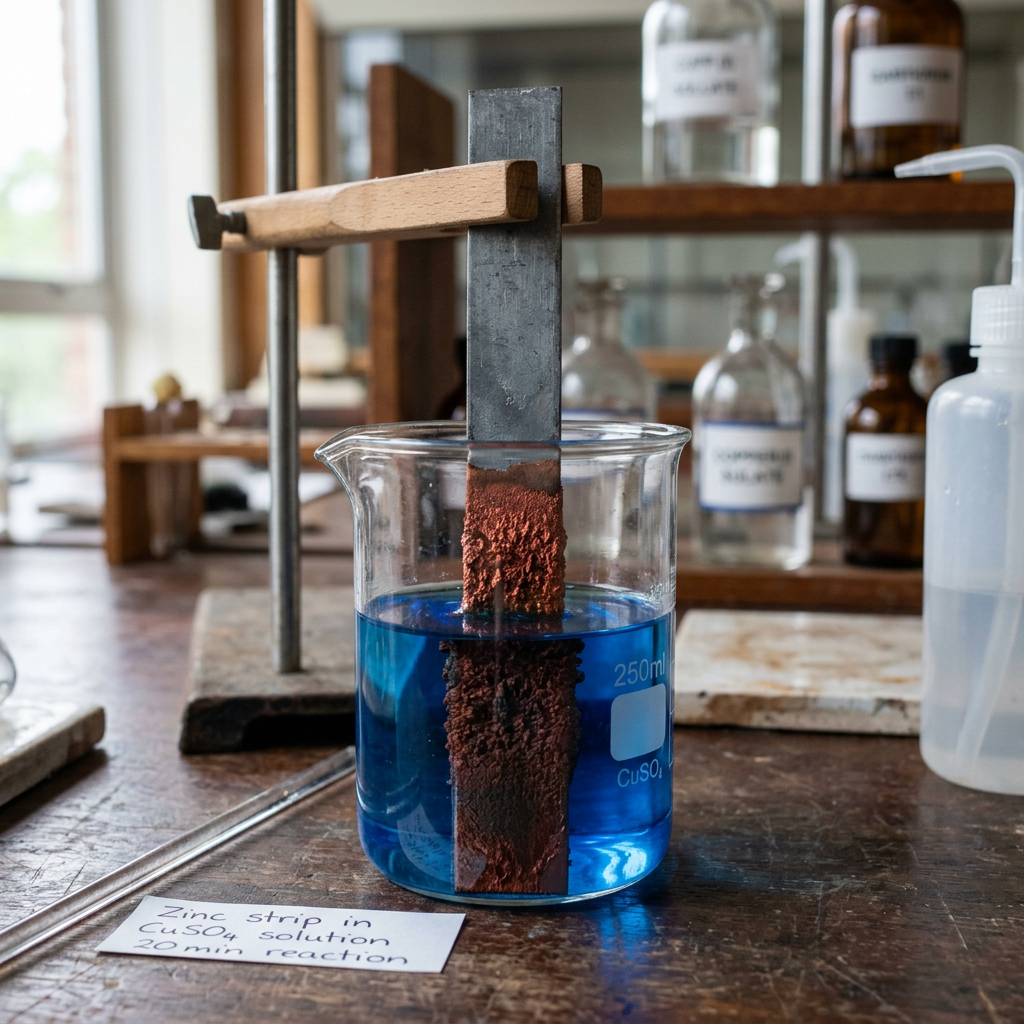
- A more reactive metal displaces a less reactive metal
- Zinc displaces copper from copper sulphate
- Halogen displacement (later in C‑Series)
Higher Tier adds:
- Ionic equations for displacement
- Electron transfer explanations
Mastery teaches students to justify displacement using reactivity + electron loss.
4. Strong vs Weak Acids (Higher Tier)
Students learn:
- Strong acids fully ionise
- Weak acids partially ionise
- pH depends on H⁺ concentration
Higher Tier adds:
- Logarithmic pH scale
- Linking ionisation to conductivity and reaction rate
Mastery explains why weak acids react more slowly but still produce the same products.
5. Redox Reactions & Half‑Equations (Higher Tier)
Students learn:
- Oxidation = loss of electrons
- Reduction = gain of electrons
- Metals form positive ions by losing electrons
Higher Tier adds:
- Writing half‑equations
- Combining half‑equations
- Identifying oxidising and reducing agents
Mastery teaches students to explain reactions using electron flow.
6. Observations & Evidence in Chemical Reactions
C5 builds the skill of describing:
- Fizzing/bubbles → gas produced
- Metal disappearing → reaction with acid
- Colour change → new substance formed
- Temperature change → exo/endothermic
Higher Tier adds:
- Linking observations to ionic processes
- Explaining why reactions stop (limiting reactant)
Mastery teaches students to justify observations using particle‑level reasoning.
7. Avoiding Common Misconceptions
C5 highlights the mistakes examiners see every year:
- “Strong acids are more concentrated” (strength ≠ concentration)
- “Magnesium gains electrons when reacting with acid” (it loses electrons)
- “Neutralisation makes pH 7 every time” (not always dependent on acid/base strength)
- “All metals react with acids” (copper does not)
- “Displacement happens because metals ‘want’ electrons” (anthropomorphism)
Fixing these earns easy marks.
8. Building Exam‑Ready Explanations
Mastery Tier teaches students how to:
- Write ionic and half‑equations
- Explain redox using electron transfer
- Justify reactivity using the series
- Describe observations with correct terminology
- Write full, structured 4–6 mark answers
This is where Grades 8–9 are earned.
Why C5 Matters
Chemical Changes underpin every reaction topic in GCSE Chemistry. C5 gives students the skills to:
- Predict reaction outcomes
- Write ionic and symbol equations
- Explain redox processes
- Interpret observations
- Write high‑quality, long answers
It turns chemical reactions from “memorising equations” into a coherent, logical system.
What Comes Next
C5 is the fifth block in the C‑Series. Next, you’ll move into:
- C6 – Electrolysis
- C7 – Energy Changes
- C8 – Rates of Reaction
- …all the way to C12.
Each one builds the exam‑ready reasoning students need across the whole course.
GCSE Chemistry Complete Exam Pack Coming Soon
The full GCSE Chemistry Complete Exam Pack (300+ exam questions, full mark schemes, worked solutions, higher‑tier questions, and printable worksheets) will be released once all Chemistry exam‑question posts are complete.
This ensures:
- Every topic is fully covered
- Every question matches the final structure
- Every mark scheme is consistent
- The pack is complete, polished, and exam‑ready
Updates will be posted on the Chemistry hub.