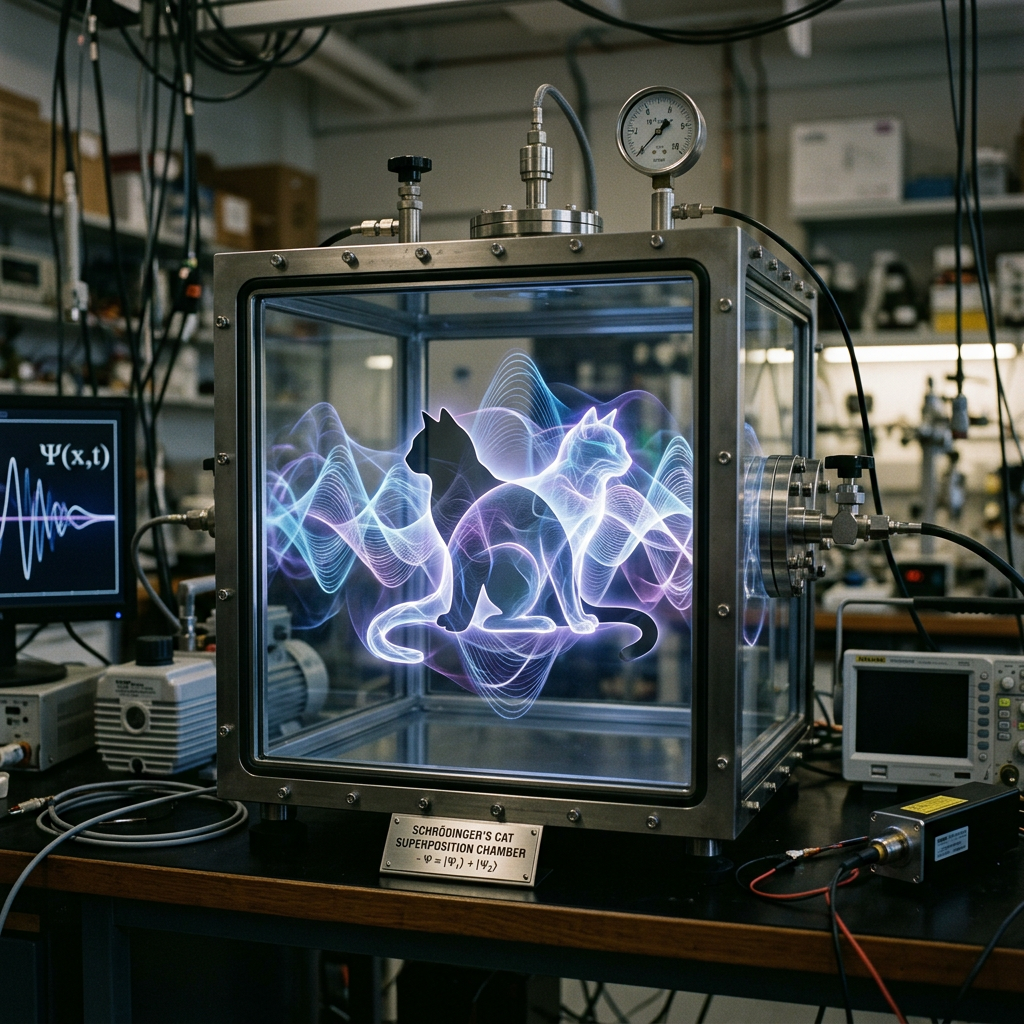
Quantum superposition is one of the strangest ideas in physics, but the basic concept is surprisingly simple once you strip away the jargon.
It describes how tiny particles can exist in multiple possible states at the same time until we measure them.
1. The simple idea
In everyday life:
- A light switch is either on or off
In quantum physics:
- A particle can be in a kind of “both on and off” state at the same time
Only when we observe it does it “choose” a definite state.
2. The famous example: Schrödinger’s cat
This thought experiment illustrates superposition:
- A cat in a sealed box is linked to a quantum event
- Until the box is opened, the system is described as both:
- Alive
- And dead (in theory)
It’s not about real cats behaving strangely; it’s about how quantum systems are described mathematically.
3. What’s actually happening in physics
At the quantum level, particles like electrons are described by a wavefunction.
This wavefunction:
- Represents all possible outcomes
- Evolves over time
- Does not settle into one result until measurement
Superposition = multiple probabilities existing at once.
4. The moment of measurement
When we measure a quantum system:
- The wavefunction “collapses”
- One outcome becomes real for us
- The other possibilities disappear from observation
This is called the measurement problem, and it’s still not fully understood.
5. Real-world evidence of superposition
Superposition isn’t just a theory; it’s been demonstrated in experiments:
- Electrons interfering like waves
- Photons passing through double slits
- Atoms exist in multiple energy states
These results only make sense if particles behave as probabilities, not fixed objects.
6. Why it matters for technology
Superposition is the foundation of:
- Quantum computing
- Quantum encryption
- Advanced sensing technologies
Quantum computers use “qubits” that can exist in multiple states at once, making them far more powerful for certain calculations.
The simple takeaway
- Superposition means quantum particles exist in multiple possible states at the same time
- We only see one outcome when we measure them
- Reality at small scales is fundamentally probabilistic, not fixed
Final thought
Quantum superposition challenges our everyday intuition because the universe at its smallest scale doesn’t behave like solid objects, but like a set of probabilities waiting to become reality.