

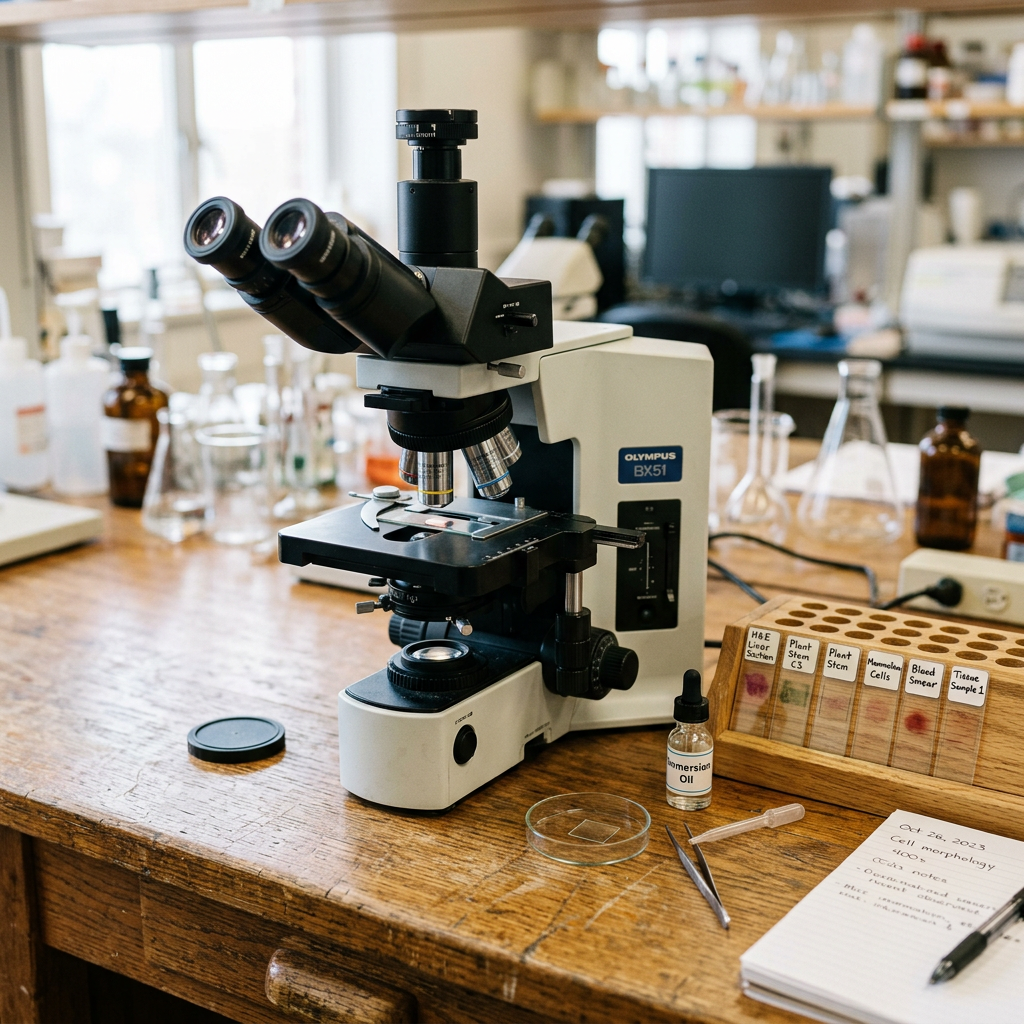
Your complete guide to the GCSE Biology course.
GCSE Biology explores how living organisms function, grow, adapt, and interact with their environment. As your document states:
“Students learn to understand the structure and function of cells, organs, and systems… analyse data, graphs, and experimental results… and link ideas across topics to build a complete picture of life processes.”
The course is structured into seven major topics, moving from microscopic structures (cells, enzymes, DNA) to whole‑organism systems (digestion, respiration, homeostasis) and finally to large‑scale interactions (ecosystems, evolution).
This overview gives you:
- The core ideas in each topic
- The key processes
- The required practical links
- Sample exam questions with mark breakdowns
Each topic will later have its own full post with deeper explanations and full question banks.
Topic 1: Cell Biology
Cell Biology is the foundation of GCSE Biology. It covers:
- Types of cells (animal, plant, bacterial)
- Specialised cells
- Microscopy and magnification
- Mitosis and stem cells
- Transport in cells
- Required practicals
“Cell Biology is the foundation of GCSE Biology… understanding how they work unlocks the rest of the course.”
Sample Exam Question (3 marks)
Describe the difference between diffusion, osmosis, and active transport. • diffusion = high → low • osmosis = water only • active transport = low → high using energy
Topic 2: Organisation
This topic explains how living things are structured from cells to whole systems. It includes:
- Levels of organisation
- Enzymes
- Digestion
- The heart and blood vessels
- Blood components
- Coronary heart disease
- Plant transport
- Required practicals
“It’s one of the most tested topics in GCSE Biology.”
Sample Exam Question (3 marks)
Describe the levels of organisation in living organisms. • cells → tissues • tissues → organs • organs → systems
Topic 3: Infection & Response
One of the most exam‑heavy topics. Students must understand:
- Pathogens
- The immune system
- Vaccination
- Antibiotics and resistance
- Drug development
- Plant diseases and defences
“Students must understand processes, evaluate treatments, and interpret unfamiliar scenarios.”
Sample Exam Question (4 marks)
Explain how vaccination prevents infection. • dead/inactive pathogen • antibodies produced • memory cells • faster response on reinfection
Topic 4: Bioenergetics
Bioenergetics covers the two most fundamental biological processes:
- Photosynthesis
- Respiration (aerobic and anaerobic)
- Limiting factors
- Required practicals
- Graph interpretation
- Inverse square law (HT)
“Students must understand equations, limiting factors, graphs, required practicals, and how organisms use energy.”
Sample Exam Question (3 marks)
Write the word and symbol equations for photosynthesis. • carbon dioxide + water → glucose + oxygen • 6CO₂ + 6H₂O → C₆H₁₂O₆ + 6O₂ • balanced correctly
Topic 5: Homeostasis & Response
Homeostasis keeps internal conditions stable so cells can function properly. This topic includes:
- The nervous system
- Reflexes
- The brain and eye (HT)
- Hormones
- Blood glucose control
- Diabetes
- The menstrual cycle
- Fertility treatments
- Thermoregulation
- Required practicals
“It’s one of the most application-heavy topics in GCSE Biology.”
Sample Exam Question (4 marks)
Describe the pathway of information in the nervous system. • Receptor • sensory neuron • CNS • Motor neuron → effector
Topic 6: Inheritance, Variation & Evolution
This concept‑heavy topic covers:
- DNA, genes, chromosomes
- Sexual vs asexual reproduction
- Meiosis
- Genetic diagrams
- Inherited disorders
- Variation
- Natural selection
- Selective breeding
- Genetic engineering
- Fossils and extinction
“It’s one of the most concept-heavy topics in GCSE Biology and appears heavily in exams.”
Sample Exam Question (3 marks)
Define DNA, gene, and chromosome. • DNA carries genetic information • gene = section of DNA coding for a protein • chromosome = long DNA molecule
Topic 7: Ecology
Ecology explores how organisms interact with each other and their environment. It includes:
- Ecosystems
- Competition
- Adaptations
- Food chains & trophic levels
- Pyramids of biomass
- The carbon and water cycles
- Biodiversity
- Human impacts
- Global warming
- Pollution
- Fieldwork methods
- Decay (HT)
“It’s a big exam topic with lots of application and data interpretation questions.”
Sample Exam Question (3 marks)
Define ecosystem, community, and population. • ecosystem = community + environment • community = all organisms • population = one species
How to Use This Overview
This post gives you:
- The structure of the course
- The essential ideas in each topic
- Sample exam questions
- A clear revision map
Each topic will have its own full post with:
- Complete explanations
- Diagrams
- Required practicals
- Higher‑tier content
- Full exam question banks
GCSE Biology Complete Exam Pack Coming Soon
The full GCSE Biology Complete Exam Pack (300+ exam questions, full mark schemes, worked solutions, higher‑tier questions, and printable worksheets) will be released once all Biology exam‑question posts are complete.
This ensures:
- Every topic is fully covered
- Every question is aligned with the final structure
- Every mark scheme is consistent
- The pack is complete, polished, and exam‑ready
Updates will be posted on the Biology hub.