

The skills you need to understand the solar system, star life cycles, orbits, redshift, and the Big Bang in GCSE Physics.
P8 is one of the most story‑driven, concept‑heavy, and application‑focused topics in GCSE Physics. Students learn how stars form and evolve, how planets orbit, how galaxies move, and what evidence supports the expanding universe.
The P‑Series version teaches students to think in cosmic systems: how gravity shapes motion, how stars change over time, and how observations reveal the universe’s history.
What P8 Helps You Master
1. The Solar System (Core)
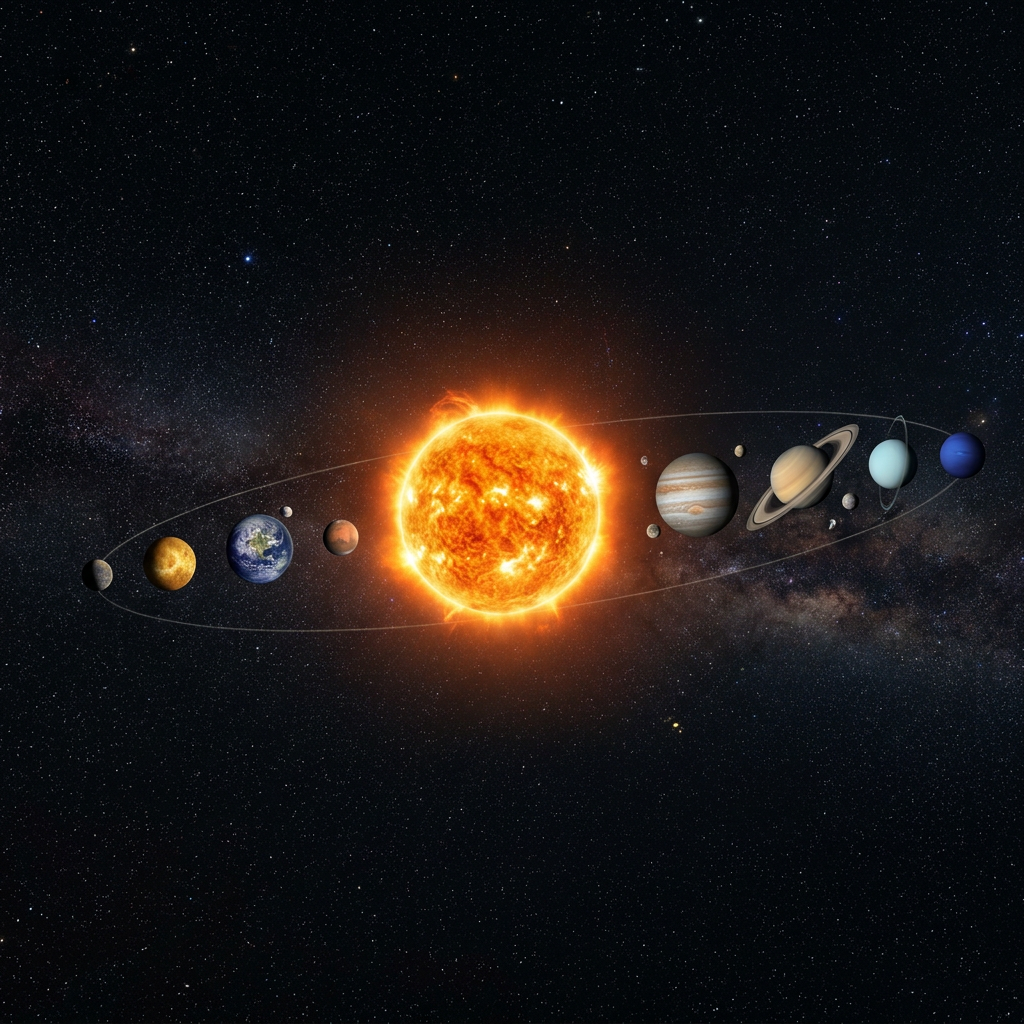
Students learn the structure of our solar system:
- The Sun (a star)
- Eight planets
- Dwarf planets (e.g., Pluto)
- Moons
- Asteroids
- Comets
Planets orbit the Sun in elliptical paths.
2. Orbits (Core)
Students learn:
- Gravity provides the centripetal force
- Planets orbit stars
- Moons orbit planets
- Artificial satellites orbit Earth
Key idea:
- Faster orbit = smaller radius
- Slower orbit = larger radius
If orbital speed increases → radius must decrease to stay in orbit.
3. Artificial Satellites (Core)
Two types:
Low Earth Orbit (LEO)
- Fast
- Used for imaging, spying, ISS
Geostationary Orbit
- 24‑hour orbit
- Stays above the same point on Earth
- Used for communication and TV
4. Life Cycle of a Star (Core)
Students learn the full sequence:
1. Nebula
Cloud of dust and gas.
2. Protostar
Gravity causes collapse → temperature rises.
3. Main Sequence Star
Hydrogen fusion → helium. Stable due to the balance of gravity and radiation pressure.
4. Red Giant / Red Supergiant
Hydrogen runs out → star expands.
5a. Low‑mass stars (like the Sun)
- Red giant
- Planetary nebula
- White dwarf
- Black dwarf (theoretical end)
5b. High‑mass stars
- Red supergiant
- Supernova
- Neutron star or black hole
5. Fusion in Stars (Core)
Students learn:
- Fusion releases energy
- Requires high temperature and pressure
- Powers stars throughout their life cycle
6. The Universe (Core)
Students learn:
- Stars → galaxies
- Billions of galaxies in the universe
- The universe is expanding
7. Red‑Shift (Core)
Light from distant galaxies is redshifted:
- Wavelength increases
- Frequency decreases
- Indicates galaxies are moving away
Greater red‑shift → faster recession.
8. Big Bang Theory (Core)
Evidence:
- Redshift of galaxies
- Cosmic microwave background radiation (CMBR)
Theory states:
- The universe began from a very small, hot, dense point
- Expanded rapidly
- Still expanding today
Higher Tier Extensions (P8 – HT)
1. Orbital Motion (HT)
Students explain:
- Gravitational force provides centripetal force
- Higher speed → smaller orbit
- Lower speed → larger orbit
2. Changing Orbits (HT)
Students analyse:
- How satellites change orbit
- Why energy changes affect orbital radius
- Why elliptical orbits vary in speed
3. Red‑Shift & Expansion (HT)
Students interpret:
- Red‑shift graphs
- Recession velocity vs distance
- Hubble’s law (qualitative)
4. CMBR (HT Reasoning)
Students explain:
- Why CMBR supports the Big Bang
- Why uniformity + tiny variations matter
- How it shows early universe conditions
5. Uncertainty in Cosmology (HT)
Students evaluate:
- Dark matter
- Dark energy
- Limitations of current models
Mastery Tier (P8 – Grade 8–9 Reasoning)
Mastery pushes students into:
- Explaining star evolution using fusion reasoning
- Analysing orbital motion using gravitational arguments
- Interpreting redshift data
- Evaluating Big Bang evidence
- Comparing alternative cosmological models
Examples include:
- Why massive stars undergo supernova
- Why black holes form
- Why galaxies further away have a greater redshift
- How CMBR supports early expansion
- Why orbital speed varies in elliptical orbits
Why P8 Matters
Space physics underpins astronomy, cosmology, satellites, and astrophysics. P8 gives students the skills to:
- Explain star life cycles
- Interpret redshift
- Analyse orbital motion
- Understand the expanding universe
- Write high‑quality, long answers
It turns space from “facts to memorise” into a coherent, evidence‑based system.
GCSE Physics Complete Exam Pack Coming Soon
The full GCSE Physics Complete Exam Pack (300+ exam questions, full mark schemes, worked solutions, higher‑tier questions, and printable worksheets) will be released once all Physics exam‑question posts are complete.
This ensures:
- Every topic is fully covered
- Every question is aligned with the final structure
- Every mark scheme is consistent
- The pack is complete, polished, and exam‑ready
Updates will be posted on the Physics Hub.