

The skills you need to understand wave behaviour, the EM spectrum, reflection, refraction, and practical wave investigations in GCSE Physics.
P6 is one of the most diagram‑heavy, maths‑linked, and application‑focused topics in GCSE Physics. Students learn how waves transfer energy, how to calculate wave speed, how waves behave at boundaries, and how the electromagnetic spectrum is used in real‑world applications.
The P‑Series version teaches students to think in wave interactions: how waves travel, change direction, reflect, refract, and carry information.
What P6 Helps You Master
1. Types of Waves (Core)
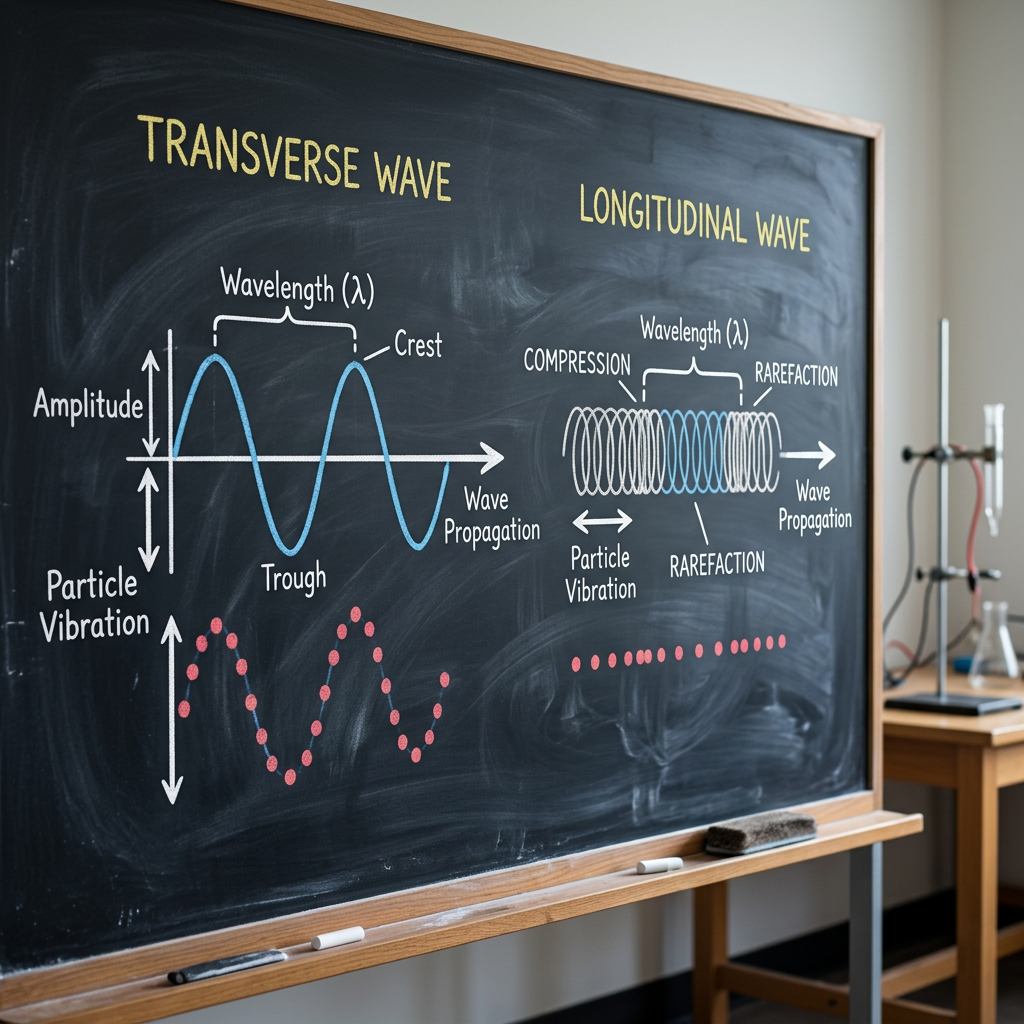
Students learn the two fundamental categories:
Transverse waves
- Oscillations perpendicular to the direction of travel
- Examples: EM waves, water waves, seismic S‑waves
Longitudinal waves
- Oscillations parallel to the direction of travel
- Examples: sound waves, seismic P‑waves
Key features:
- Compression
- Rarefaction
2. Wave Properties (Core)
Students learn the key terms:
- Wavelength (λ)
- Frequency (f)
- Amplitude
- Period (T)
- Wave speed (v)
3. Wave Speed Equation (Core)

And:

Students calculate:
- Wave speed
- Frequency
- Wavelength
- Period
4. Reflection (Core)
Students learn:
- Angle of incidence = angle of reflection
- Normal line
- Specular vs diffuse reflection
Ray diagrams are essential.
5. Refraction (Core)
Refraction occurs when waves change speed at a boundary.
Students learn:
- Entering a denser medium → slows down → bends towards the normal
- Entering a less dense medium → speeds up → bends away from normal
Ray diagrams required.
6. Sound Waves (Core)
Students learn:
- Sound is a longitudinal wave
- Travels through solids, liquids, gases
- Cannot travel through a vacuum
- Speed increases in denser media (solids fastest)
7. Electromagnetic Spectrum (Core)
All EM waves are:
- Transverse
- Travel at 3 × 10⁸ m/s in a vacuum
- Transfer energy
Order (low → high frequency):
- Radio
- Microwaves
- Infrared
- Visible
- Ultraviolet
- X‑rays
- Gamma rays
Students learn the uses and dangers of each.
8. Ultrasound (Core)
Students learn:
- Frequency above human hearing (> 20 kHz)
- Used for medical imaging and industrial testing
- Reflection at boundaries allows distance calculation
9. Seismic Waves (Core)
Two types:
- P‑waves: longitudinal, travel through solids + liquids
- S‑waves: transverse, travel through solids only
Used to study Earth’s structure.
Higher Tier Extensions (P6 – HT)
1. Refraction in Detail (HT)
Students explain:
- Wavefront behaviour
- Change in speed
- Why wavelength changes but the frequency stays constant
2. Wavefront Diagrams (HT)
Students draw:
- Incident wavefronts
- Refracted wavefronts
- Normal lines
- Direction arrows
3. Total Internal Reflection (HT)
Occurs when:
- Angle of incidence > critical angle
- A wave stays inside the medium
Used in:
- Fibre optics
- Medical endoscopes
4. EM Spectrum Risks (HT)
Students evaluate:
- Ionising vs non‑ionising radiation
- DNA damage
- Cancer risk
- Penetration depth
5. Measuring Wave Speed (HT Reasoning)
Students analyse:
- Ripple tank method
- String wave method
- Sound wave method
Including:
- Sources of error
- Improvements
- Uncertainty
Mastery Tier (P6 – Grade 8–9 Reasoning)
Mastery pushes students into:
- Multi‑step wave calculations
- Interpreting complex ray diagrams
- Explaining refraction using wavefronts
- Evaluating EM wave risks
- Analysing seismic wave data
Examples include:
- Why frequency stays constant at boundaries
- Why S‑waves cannot travel through liquids
- How ultrasound reflection reveals internal structures
- Why gamma rays are highly penetrating
- How total internal reflection depends on refractive index
Why P6 Matters
Waves underpin light, sound, communication, imaging, and seismic science. P6 gives students the skills to:
- Calculate wave speed
- Interpret ray diagrams
- Explain reflection and refraction
- Understand the EM spectrum
- Write high‑quality, long answers
It turns wave behaviour from “diagrams to memorise” into a predictable, logical system.
GCSE Physics Complete Exam Pack Coming Soon
The full GCSE Physics Complete Exam Pack (300+ exam questions, full mark schemes, worked solutions, higher‑tier questions, and printable worksheets) will be released once all Physics exam‑question posts are complete.
This ensures:
- Every topic is fully covered
- Every question is aligned with the final structure
- Every mark scheme is consistent
- The pack is complete, polished, and exam‑ready
Updates will be posted on the Physics Hub.