

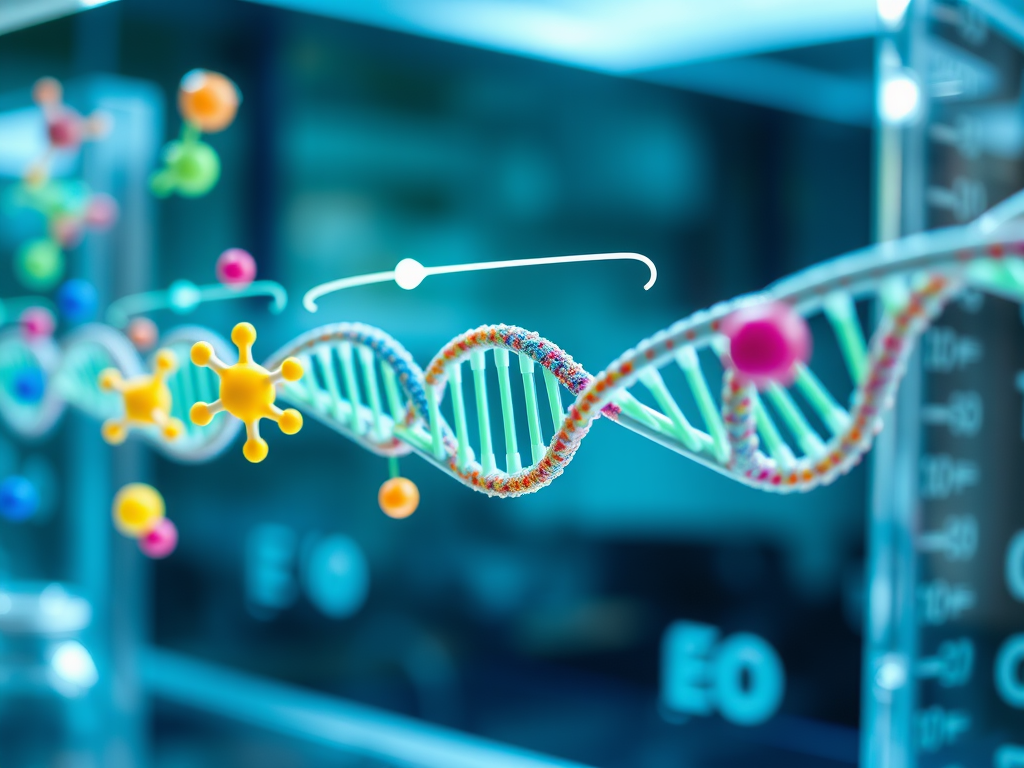
A modular guide to amplification cycles, gene editing steps, and how biology choreographs molecular kinetics
1. Why biology belongs in kinetics
Chemical kinetics isn’t confined to flasks and reactors; it’s alive in cells, enzymes, and genetic machinery. Biological systems use kinetic logic to replicate DNA, edit genomes, and regulate molecular behaviour. They rely on cycles, intermediates, and rate-determining steps just like synthetic reactions.
This lecture explores two iconic biological processes:
- PCR (Polymerase Chain Reaction)
- CRISPR-Cas9 gene editing
Both are kinetic systems. PCR amplifies DNA through thermal cycling and enzymatic steps. CRISPR edits genes through targeted cleavage and repair. Each involves intermediates, activation energy, and molecular choreography.
2. PCR: the kinetic engine of DNA amplification
PCR is a technique used to amplify specific DNA sequences. It mimics natural replication but accelerates it through controlled temperature cycles. The process involves:
- Denaturation (95°C): double-stranded DNA separates into single strands
- Annealing (≈60°C): primers bind to complementary sequences
- Extension (72°C): Taq polymerase synthesises new DNA strands
Each cycle doubles the amount of target DNA, leading to exponential amplification.
From a kinetic perspective, PCR is a repetitive, multi-step reaction with:
- Temperature-dependent rate constants
- Enzyme saturation and turnover
- Primer–template hybridisation as a reversible step
- Product accumulation over time
3. PCR as a kinetic model
Let’s model PCR as a three-step cycle:
- DNA → ssDNA (denaturation)
- ssDNA + primer ⇌ hybrid (annealing)
- hybrid + polymerase → dsDNA (extension)
Each step has its own rate constant (k₁, k₂, k₃) and temperature dependence. The overall rate depends on:
- Primer concentration
- Polymerase activity
- Cycle number
- Fidelity and efficiency of each step
In early cycles, amplification is exponential. At later cycles, reagents become limiting, and the rate plateaus, a classic example of saturation kinetics.
4. Steady state and limiting steps
During extension, Taq polymerase operates near its maximum rate. If primer binding is efficient, the rate-determining step becomes polymerisation.
PCR as a Kinetic System
- Reaction Overview

- Key intermediate: hybrid (primer-template complex)
- Enzyme: DNA polymerase
Applying SSA to the Hybrid Intermediate
Assume the hybrid intermediate [hybrid] reaches a quasi-steady concentration.

- The rate of formation ≈ rate of consumption
- Simplifies kinetic analysis and lets us express the overall amplification rate in terms of observable species like template and primers
Implications for PCR Efficiency
- Amplification efficiency depends on:
- [Primers] and their binding to the template
- DNA polymerase activity
- Concentration of nucleotides
- Limiting steps:
- If hybrid formation is slow (poor primer design), SSA shows low steady-state [hybrid] → slower product formation
- If polymerase activity is low, the effective turnover of hybrids is reduced → lower yield
- Rate laws perspective:
- PCR kinetics can be described by rate equations with intermediates (hybrids) and rate constants for binding and elongation
- SSA allows prediction of how changing primers, enzyme, or template affects amplification
Key Takeaway:
Applying SSA to PCR’s hybrid intermediate provides a quantitative framework to understand and optimise reaction efficiency, explaining why primer quality, enzyme activity, or limiting nucleotides can dramatically affect yield.
5. CRISPR-Cas9: gene editing as molecular choreography
CRISPR-Cas9 is a gene editing system derived from bacterial immunity. It uses:
- Guide RNA (gRNA): scans DNA for target sequence
- Cas9 enzyme: cleaves DNA at the target site
- Repair machinery: edits or replaces the gene
The process involves:
- gRNA–Cas9 complex formation
- Target recognition and binding
- DNA cleavage
- Repair via non-homologous end joining (NHEJ) or homology-directed repair (HDR)
Each step has kinetic implications, from binding affinity to cleavage rate to repair pathway choice.
6. CRISPR as a kinetic sequence
Let’s break down the steps:
- Complex formation: gRNA + Cas9 → active complex
- Target scanning: complex binds DNA, searches for PAM sequence
- Cleavage: Cas9 cuts both DNA strands
- Repair: cell machinery edits the break
Each step has a rate constant and may involve reversible binding, conformational change, or competition between pathways.
For example:
- High gRNA–DNA affinity speeds up recognition
- Slow cleavage may allow off-target binding
- NHEJ is fast but error-prone; HDR is slower but precise
CRISPR is a kinetic system balancing speed, specificity, and repair fidelity.
7. Intermediates and rate control
Key intermediates include:
- gRNA–Cas9 complex
- DNA–complex hybrid
- Cleaved DNA ends
- Repair intermediates
We can apply SSA to the gRNA–Cas9 complex:

- Intermediate: gRNA–Cas9 complex (active nuclease)
- Step 1: gRNA binds Cas9 → active complex
- Step 2: Complex binds target DNA → cleavage
Applying SSA to the gRNA–Cas9 Complex
Assume the intermediate complex rapidly reaches a steady-state concentration:

- Formation rate ≈ consumption rate
- Allows the overall cleavage rate to be expressed in terms of gRNA, Cas9, and DNA concentrations
Implications for Editing Efficiency
- Predicts on-target activity:
- Rate of DNA cleavage depends on [complex] under SSA
- Higher steady-state [complex] → faster editing
- Predicts off-target effects:
- Complex can bind mismatched sequences
- SSA allows modelling how changes in kinetics affect specificity
- Guides enzyme design:
- Fast kinetics → higher chance of errors
- Too slow → inefficient editing
- High-fidelity Cas9 variants often trade off speed for accuracy
Key Takeaways
- SSA simplifies modelling of multi-step CRISPR reactions
- Provides a quantitative framework for enzyme engineering and guides RNA design
- Helps balance efficiency vs. specificity
8. Amplification vs. editing: kinetic contrasts
PCR and CRISPR differ in purpose, but share kinetic themes:
- Both involve multi-step mechanisms
- Both rely on intermediates and activation energy
- Both use enzymes with defined turnover rates
- Both exhibit saturation and limiting behaviour
PCR is cyclical and exponential. CRISPR is targeted and conditional. PCR amplifies; CRISPR edits. But both are governed by kinetic logic, and both benefit from mechanistic insight.
9. Experimental design and kinetic tuning
Understanding kinetics helps optimise both systems:
For PCR:
- Primer design affects annealing rate
- Enzyme concentration affects extension rate
- Cycle number affects yield and fidelity
- Buffer composition affects stability
For CRISPR:
- gRNA sequence affects binding specificity
- Cas9 variants affect cleavage rate
- Repair template affects HDR efficiency
- Timing and delivery affect pathway choice
Kinetic tuning improves accuracy, efficiency, and outcome, essential for diagnostics, therapeutics, and research.
10. Summary and what’s next
PCR and CRISPR are kinetic systems: choreographed sequences of molecular events, governed by rate laws, intermediates, and limiting steps. They show how biology uses chemical logic to replicate, edit, and regulate genetic material.
Understanding their kinetics means understanding how life controls molecular behaviour with precision, feedback, and design.
In Lecture 10, we’ll explore Nuclear Kinetics and Element Synthesis, including how fission, fusion, and superheavy element formation reflect kinetic principles at the atomic scale.
Support the Archive
This archive is freely shared as a communal act of care.
If you’d like to support its continuation, consider purchasing a companion PDF set for £1 per lecture via Payhip, with the final price depending on the number of lectures in the set, available only once the full series is complete.