

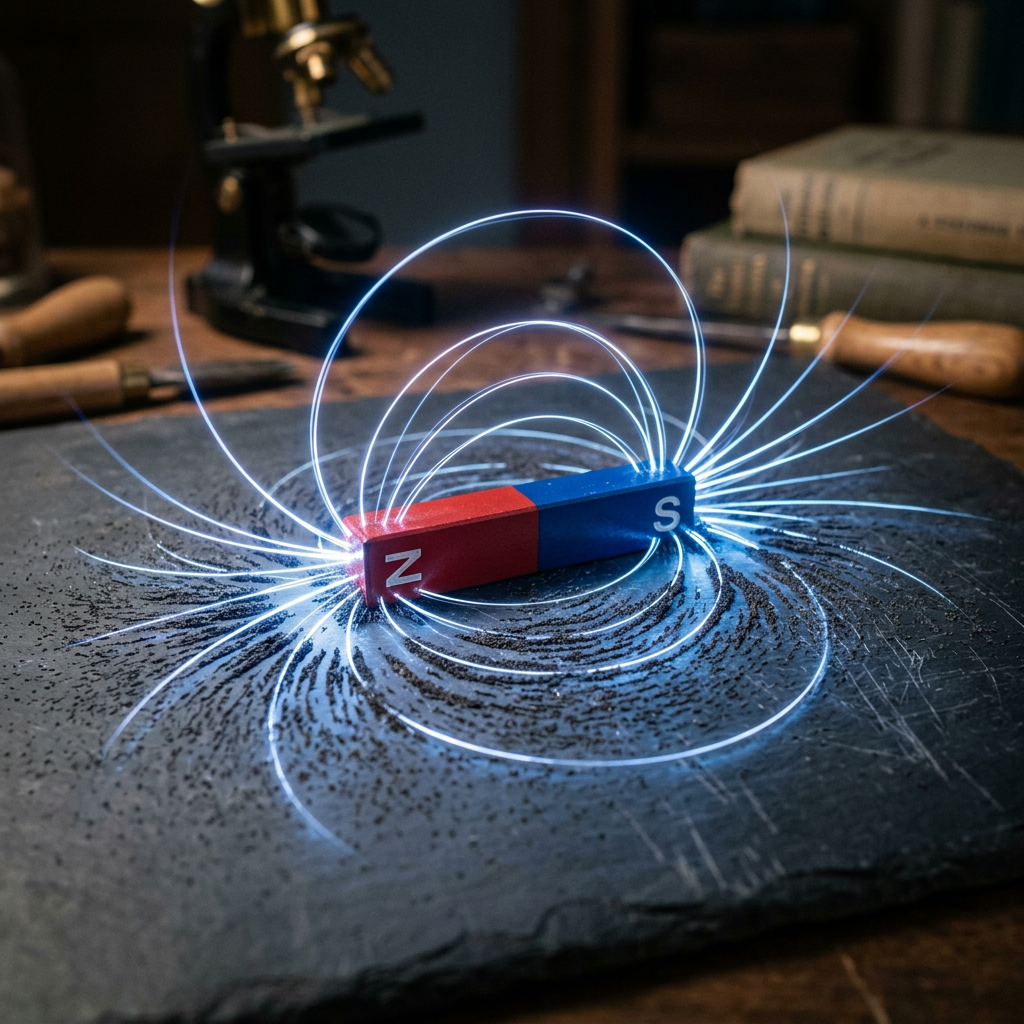
How magnets interact, how electric currents create magnetic fields, and how we harness electromagnetism in real systems
Magnetism and electromagnetism explain everything from compasses to electric motors, transformers, speakers, and the National Grid. This topic ties together electricity, forces, and energy and is one of the most applied areas of GCSE Physics.
GCSE Exam Essentials
Students must be able to:
- Describe magnetic fields and field lines
- Explain the difference between permanent and induced magnets
- Understand the motor effect and use the equation
F=BIL
Where:
- = force (N)
- = magnetic flux density (T)
- = current (A)
- = length of wire in field (m)
- Describe electromagnets and their uses
- Explain Fleming’s left‑hand rule
- Understand induced potential and the generator effect
- Describe transformers and the National Grid
- Use the transformer equation (higher tier)
These appear across AQA, Edexcel, and OCR GCSE Physics specifications.
1. Magnets and Magnetic Fields
Permanent magnets
Produce their own magnetic field.
Induced magnets
Become magnetic only when in a magnetic field.
Magnetic field lines
- Show the direction of the magnetic force
- Always go north → south
- Closer lines = stronger field
“Magnetic fields show the region where a magnetic force acts.”
Earth’s magnetic field
A compass aligns with Earth’s field → points north.
2. Electromagnets
A current in a wire creates a magnetic field. Wrapping the wire around an iron core makes the field stronger → an electromagnet.
How to increase strength
- More turns on the coil
- Higher current
- Iron core
Uses
- Cranes in scrap yards
- Relays
- Electric bells
- MRI machines
Electromagnets can be switched on/off, a key advantage over permanent magnets.
3. The Motor Effect
When a current‑carrying wire is placed in a magnetic field, it experiences a force.
This is the basis of electric motors.
Fleming’s Left‑Hand Rule
Thumb = Force First finger = Field Second finger = Current
(Used to predict the direction of the force.)
Motor effect equation

- F = force (N)
- = magnetic flux density (T)
- = current (A)
- = length of wire in the magnetic field (m)
This is a core calculation.
4. Electric Motors
A coil of wire in a magnetic field experiences forces on opposite sides → rotates.
A split‑ring commutator keeps the coil turning in the same direction.
Motors appear frequently in exam questions.
5. The Generator Effect
Moving a conductor in a magnetic field induces a potential difference.
This is the basis of:
- Alternators (AC generators)
- Dynamos (DC generators)
- Microphones
How to increase induced p.d.
- Move the wire faster
- Stronger magnetic field
- More turns on the coil
6. Transformers (Higher Tier)
Transformers change the potential difference of an AC supply.
Step‑up transformer
Increases voltage, decreases current.
Step‑down transformer
Decreases voltage, increases current.
Transformer equation

Where:
- Vp,Vs = primary / secondary voltages
- Np,Ns = number of turns on primary/secondary coils
Transformers only work with AC because a changing magnetic field is required.
7. National Grid Link
Electromagnetism underpins the entire National Grid:
- Power stations generate AC using the generator effect
- Step‑up transformers reduce energy loss in transmission
- Step‑down transformers make electricity safe for homes
This ties back to Topic 2: Electricity.
8. Common Misconceptions (GCSE‑specific)
Students often:
- Think magnetic field lines are physical objects (they’re models)
- Confuse permanent and induced magnets
- Mix up Fleming’s left‑hand and right‑hand rules
- Forget that transformers only work with AC
- Think increasing voltage increases current in transmission lines (it reduces it)
“Confusing permanent and induced magnets” “Thinking transformers work with DC”
9. Quick Check Questions
Use these for active recall:
- What is the difference between a permanent and an induced magnet?
- State the motor effect equation.
- What does Fleming’s left‑hand rule predict?
- Why do transformers only work with AC?
- How can you increase the strength of an electromagnet?
10. Summary
Magnetism and electromagnetism explain how electric currents create magnetic fields and how we harness these effects in motors, generators, and transformers. Understanding these principles completes the core GCSE Physics pathway and links directly to engineering, electronics, and energy systems.