

Core idea
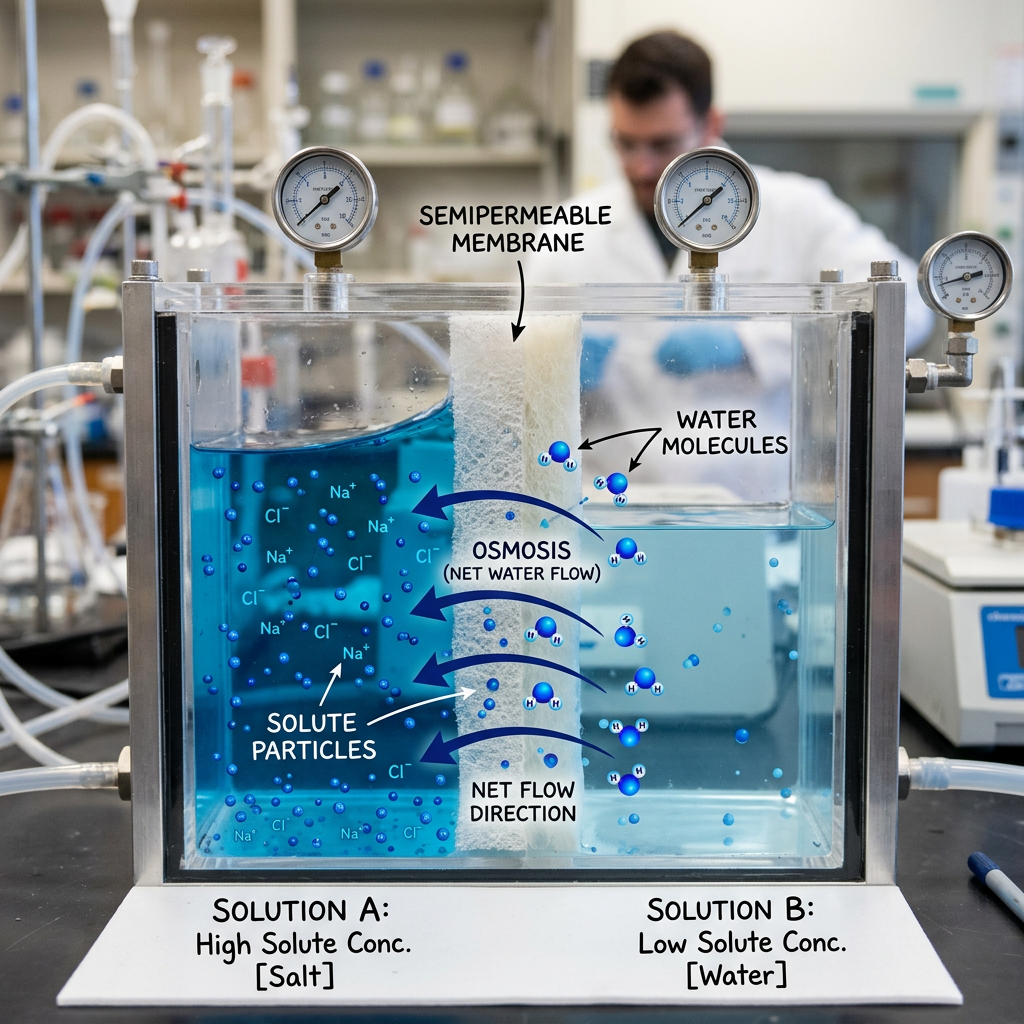
Osmosis is a passive transport system where water moves across a semipermeable membrane from regions of higher water concentration (lower solute concentration) to lower water concentration (higher solute concentration) until equilibrium is reached.
Experiment: Osmosis Through a Membrane System
Materials:
- Potatoes or eggs (optional classic setup)
- Salt
- Water
- Two containers
- Spoon
- Optional: dialysis tubing or plastic wrap
Method:
1. Saltwater vs. freshwater comparison
Place potato slices in:
- Plain water
- Saltwater
Observe over time:
- A potato in saltwater becomes softer
- Potato in freshwater stays firmer or swells
2. Shrink–swell system test
Leave samples for an extended time.
Observe:
- Mass and texture changes
3. Semipermeable barrier test (advanced)
Use a membrane or egg without a shell in vinegar-prepared demo setups.
Observe:
- Selective water movement
What is actually happening (pre-A-level explanation)
Water molecules are constantly moving in all directions.
When a barrier allows water through but not larger solutes:
- Water moves across the membrane
- Solute particles are restricted
- Imbalance drives the net movement of water
So, osmosis is:
Selective molecular movement through a constrained boundary system.
Why does water move in osmosis?
Water moves to balance:
- Solute concentration differences
- Water potential differences
- Molecular distribution across the membrane
So, movement occurs toward:
Equilibrium between two systems separated by a barrier.
What is a semipermeable membrane?
A semipermeable membrane is:
A boundary that allows certain molecules (like water) to pass while blocking others (like salts or sugars).
So, it acts as:
- Selective filter
- Transport regulator
- System boundary constraint
Why is osmosis important in biology
Cells rely on osmosis to maintain:
- Internal pressure (turgor in plants)
- Hydration balance
- Nutrient transport conditions
Without osmosis:
Cells cannot regulate internal stability.
Why salt changes cell behaviour
Salt increases external solute concentration:
- Water leaves cells to balance concentration
- Cells lose internal water
- Structure weakens or shrinks
So, salt creates:
Outward water flux through concentration imbalance.
System interpretation
Osmosis can be understood as:
A selective membrane transport system where water molecules move across semipermeable boundaries in response to solute concentration gradients, driving the system toward equilibrium through constrained diffusion processes.
Key properties:
- Selective permeability boundary
- Gradient-driven water movement
- Passive transport mechanism
- Equilibrium-seeking redistribution
Real-world systems this explains
Plant hydration
Water moves into the roots from the soil.
Cell stability
Cells regulate internal pressure via osmotic balance.
Food preservation
Salt draws water out of biological tissue.
Medical IV solutions
Fluid balance depends on osmotic compatibility.
Natural water systems
Water moves across biological and mineral membranes.
Extension experiments
1. Potato mass change test
Measure before and after soaking.
2. Salt concentration gradient test
Compare different salt levels.
3. Time dependency test
Track osmosis over hours vs. days.
Common misunderstanding
❌ “Water is attracted to salt”
Incorrect.
✔ Correct interpretation:
Water moves due to concentration gradients and selective membrane constraints, not attraction.
Key conceptual takeaway
Osmosis is not active pumping.
It is:
A passive membrane transport system where water moves across selective barriers to balance solute concentration differences between two systems.