

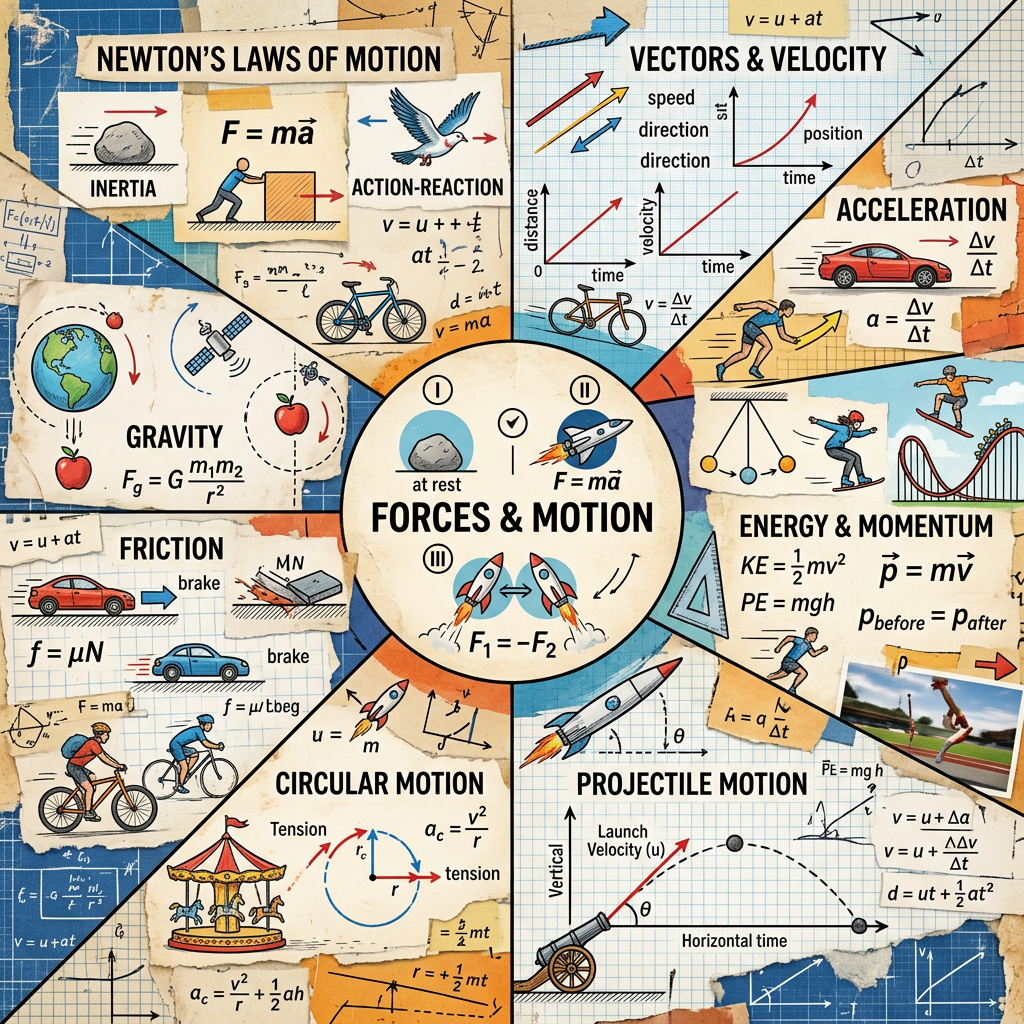
How forces interact, how motion changes, and the laws that govern every movement
Forces explain how objects start moving, stop moving, speed up, slow down, and change direction. This topic builds directly on energy and electricity and sets the stage for waves and electromagnetism.
Once students understand vectors, Newton’s laws, and motion graphs, mechanics becomes predictable and logical.
GCSE Exam Essentials
Students must be able to:
- Describe scalar and vector quantities
- Draw and interpret force diagrams
- Calculate resultant forces
- Apply Newton’s three laws of motion
- Use equations for weight, work done, momentum, and acceleration
- Interpret distance–time and velocity–time graphs
- Understand terminal velocity, friction, and drag
- Describe elasticity, Hooke’s law, and moments
These appear across AQA, Edexcel, and OCR GCSE Physics specifications.
1. Scalars and Vectors
Scalar quantities
Have magnitude only. Examples: speed, distance, mass, temperature.
Vector quantities
Have magnitude and direction. Examples: velocity, displacement, force, acceleration.
“Forces are vectors; direction matters.”
2. Resultant Forces
When multiple forces act on an object, they combine into a single resultant force.
- If resultant force = 0 → object stays still or moves at constant velocity
- If resultant force ≠ 0 → object accelerates
Calculating resultant forces
- Same direction → add
- Opposite direction → subtract
- At right angles → use scale diagrams or Pythagoras (higher tier)
3. Newton’s Laws of Motion
Newton’s First Law
An object will remain at rest or move at constant velocity unless acted on by a resultant force.
Newton’s Second Law

Force = mass × acceleration.
Newton’s Third Law
Every action has an equal and opposite reaction.
These laws underpin all mechanics questions.
4. Weight, Mass and Gravity
Weight

- Weight (N)
- Mass (kg)
- Gravitational field strength (N/kg)
Weight changes with gravity; mass does not.
5. Work Done and Energy Transfer

Measured in joules (J).
Work done = energy transferred.
6. Forces and Motion
Acceleration

Change in velocity ÷ time.
Distance–time graphs
- Gradient = speed
- Straight line = constant speed
- Curved line = acceleration
Velocity–time graphs
- Gradient = acceleration
- Area under the graph = distance travelled
These graphs appear frequently in exams.
7. Terminal Velocity
Falling objects accelerate until:
- Weight = air resistance
- Resultant force = 0
- Velocity becomes constant
Classic example: skydiver before and after opening the parachute.
8. Momentum

Momentum = mass × velocity.
Conservation of momentum
Total momentum before = total momentum after (in closed systems).
Used in collision and explosion questions.
9. Forces and Elasticity
Hooke’s Law

Force = spring constant × extension.
Only valid up to the limit of proportionality.
10. Moments and Levers
Moment
Measured in newton‑metres (Nm).
Levers and gears act as force multipliers.
11. Common Misconceptions (GCSE‑specific)
Students often:
- Think mass and weight are the same
- Forget that forces are vectors
- Confuse speed and velocity
- Misread motion graphs (especially curved lines)
- Think heavier objects fall faster (they don’t, ignoring air resistance)
“Confusing mass with weight” “Misinterpreting distance–time graphs”
12. Quick Check Questions
Use these for active recall:
- What is the difference between a scalar and a vector?
- Write the equation for Newton’s second law.
- What happens when the resultant force on an object is zero?
- What does the gradient of a velocity–time graph represent?
- State Hooke’s law.
13. Summary
Forces explain how objects move and interact. Understanding vectors, Newton’s laws, motion graphs, and momentum provides the foundation for waves, electromagnetism, and advanced mechanics.