


A modular guide to chain-branching kinetics, thermal feedback, and the tipping points of molecular detonation
1. Why explosions belong in kinetics
Explosions are not just dramatic events; they’re kinetic phenomena. They occur when a chemical reaction accelerates uncontrollably, releasing energy faster than it can dissipate. This leads to rapid gas expansion, pressure spikes, and often a shock wave.
In kinetic terms, explosions are the result of:
- Chain-branching reactions
- Positive feedback loops
- Thermal acceleration
- Pressure-dependent dynamics
Understanding explosions requires more than thermodynamics. It demands a grasp of how reactive intermediates multiply, how energy release couples to reaction rate, and how environmental conditions shape the outcome.
2. Two types of explosion
There are two main types of chemical explosions:
Thermal explosion
This occurs when the heat generated by an exothermic reaction cannot escape. As temperature rises, the reaction rate increases (via the Arrhenius equation), generating more heat in a feedback loop that leads to detonation.
Key features:
- No chain branching required
- Driven by temperature rise
- Common in confined spaces
- Often slow to start, then rapid
Chain-branching explosion
This involves reactive intermediates (e.g. radicals) that multiply during the reaction. Each step produces more chain carriers, accelerating the reaction exponentially.
Key features:
- Requires branching steps
- Driven by radical multiplication
- Sensitive to pressure and dilution
- Can occur even at low temperatures
The hydrogen–oxygen reaction exhibits both types, making it a canonical case study in advanced kinetics.
3. The hydrogen–oxygen mechanism
The reaction between hydrogen and oxygen to form water is deceptively simple:
2 H₂ + O₂ → 2 H₂O
But the mechanism is complex, involving multiple radicals, branching steps, and pressure-dependent behaviour. Key intermediates include:
– H· (hydrogen radical)
– O· (oxygen radical)
– ·OH (hydroxyl radical)
– HO₂· (hydroperoxyl radical)
Initiation often occurs at the wall:
– H₂ + wall → 2 H·
Propagation and branching steps include:
– H· + O₂ → ·OH + O·
– O· + H₂ → ·OH + H·
– ·OH + H₂ → H· + H₂O
– ·OH + O₂ + M → HO₂· + M
Termination occurs via radical recombination or wall adsorption:
– H· + wall → H-wall
– O· + wall → O-wall
– ·OH + wall → OH-wall
This mechanism includes initiation, propagation, branching, and termination of a full chain architecture.
4. Branching steps and explosion risk
The key branching steps are:
– H· + O₂ → ·OH + O·
– O· + H₂ → ·OH + H·
Each consumes one radical and produces two, doubling the number of chain carriers. If these steps dominate, the reaction accelerates exponentially.
However, these steps are endothermic:
– ΔH₁ (H· + O₂) = +71 kJ/mol
– ΔH₂ (O· + H₂) = +17 kJ/mol
This means they’re slow at low temperatures. The system needs a temperature boost from initiation or thermal feedback to enter the branching regime.
5. Pressure dependence and explosion limits
The hydrogen–oxygen system exhibits three distinct explosion limits as pressure increases:
First explosion limit
At low pressure, radicals reach the walls and terminate before branching dominates. The reaction is steady and slow.
As pressure increases, the mean free path shortens, and radicals are more likely to react in the gas phase. When branching outpaces termination, the system crosses the first explosion limit and detonates.
Second explosion limit
At moderate pressure, three-body collisions become important. These stabilise intermediates like HO₂·, reducing branching efficiency. The reaction becomes steady again.
Third explosion limit
At high pressure, thermal feedback dominates. The heat generated accelerates the reaction, leading to a thermal explosion even without radical branching.
These limits reflect the balance between propagation, termination, and energy release. They’re visualised as inflexion points on a pressure–temperature graph.
6. Temperature dependence and feedback
Temperature affects reaction rate via the Arrhenius equation:

where:
k = Rate constant of the reaction
A = Pre-exponential factor (frequency of collisions with correct orientation)
Eₐ = Activation energy (energy barrier for the reaction)
R = Gas constant (8.314 J·mol⁻¹·K⁻¹)
T = Absolute temperature (in Kelvin)
Key Points
- Exponential dependence on temperature:
- Higher T → larger k
- Stronger effect if Eₐ is large
- Pre-exponential factor
:
- Accounts for collision frequency and orientation probability
- Also called the frequency factor
- Linearised form (useful for plotting):
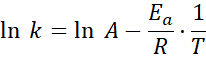
- Plotting ln k vs. 1/T gives a straight line with slope −Eₐ / R and intercept ln A.
Physical Interpretation
- Eₐ represents the minimum energy needed for reactants to form products.
- The fraction of molecules exceeding this energy barrier is e^(−Eₐ / (R T)).
As the temperature rises:
– Initiation becomes faster
– Branching steps overcome activation barriers
– Radical concentrations increase
– Heat release accelerates
This creates a feedback loop:
– Reaction → heat → faster reaction → more heat
If heat cannot escape (e.g. in a sealed vessel), the system spirals into a thermal explosion. This is why insulation, dilution, and heat sinks are critical in reactor design.
7. Wall effects and vessel geometry
Walls play a crucial role in radical termination. Smooth, inert surfaces allow radicals to recombine or adsorb, reducing chain length. Rough or catalytic surfaces may promote initiation or branching.
Vessel geometry affects:
- Surface-to-volume ratio
- Radical diffusion paths
- Heat dissipation
Small vessels with high surface area favour termination. Large, insulated vessels favour propagation and thermal feedback.
This is why explosion risk increases with scale and why lab-scale reactions may behave differently from industrial ones.
8. Real-world relevance
The hydrogen–oxygen reaction is not just academic. It underpins:
- Rocket propulsion
- Fuel cell design
- Combustion modelling
- Safety engineering
Understanding its mechanism helps:
- Predict ignition conditions
- Design inhibitors and suppressants
- Model atmospheric reactions
- Develop clean energy technologies
It also serves as a template for other chain-branching systems, from hydrocarbon combustion to nuclear fission.
9. Diagnostic tools and modelling
Studying explosions requires:
- Time-resolved spectroscopy: tracking radical concentrations
- Pressure sensors: detecting shock waves and inflexion points
- Computational modelling: simulating reaction pathways
- ESR and mass spectrometry: identifying intermediates
Kinetic models incorporate:
- Rate constants for each step
- Activation energies
- Pressure and temperature dependencies
- Radical diffusion and wall interactions
These models predict explosion limits, ignition delays, and energy release essential for safe design and control.
10. Summary and what’s next
Explosions are the kinetic climax of chain reactions. They arise when branching and thermal feedback outpace termination and heat dissipation. The hydrogen–oxygen system exemplifies this balance with its complex mechanism, pressure–dependent behaviour, and multiple tipping points.
Understanding explosions means understanding how molecules multiply, how energy flows, and how systems cross thresholds. It’s a lesson in control, prediction, and molecular choreography.
In Lecture 5, we’ll explore Enzyme Kinetics and Gas Adsorption Models, including Michaelis–Menten and Lindemann–Hinshelwood mechanisms, and how they reveal rate laws from complex systems.
Support the Archive
This archive is freely shared as a communal act of care.
If you’d like to support its continuation, consider purchasing a companion PDF set for £1 per lecture via Payhip, with the final price depending on the number of lectures in the set, available only once the full series is complete.