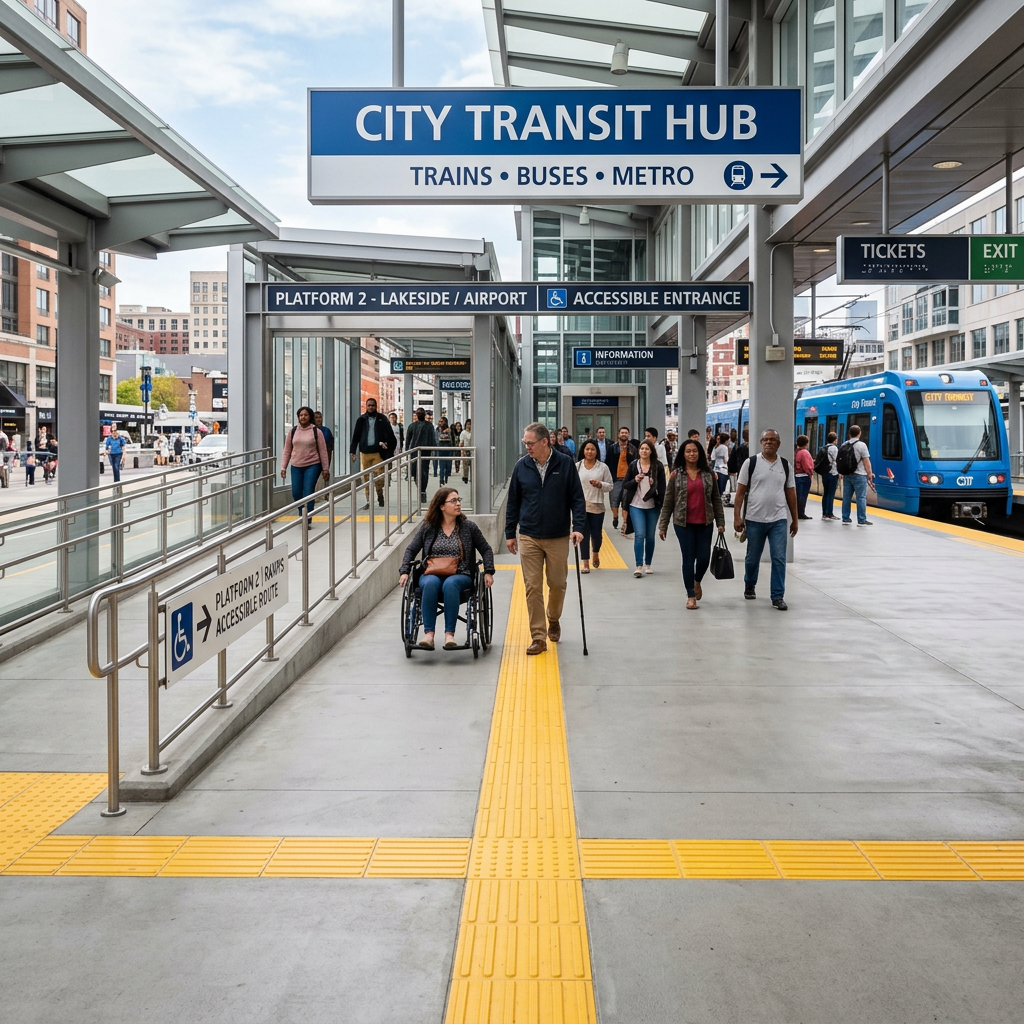
Infrastructure rarely fails in dramatic or visible ways.
More often, it fails quietly through friction, exclusion, and breakdowns that only emerge under specific conditions of use.
For disabled users, those conditions are not exceptional cases.
They represent stable and recurring interaction realities.
From a systems perspective, this is not primarily a question of individual limitation.
It reflects a mismatch between environmental structure and human variability, where built systems are often shaped around simplified assumptions of human function.
Infrastructure is constructed around an idealised user model
Most infrastructure is implicitly organised around a normative model of human capability:
- Continuous mobility
- Typical sensory processing (vision and hearing)
- Standardised cognitive processing speed
- Immediate interpretation of visual information
- Unassisted spatial navigation
This model reduces complexity during planning and implementation.
However, it also introduces a systematic divergence between assumed human function and actual human diversity.
When this divergence exists, infrastructure may appear functional while only partially supporting its user population.
Variability is central to system performance
In complex environments, performance cannot be understood only under ideal conditions.
It must be understood across variation.
Disabled users introduce structured variability in:
- Sensory processing modalities
- Movement dynamics and pacing
- Temporal processing of information
- Communication and interpretation pathways
- Environmental interaction strategies
When systems are not structured to accommodate this variability, they tend not to fail randomly.
Instead, breakdowns occur in repeatable and predictable patterns.
Failure emerges through modal restriction rather than total absence
Infrastructure rarely fails due to a complete lack of provision.
More often, it fails through restriction of informational and physical modalities.
Breakdowns occur when:
- Information is presented through a single sensory channel
- Redundant representations are absent
- Temporal assumptions exceed processing capacity
- Navigation relies on prior contextual knowledge
Examples include:
- Visual-only maps without tactile or auditory equivalents
- Audio announcements without visual reinforcement
- Route designs that assume uniform physical accessibility
These are not absences of infrastructure, but constrained representational systems that exclude alternative forms of perception and interaction.
Cognitive load as a limiting condition of usability
A frequently overlooked factor in accessibility is cognitive load.
Many infrastructural systems assume:
- Rapid decision formation
- Immediate interpretation of cues
- Minimal working memory demand
- Low environmental interference
However, interaction with space is often cognitively demanding for disabled users due to:
- Extended processing time for sensory input
- Simultaneous integration of multiple signals
- Environmental unpredictability
- Compensation for missing or altered sensory channels
When cumulative cognitive demand exceeds processing capacity, usability deteriorates even when physical access is technically present.
Fragmentation produces discontinuity in experience
Infrastructure is rarely experienced as a single coherent system.
It is encountered as a sequence of partially connected environments:
- Transport systems
- Physical public spaces
- Information systems
- Digital navigation tools
- Human assistance networks
When these components are not aligned, users must actively construct continuity across discontinuities.
For disabled users, these discontinuities impose disproportionately higher interaction costs, often resulting in fragmented or incomplete journeys.
This type of discontinuity can be observed in real-world mobility environments documented through field-based accessibility mapping, such as Access Trails UK: https://accesstrails.uk/
Recovery mechanisms are structurally underdeveloped
System resilience depends not only on primary functionality but also on recovery pathways following disruption.
In many environments:
- Alternative routes are not clearly defined
- Assistance pathways are inconsistently represented
- Contingency instructions are not accessible in situ
- Equivalent fallback options are absent
Without recovery mechanisms, small disruptions propagate into complete breakdowns of usability.
In such cases, minor interruptions become structurally significant failures in access continuity.
Accessibility reflects system completeness rather than add-on functionality
Accessibility should not be interpreted as an auxiliary layer of design.
Instead, it can be understood as an indicator of whether a system accounts for:
- Diversity in human capability
- Variability in environmental context
- Multiple modes of interaction
- Realistic failure conditions
Systems that only function under narrow and stable conditions demonstrate partial completeness rather than full environmental adaptability.
Inclusion enhances systemic stability
Systems that accommodate a wider range of human variation tend to exhibit improved performance characteristics across all users.
- Clearer informational structures reduce interpretive errors
- Multimodal communication improves comprehension in degraded conditions
- Predictable spatial organisation reduces cognitive demand
- Redundant pathways increase continuity under disruption
What is often framed as accessibility aligns closely with broader system stability under variability.
Final thought
Infrastructure does not fail disabled users because they exist outside of its scope.
It fails because many systems are constructed without full integration of human variability into their underlying assumptions.
From a systems perspective, disability does not function as an edge-case anomaly.
It acts as a revealing condition that exposes how well an environment accommodates real-world complexity in human interaction.
Where variability is not structurally represented, failure becomes not exceptional, but inevitable.