

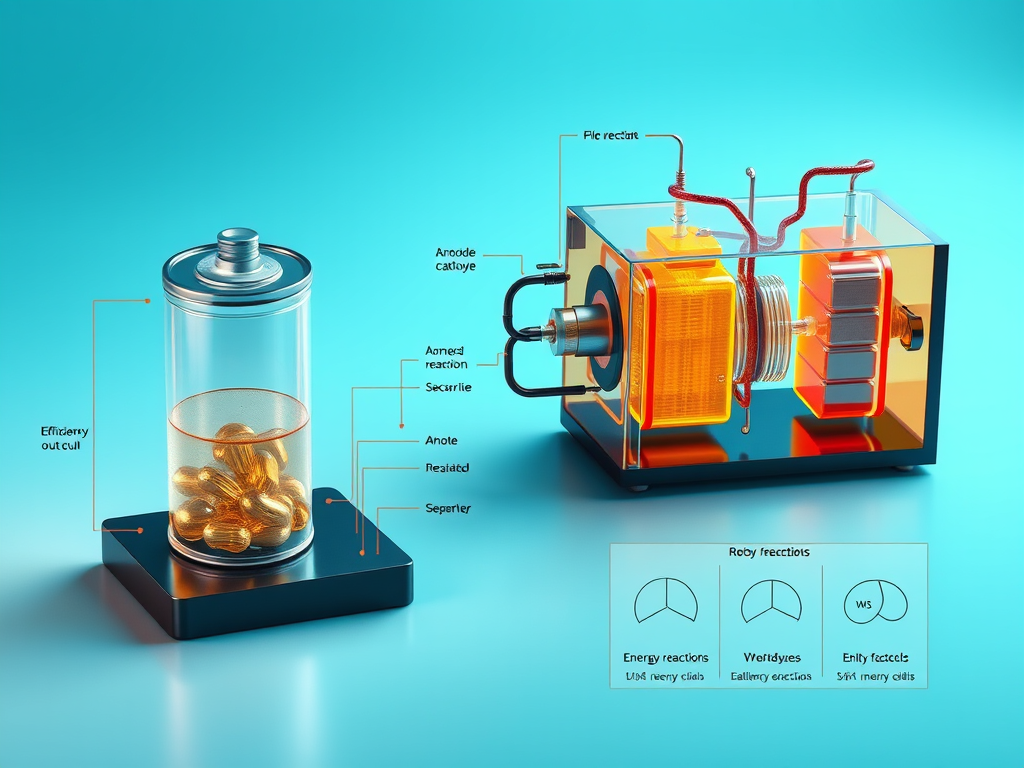
A modular guide to energy storage, redox design, and portable power
1. Introduction
Batteries and fuel cells are practical applications of electrochemistry, converting chemical energy into electrical energy via controlled redox reactions. While batteries store energy internally, fuel cells continuously generate electricity if fuel and oxidiser are supplied. Understanding these systems is crucial for:
- Portable electronics (smartphones, laptops)
- Renewable energy storage (solar, wind)
- Electric vehicles and industrial power systems
Electrochemistry allows us to calculate EMF, energy output, efficiency, and optimise electrode reactions for real-world applications.
References:
2. What Is a Battery?
A battery is a self-contained electrochemical system that stores energy chemically and releases it electrically. Its main components:
| Component | Role |
| Anode | Site of oxidation; electrons released |
| Cathode | Site of reduction: electrons consumed |
| Electrolyte | An ion conductor to balance the charge |
| Separator | Prevents short-circuiting |
Example: Alkaline battery (Zn/MnO₂)
- Anode reaction:

- Cathode reaction:

- EMF: ≈ 1.5 V
Batteries can be primary (non-rechargeable) or secondary (rechargeable), depending on whether the reactions are reversible.
Reference: Battery University – Types of Batteries
3. What Is a Fuel Cell?
A fuel cell is an open electrochemical system that continuously converts a fuel (H₂, CH₄) and an oxidiser (O₂) into electricity. It relies on catalysed electrode reactions rather than stored chemical energy.
Hydrogen Fuel Cell Example
- Anode reaction:

- Cathode reaction:

- Overall reaction:

- EMF: ≈ 1.23 V
Fuel cells produce water and heat as by-products and can operate continuously if fuel is supplied.
Reference: DOE Hydrogen Program – Fuel Cell Types
4. Redox Reactions in Energy Systems
Both batteries and fuel cells rely on oxidation at the anode and reduction at the cathode, connected by ion migration through the electrolyte. The overall cell reaction determines:
- Electromotive force (EMF): E₍cell₎ = E₍cathode₎ − E₍anode₎
- Gibbs free energy change: ΔG° = −n F E₍cell₎
- Efficiency and power output
Example: For a Zn-Cu galvanic battery:


5. Battery Chemistries
| Type | Electrodes | Features |
| Alkaline | Zn/MnO₂ | Disposable, low cost, moderate energy density |
| Lead–acid | Pb/PbO₂ | Rechargeable, high current output, automotive use |
| Lithium-ion (Li-ion) | Graphite/LiCoO₂ | High energy density, rechargeable, portable devices |
| Nickel-metal hydride (NiMH) | Metal hydride/NiOOH | Rechargeable, moderate capacity |
Reference: Energy.gov – Battery Types
6. Fuel Cell Types and Applications
| Type | Electrolyte | Application |
| PEMFC | Proton Exchange Membrane | Cars, buses, portable devices |
| SOFC | Solid Oxide | Industrial, high-temperature stationary |
| AFC | Alkaline | Aerospace, backup systems |
| MCFC | Molten Carbonate | Stationary power, grid support |
Reference: Fuel Cell & Hydrogen Energy Association
Applications of fuel cells include:
- Vehicles: Electric cars, buses
- Backup power: Hospitals, communication networks
- Portable electronics: Laptops, drones
- Grid support: Renewable energy storage
7. EMF, Capacity, and Efficiency
7.1 EMF
Calculated from standard electrode potentials:

7.2 Capacity
Measured in ampere-hours (Ah):

Where n = moles of electrons transferred, F = Faraday’s constant (96,485 C/mol).
7.3 Efficiency

- Batteries vary widely; Li-ion ≈ 90–95%
- Fuel cells ≈ 40–60% (higher when heat recovery is used)
Reference: Khan Academy – Electrochemical Cell Calculations
8. Environmental and Design Considerations
Key factors in electrochemical energy system design:
- Energy density vs. weight (important for EVs)
- Cycle life (number of charge/discharge cycles)
- Safety and stability (thermal runaway, flammability)
- Material sustainability (rare metals, recycling)
- Cost and scalability
Design choices affect:
- Rechargeability
- Operating temperature range
- Environmental footprint
- Integration with renewable energy
Reference: IEA – Battery and Fuel Cell Sustainability
9. Summary
- Batteries store energy chemically; fuel cells continuously generate electricity from supplied fuel
- Both rely on redox reactions at the anode and cathode, linked by ion migration
- EMF, capacity, and efficiency are determined by thermodynamic and kinetic principles
- Design optimisation balances energy density, durability, cost, and environmental impact
- Understanding electrochemical principles allows engineers to develop sustainable, high-performance energy systems
Further Reading
- Battery University: How Batteries Work
- Energy.gov – Battery Types
- Fuel Cell & Hydrogen Energy Association
- Khan Academy – Electrochemical Cells
Support the Archive
This archive is freely shared as a communal act of care.
If you’d like to support its continuation, consider purchasing a companion PDF set for £1 per lecture via Payhip, with the final price depending on the number of lectures in the set, available only once the full series is complete.