

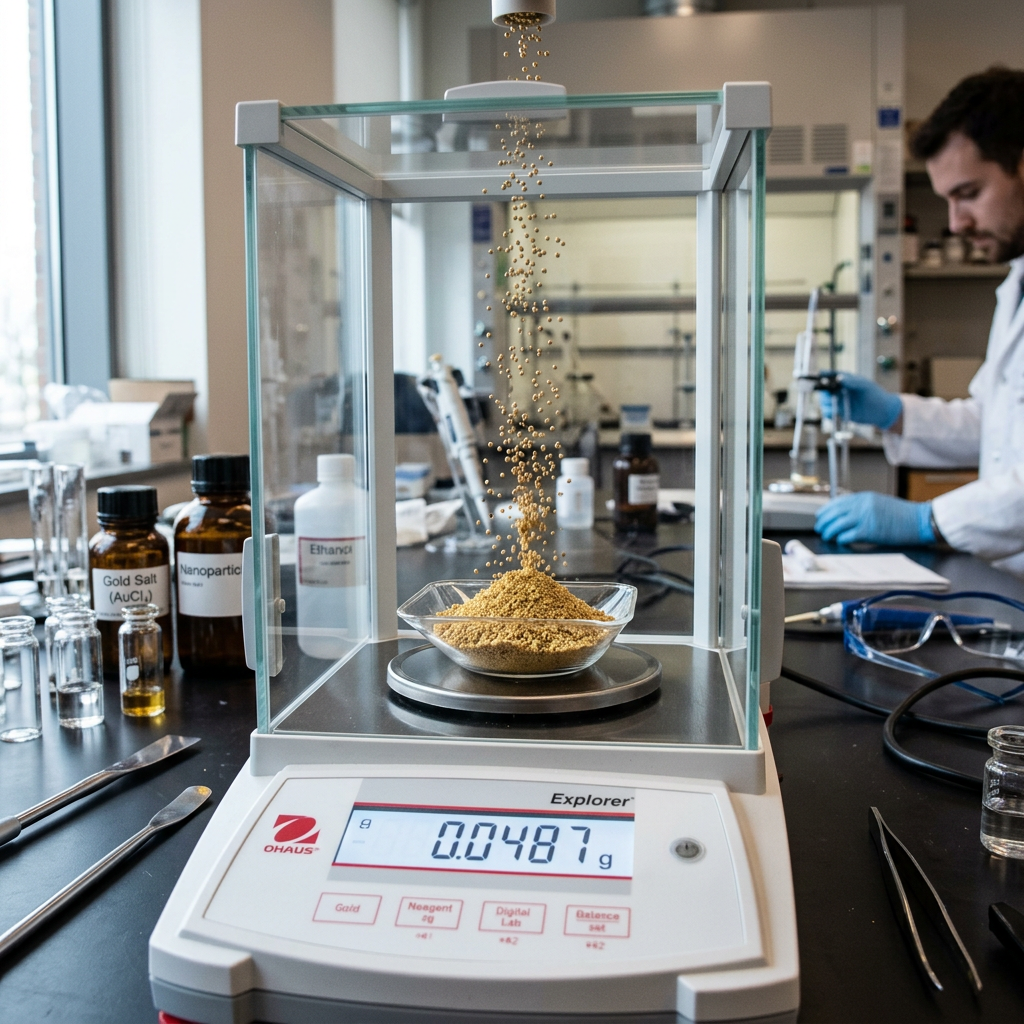
How chemists measure substances, why the mole exists, and how equations become predictable
Quantitative chemistry is the maths of chemistry. It takes the ideas from chemical reactions and turns them into calculations you can rely on.
Once students understand the mole, equations, and masses, chemistry stops feeling like guesswork and becomes a predictable system.
GCSE Exam Essentials
Students must be able to:
- Define the mole and Avogadro’s constant
- Calculate moles using:
- Use balanced equations to work out reacting masses
- Calculate the concentration of solutions
- Understand percentage yield and atom economy
- Explain the conservation of mass in reactions
These appear across AQA, Edexcel, and OCR GCSE Chemistry specifications.
1. Why Quantitative Chemistry Matters
Atoms are far too small to count individually. Chemists needed a way to measure them in real quantities.
The solution is the mole.
“Chemistry requires counting extremely small particles, which is why the mole is used.”
The mole links mass in grams to the number of particles.
2. What a Mole Is
A mole is a fixed number of particles:
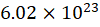
This is Avogadro’s constant.
One mole of any substance contains the same number of particles, just like a “dozen” always means 12.
3. The Key Formula (GCSE Core)
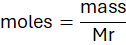
Where:
- mass = in grams
- Mr = relative formula mass (add up the atomic masses)
Rearranged:

This is the foundation of all quantitative chemistry.
4. Balanced Equations and Ratios
Equations must be balanced because:
- Atoms are not created
- Atoms are not destroyed
- They are simply rearranged
Balanced equations give ratios.
Example: 2H₂ + O₂ → 2H₂O This means:
- 2 moles of hydrogen react with
- 1 mole of oxygen to make
- 2 moles of water
These ratios allow you to calculate reacting masses.
5. Concentration of Solutions
Another essential GCSE skill:

Volume must be in dm³ (divide cm³ by 1000).
Used in titrations and solution chemistry.
6. Percentage Yield and Atom Economy
Percentage Yield
How much product do you actually get:

Atom Economy
How efficient a reaction is:

These links connect chemistry to real‑world industry and sustainability.
7. Common Misconceptions (GCSE‑specific)
Students often:
- Confuse mass with moles
- Forget to balance the equation first
- Use the wrong Mr
- Mix up cm³ and dm³
- Think yield is always 100%
- Forget that gases have molar volumes
“Confusing mass with moles” “Forgetting to balance equations”
8. Quick Check Questions
Use these for active recall:
- What is Avogadro’s constant?
- Calculate the moles in 12 g of carbon (Mr = 12).
- Why must equations be balanced before doing calculations?
- What is the formula for concentration?
- Why is the percentage yield rarely 100%?
9. Summary
Quantitative chemistry turns chemical reactions into predictable calculations. Once students understand the mole, reacting masses, and concentration, they can solve almost any exam question with confidence.