

How substances change, why reactions happen, and the patterns behind chemical change
Chemical reactions are the heart of chemistry. They explain everything from rusting to digestion, from fuel burning to metals reacting with acids.
Once students understand what a reaction actually is, the rest of chemistry becomes far more predictable.
GCSE Exam Essentials
Students must be able to:
- Describe what happens during a chemical reaction
- Identify and explain key reaction types (acid–base, displacement, combustion, electrolysis, etc.)
- Use the pH scale correctly
- Write and interpret word and symbol equations
- Understand conservation of mass
- Predict products of common reactions
- Distinguish between physical and chemical changes
These appear across AQA, Edexcel, and OCR GCSE Chemistry specifications.
1. What a Chemical Reaction Is
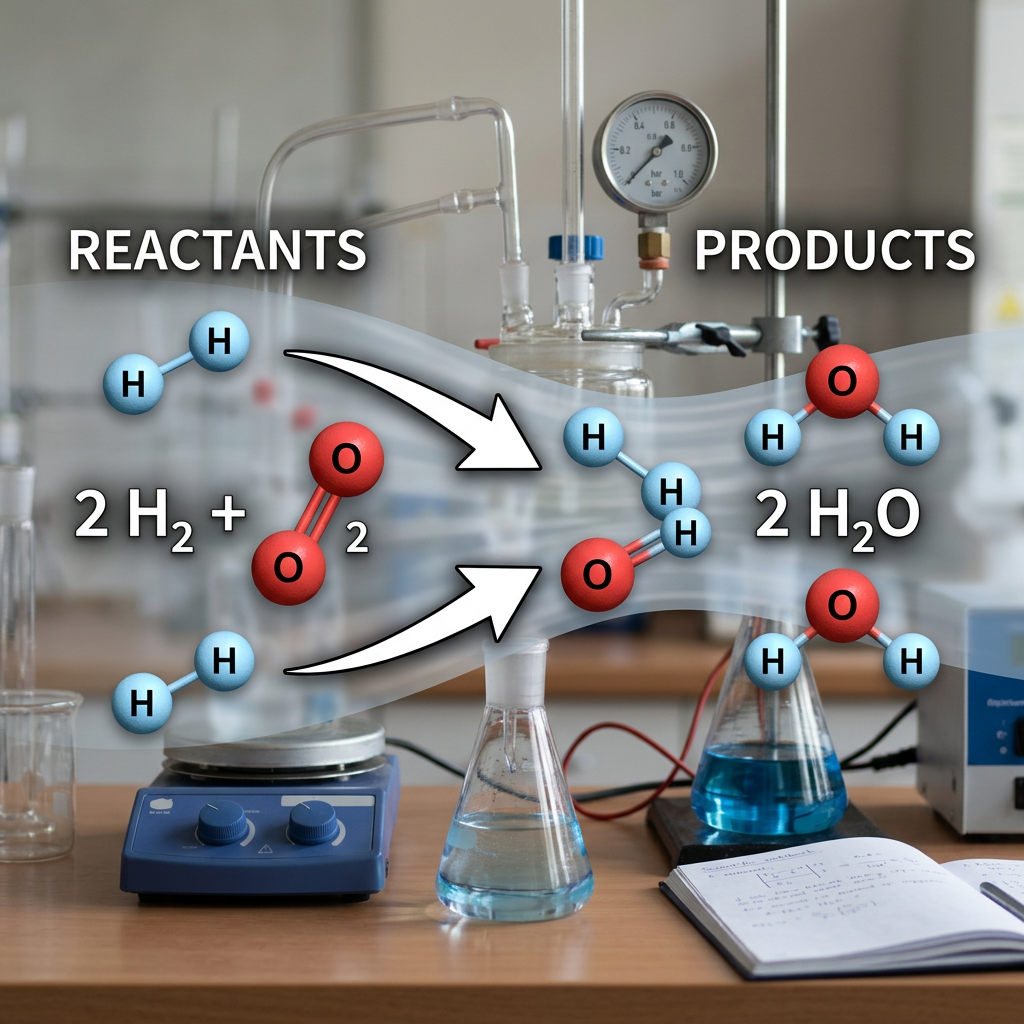
A chemical reaction is a process where atoms are rearranged to form new substances.
- No atoms are created
- No atoms are destroyed
- They are simply rearranged
This is why equations must be balanced.
“Chemical reactions involve rearranging atoms to form new substances.”
2. Key Types of Chemical Reactions
Acid–Base Reactions (Neutralisation)
Acid + Alkali → Salt + Water
Examples: HCl + NaOH → NaCl + H₂O H₂SO₄ + MgO → MgSO₄ + H₂O
Used in:
- Indigestion remedies
- Agriculture
- Environmental chemistry
Metal Reactions
Metals react with:
Acids
Metal + Acid → Salt + Hydrogen
Example: Mg + 2HCl → MgCl₂ + H₂
Oxygen
Metal + Oxygen → Metal oxide
Example: 4Fe + 3O₂ → 2Fe₂O₃ (rusting)
Displacement Reactions
A more reactive metal displaces a less reactive metal from its compound.
Example: Zn + CuSO₄ → ZnSO₄ + Cu
This links directly to the reactivity series.
Combustion
Burning fuels in oxygen.
Hydrocarbon + Oxygen → Carbon dioxide + Water
Example: CH₄ + 2O₂ → CO₂ + 2H₂O
Electrolysis
Using electricity to split compounds.
Example: Electrolysis of molten NaCl → sodium + chlorine gas
This is essential in industry (aluminium extraction, chlorine production).
3. Acids, Alkalis and the pH Scale
Acids
- Produce H⁺ ions in solution
- pH below 7
Alkalis
- Produce OH⁻ ions
- pH above 7
pH Scale
- 0–6 → acidic
- 7 → neutral
- 8–14 → alkaline
This is a core GCSE skill.
4. Conservation of Mass
Mass is conserved in chemical reactions because:
- Atoms are not created
- Atoms are not destroyed
- They are simply rearranged
If mass appears to change, it is usually because:
- A gas has escaped
- A gas has been absorbed
This is a common exam point.
5. Common Misconceptions (GCSE‑specific)
Students often:
- Think pH measures strength (it measures concentration)
- Confuse bases with alkalis
- Forget that neutralisation always produces salt + water
- Believe mass changes because atoms disappear
- Mix up physical changes (melting, dissolving) with chemical changes
“Thinking pH measures strength instead of concentration” “Forgetting products of neutralisation”
6. Quick Check Questions
Use these for active recall:
- What happens to atoms during a chemical reaction?
- What ions do acids produce in solution?
- Write the products of:
- magnesium + hydrochloric acid
- What does the pH scale measure?
- Why must chemical equations be balanced?
7. Summary
Chemical reactions are simply the rearrangement of atoms into new substances. Once students understand the patterns of acids, metals, and displacement, combustion chemistry becomes far more logical and predictable.