

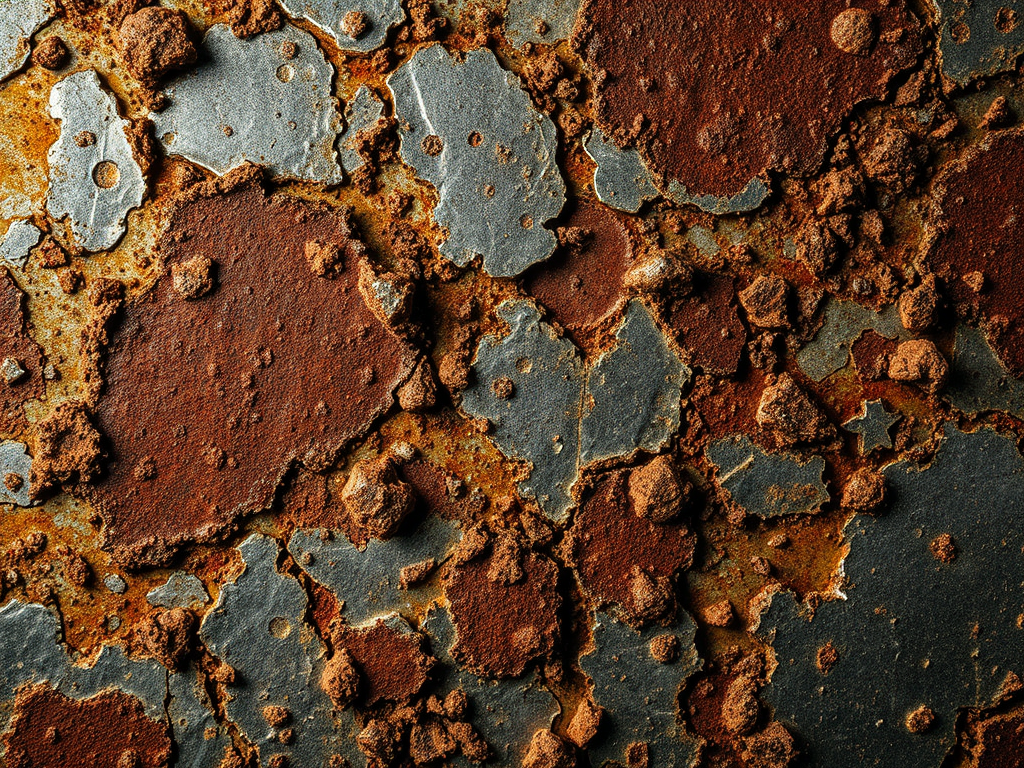
A modular guide to spontaneous metal breakdown and protective strategies
1. Introduction
Corrosion is the unwanted electrochemical degradation of metals through spontaneous redox reactions with their environment. It represents a natural thermodynamic tendency for metals to revert to more stable oxidised forms.
Electrochemistry not only explains the mechanisms of corrosion but also offers predictive and preventive tools. Understanding corrosion is vital for:
- Infrastructure durability: bridges, pipelines, and buildings
- Marine engineering: ships and offshore platforms
- Industrial systems: chemical reactors and heat exchangers
Reference: Corrosion Basics
2. What Is Corrosion?
Corrosion occurs when a metal undergoes oxidation, and electrons are consumed by environmental species such as oxygen, water, or acids.
Example: Iron Corrosion
Anodic reaction (metal oxidation):

Cathodic reaction (environmental reduction):

Together, these reactions form a galvanic microcell on the metal surface, with local anodes and cathodes facilitating electron flow.
Reference: Corrosionpedia – Electrochemical Nature
3. Electrochemical Nature of Corrosion
Corrosion is essentially an electrochemical process, driven by:
- Electrode potential differences between the metal and the environment
- Oxidisers such as O₂ or H⁺
- Presence of moisture or electrolyte (water, salts)
Microcell formation on the metal surface:
| Site | Reaction |
| Anode | Metal oxidation (e.g., Fe → Fe²⁺ + 2e⁻) |
| Cathode | Environmental reduction (e.g., O₂ + 4H⁺ + 4e⁻ → 2H₂O) |
| Electrolyte | Ion migration to complete the circuit |
Electrons flow through the metal, while ions migrate through the electrolyte, completing the redox circuit.
4. Types of Corrosion
4.1 Uniform Corrosion
- Occurs evenly over the metal surface
- Common in iron exposed to air and moisture
4.2 Galvanic Corrosion
- Occurs between dissimilar metals electrically connected in an electrolyte
- The more active metal (anode) corrodes preferentially
Example: Zinc corrodes when attached to copper
4.3 Pitting Corrosion
- Localised attack forming small pits
- Often initiated by chloride ions
4.4 Crevice Corrosion
- Occurs in shielded areas with stagnant electrolyte
4.5 Intergranular Corrosion
- Targets grain boundaries in alloys
Reference: Types of Corrosion
5. Thermodynamics of Corrosion
Corrosion is thermodynamically favoured if the cell potential (EMF) is positive:

Example: Zinc Corrosion
- Zn²⁺/Zn: E° = −0.76 V
- O₂/H₂O: E° = +1.23 V
- EMF = 1.23 − (−0.76) = 1.99 V → strongly spontaneous
Positive EMF confirms the thermodynamic feasibility of zinc oxidation in moist air.
Reference: LibreTexts – Electrochemistry and Corrosion
6. Environmental Factors Affecting Corrosion
Corrosion rate depends on:
| Factor | Effect |
| Moisture | Enables ionic conductivity |
| Electrolyte composition | Cl⁻ ions accelerate corrosion |
| Temperature | Higher T increases the reaction rate |
| pH | Acidic environments favour metal dissolution |
| Oxygen | Drives cathodic reduction |
Example: Saltwater environments accelerate corrosion due to chloride ions and increased conductivity.
7. Corrosion Protection Strategies
7.1 Barrier Methods
- Paints, coatings, and sealants prevent electrolyte contact
7.2 Cathodic Protection
- Use a sacrificial anode (more active metal)
- Example: Zinc blocks protect steel in ship hulls
7.3 Alloying
- Add corrosion-resistant elements
- Example: Chromium in stainless steel
7.4 Passivation
- Formation of a stable oxide layer
- Example: Al₂O₃ on aluminium
7.5 Electrochemical Monitoring
- Sensors detect the onset of corrosion using potential differences
8. Microcell Formation in Corrosion
Corrosion often forms local galvanic cells:
| Component | Role |
| Anode | Active metal site, oxidises |
| Cathode | Passive site: reduction occurs |
| Electrolyte | A thin film of water or solution conducts ions |
These microcells evolve over time, changing location and intensity. Continuous monitoring helps predict corrosion patterns.
9. Real-World Examples
Iron Structures
- Bridges, pipelines, and reinforcing bars in concrete
- Corrosion is mitigated by coatings, inhibitors, or cathodic protection
Marine Applications
- Ships, offshore platforms, and seawater pipes
- High Cl⁻ content accelerates pitting corrosion
Electronics and Batteries
- Silver or copper connections corrode in humid air
- Protective coatings and sealed environments prevent degradation
10. Summary
- Corrosion is a spontaneous electrochemical process driven by redox reactions
- Formation of microcells on the metal surface explains localised and uniform corrosion
- Environmental factors (pH, Cl⁻, moisture, temperature) influence the corrosion rate
- Thermodynamic evaluation (ΔG and EMF) predicts feasibility
- Protection strategies include barriers, cathodic protection, alloying, and passivation
- Continuous monitoring via sensors and electrochemical techniques enables preventive maintenance
By understanding corrosion, engineers and chemists can design safer, longer-lasting materials and implement cost-effective preventive strategies.
Further Reading
Support the Archive
This archive is freely shared as a communal act of care.
If you’d like to support its continuation, consider purchasing a companion PDF set for £1 per lecture via Payhip, with the final price depending on the number of lectures in the set, available only once the full series is complete.