

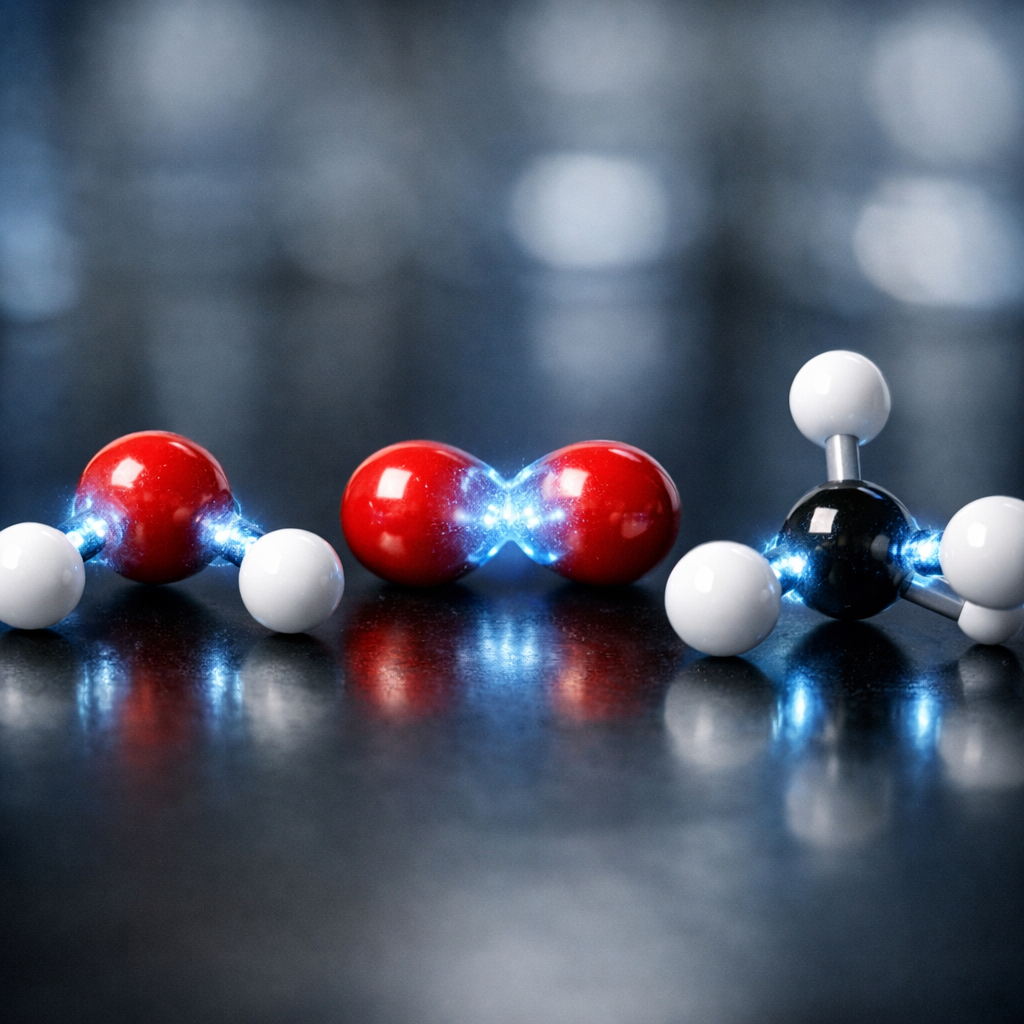
How atoms join, why materials behave differently, and the patterns behind chemical structure
Once you understand atomic structure, the next step in chemistry is understanding how atoms join together. Bonding explains:
- Why salt dissolves
- Why metals conduct
- Why water is a liquid
- Why diamonds are hard
- Why plastics behave the way they do
Bonding is the bridge between atoms and materials.
GCSE Exam Essentials
Students must be able to:
- Describe ionic, covalent, and metallic bonding
- Explain how electrons are transferred or shared
- Draw or interpret dot‑and‑cross diagrams
- Link bonding type to properties (melting point, conductivity, structure)
- Distinguish between simple molecules, giant covalent structures, and ionic lattices
- Explain metallic bonding using delocalised electrons
These appear across AQA, Edexcel, and OCR GCSE Chemistry specifications.
1. Why Bonding Happens
Atoms bond to become more stable by achieving a full outer electron shell.
They do this by:
- Losing electrons
- Gaining electrons
- Sharing electrons
This leads to three types of bonding.
2. Ionic Bonding
Between metals and non‑metals
How it works
- Metal atoms lose electrons → form positive ions
- Non‑metal atoms gain electrons → form negative ions
- Oppositely charged ions attract strongly
This creates a giant ionic lattice.
Properties explained
- High melting/boiling points → strong electrostatic forces
- Conduct electricity when molten or dissolved → ions are free to move
- Brittle → layers shift and like charges repel
Example
Sodium + Chlorine → Sodium chloride Na → Na⁺ + e⁻ Cl + e⁻ → Cl⁻
3. Covalent Bonding
Between non‑metals
How it works
Atoms share pairs of electrons to fill their outer shells.
Two types of covalent structures
1. Simple molecules
Examples: H₂O, CO₂, CH₄
- Low melting/boiling points → weak intermolecular forces
- Do not conduct electricity → no free electrons or ions
2. Giant covalent structures
Examples: diamond, graphite, silicon dioxide
- Very high melting points
- Hard (diamond)
- Conducts electricity (graphite) → delocalised electrons between layers
4. Metallic Bonding
Between metal atoms
How it works
- Positive metal ions sit in a lattice
- Surrounded by a sea of delocalised electrons
Properties explained
- Conduct electricity → electrons move freely
- Malleable and ductile → layers slide
- High melting points → strong attraction between ions and electrons
This model explains why metals behave the way they do.
5. States of Matter and Bonding
Bonding type determines physical state:
- Ionic compounds → solid at room temperature
- Simple covalent molecules → often gases or liquids
- Giant covalent structures → solid
- Metals → solid (except mercury)
This links bonding to real‑world materials.
6. Common Misconceptions (GCSE‑specific)
Students often:
- Think ionic bonds share electrons (they transfer)
- Confuse molecules with ionic compounds
- Forget that metals conduct because of delocalised electrons
- Believe covalent substances always have high melting points
- Think intermolecular forces are the same as covalent bonds
“Thinking ionic bonds share electrons” “Confusing molecules and ionic compounds”
7. Quick Check Questions
Use these for active recall:
- What type of bonding occurs between a metal and a non‑metal?
- Why do ionic compounds conduct electricity when molten?
- What is a simple covalent molecule?
- Why is graphite able to conduct electricity?
- What holds metal ions together in metallic bonding?
8. Summary
Bonding explains how atoms join and why materials behave differently. Once you understand ionic, covalent, and metallic bonding, the rest of chemical reactions, materials, and states of matter become far more predictable.