

The skills you need to understand, explain, and apply Ecology with confidence.
B7 is one of the broadest and most application‑heavy topics in GCSE Biology. The B‑Series version doesn’t just list definitions; it teaches students how to think ecologically: how to reason about interdependence, interpret trophic levels, analyse sampling data, and evaluate human impacts.
This summary brings together the Core, Higher, Mastery, and Required Practical posts into one complete overview.
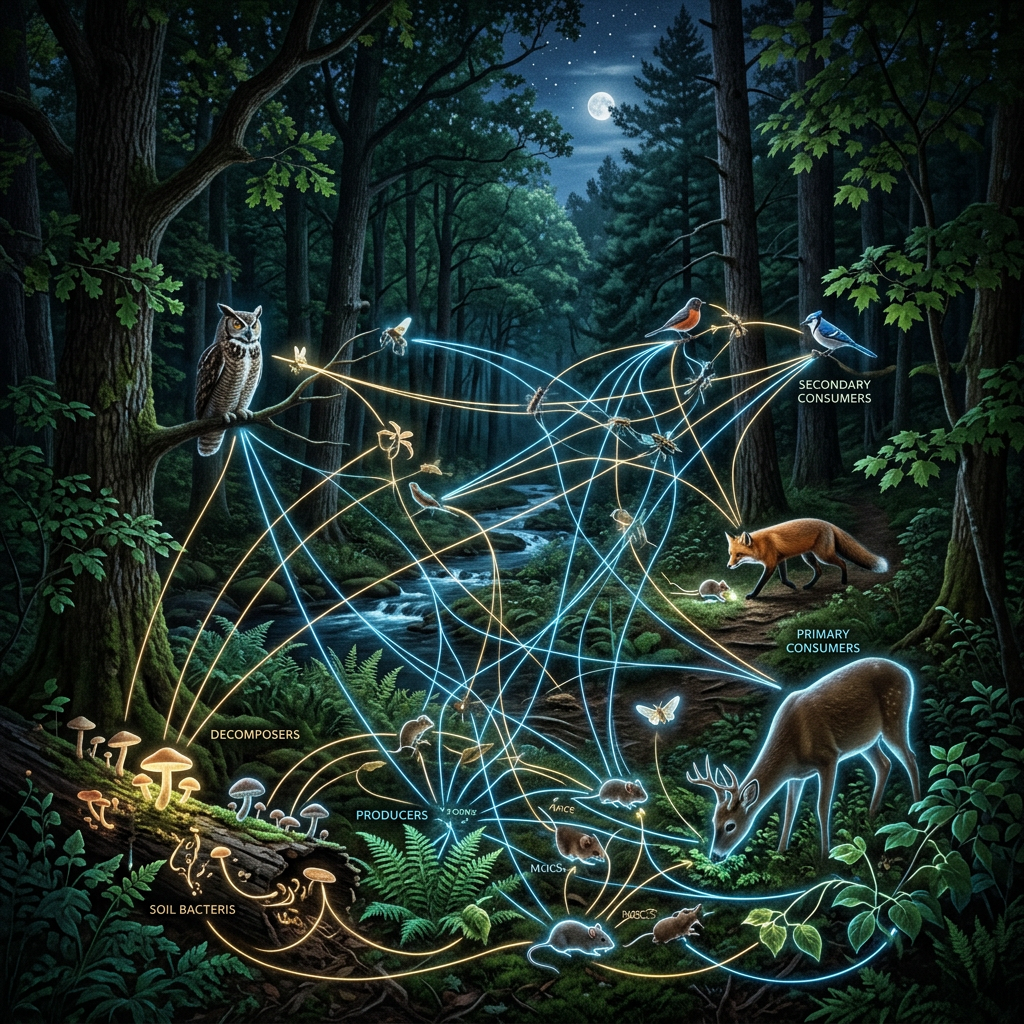
What B7 Helps You, Master
1. Understanding Ecosystems Properly
Students learn:
- What ecosystems, communities, populations, and habitats actually mean
- How organisms depend on each other
- How removing one species affects the whole system
Mastery links interdependence to stability, resilience, and trophic cascades.
2. Competition & Adaptations
B7 builds the skill of explaining:
- What animals compete for (food, mates, territory)
- What plants compete for (light, water, minerals, space)
- Structural, behavioural, and functional adaptations
Higher Tier adds:
- Environmental change
- Abiotic vs biotic factors
Mastery teaches students to justify adaptations using ecological reasoning.
3. Food Chains, Trophic Levels & Biomass
Students learn:
- Producers → consumers → apex predators
- Why biomass decreases at each trophic level
- Why only ~10% of energy transfers
Higher Tier adds:
- Trophic level notation
- Energy‑transfer calculations
- Decay and nutrient cycling
Mastery explains why biomass pyramids are always pyramids.
4. The Water Cycle & Carbon Cycle
Students learn:
- Evaporation, condensation, precipitation, transpiration
- Photosynthesis, respiration, combustion, decomposition
Higher Tier adds:
- Decay conditions
- Biogas production
- Nutrient recycling
Mastery links cycles to ecosystem stability and food security.
5. Biodiversity & Human Impacts
Students learn:
- What biodiversity is
- Why high biodiversity increases stability
- How humans reduce biodiversity (deforestation, pollution, global warming)
Higher Tier adds:
- Conservation strategies
- Food security
- Sustainable farming
Mastery teaches students to evaluate ecological solutions with balance.
6. Sampling Skills: Quadrats & Transects
B7 includes one of the most exam‑tested practicals:
Quadrats (Random Sampling)
Students learn:
- How to estimate population size
- How to calculate means
- How to scale up to whole areas
Transects (Systematic Sampling)
Students learn:
- How to investigate distribution along a gradient
- How to record abiotic factors
- How to interpret abundance patterns
Higher Tier adds:
- Validity vs reliability
- Avoiding bias
- Improving sampling accuracy
Mastery teaches students to interpret real ecological data.
7. Avoiding Common Misconceptions
B7 highlights the mistakes examiners see every year:
- “Producers are always plants” (algae count too)
- “Energy is recycled” (it isn’t; only matter is)
- “All biomass is eaten” (most isn’t)
- “Predator numbers rise first” (prey rise first)
- “Random sampling means walking around randomly” (it doesn’t)
Fixing these earns easy marks.
8. Building Exam‑Ready Explanations
Mastery Tier teaches students how to:
- Link environmental change → survival → distribution
- Explain trophic cascades
- Interpret predator–prey graphs
- Evaluate conservation strategies
- Write 6‑mark extended ecological explanations
This is where Grades 8–9 are earned.
Why B7 Matters
Ecology appears in every exam series, often with:
- Data interpretation
- Graph analysis
- Practical evaluation
- Long‑form reasoning
B7 gives students the skills to:
- Understand ecological systems
- Explain interactions clearly
- Interpret sampling data
- Evaluate human impacts
- Write high‑quality, long answers
It turns ecology from “lots of definitions” into a connected, logical system.
What Comes Next
B7 is the final block in the B‑Series.
The full B‑Series PDF is now ready, a complete skill‑based companion to the entire GCSE Biology course.