

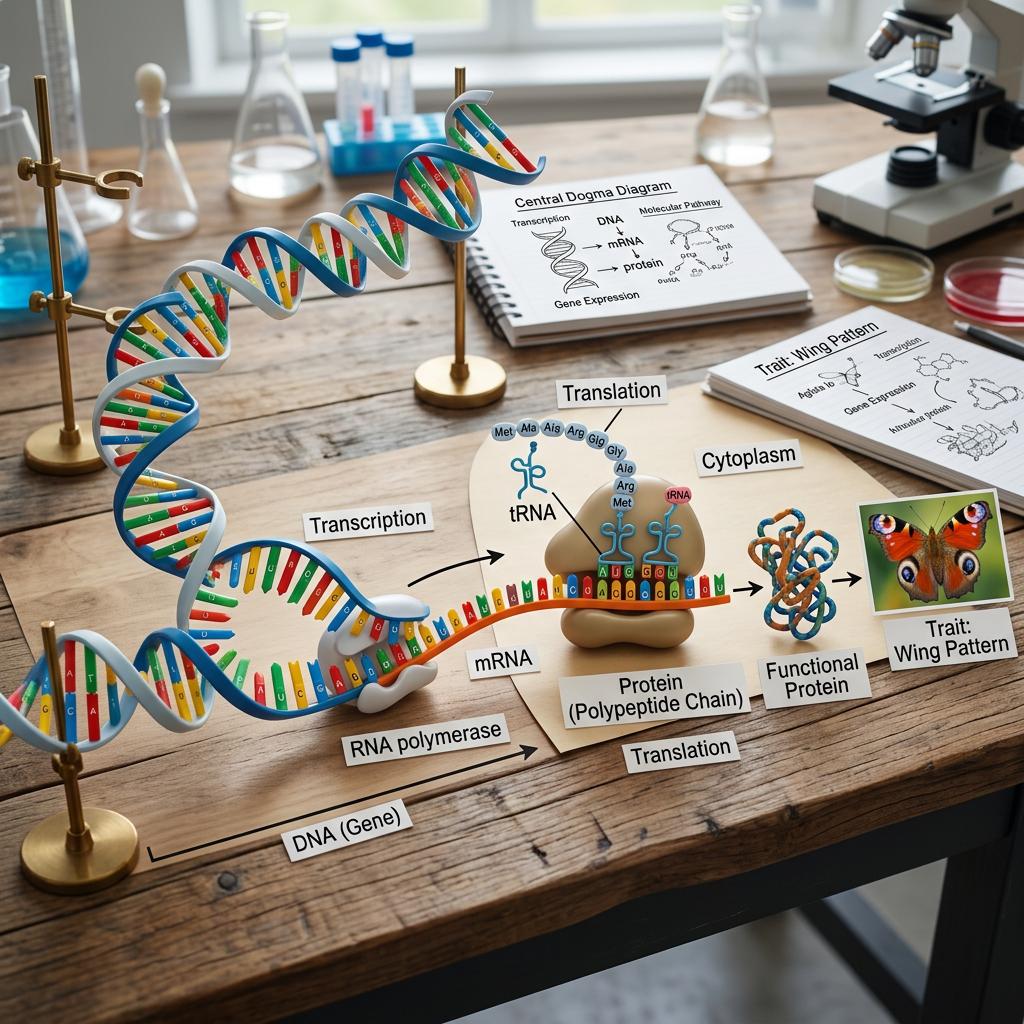
The skills you need to understand, explain, and apply Genetics & Evolution with confidence.
B6 is one of the longest, deepest, and most heavily examined units in GCSE Biology. The B‑Series version doesn’t just list facts; it teaches students how to think genetically: how to decode diagrams, reason through inheritance, interpret mutations, and explain evolution with clarity.
This summary brings together the Core, Higher, Mastery, Punnett Practice Pack, and Question Bank into one complete overview.
What B6 Helps You, Master
1. Understanding DNA, Genes & Chromosomes Properly
Students learn:
- DNA is a polymer, a double helix, with two strands
- Genes code for proteins
- Chromosomes store DNA
- Humans have 23 pairs
Higher Tier adds:
- Alleles
- Genotype vs phenotype
- Dominant vs recessive
Mastery links DNA → protein → phenotype → evolution.
2. Reproduction & Meiosis
B6 builds the skill of explaining:
- Asexual reproduction (one parent, identical offspring)
- Sexual reproduction (two parents, variation)
- Meiosis (gametes, half chromosome number, variation)
Higher Tier adds:
- Independent assortment
- Crossing over
- Random fertilisation
Mastery teaches students to link meiosis + fertilisation → variation → evolution.
3. Variation & Mutation
Students learn:
- Genetic variation
- Environmental variation
- Most characteristics = both
- Mutations are random
Higher Tier adds:
- Continuous vs discontinuous variation
- How mutations change proteins
Mastery explains why most mutations have no effect and why some persist.
4. Natural Selection & Evolution
Students learn:
- Variation
- Competition
- Survival of the fittest
- Allele frequency increases
Higher Tier adds:
- Darwin vs Lamarck
- Speciation
- Selection pressures
Mastery teaches students to write full 6‑mark evolution explanations.
5. Fossils, Extinction & Evidence for Evolution
Students learn:
- Fossil formation
- Reasons for extinction
- Incomplete fossil record
Higher Tier adds:
- Interpreting evolutionary graphs
- Allele frequency changes
Mastery links fossil evidence to natural selection and speciation.
6. Selective Breeding
Students learn:
- Choosing parents
- Breeding over generations
- Desired traits
Higher Tier adds:
- Inbreeding
- Reduced variation
- Recessive disorders
Mastery evaluates selective breeding vs genetic engineering.
7. Genetic Engineering
Students learn:
- Identifying genes
- Cutting with enzymes
- Inserting into vectors
- GM crops
- Insulin production
Higher Tier adds:
- Plasmids vs viruses
- Advantages vs concerns
- Evaluation questions
Mastery teaches students to write balanced 6‑mark GM crop evaluations.
8. Cloning
Higher Tier covers:
- Tissue culture
- Cuttings
- Embryo transplants
- Adult cell cloning
Mastery links cloning to variation, ethics, and conservation.
9. Punnett Squares & Genetic Diagrams
The B6 Punnett Pack gives students the procedural fluency examiners expect:
- Allele notation
- Genotype → phenotype
- Monohybrid crosses
- Probability
- Inherited disorders (CF, polydactyly)
- Pedigree analysis
Mastery adds:
- Multi‑step reasoning
- Linking genotype → protein → phenotype
- Interpreting complex pedigrees
This is where students gain the confidence to handle any genetics question.
10. Avoiding Common Misconceptions
B6 highlights the mistakes examiners see every year:
- “Dominant = common” (not true)
- “Recessive disorders disappear” (they persist via carriers)
- “Mutations always cause problems” (most have no effect)
- “Offspring get 50% of each parent’s traits” (they get alleles, not traits)
- “GM crops are always harmful/always safe” (evaluation needed)
Fixing these earns easy marks.
11. Building Exam‑Ready Explanations
Mastery Tier teaches students how to:
- Link DNA → protein → phenotype
- Explain mutation → protein change → characteristic change
- Interpret allele frequency graphs
- Write 6‑mark evolution and speciation answers
- Evaluate GM crops and selective breeding
- Reason through multi‑step inheritance problems
This is where Grades 8–9 are earned.
Why B6 Matters
Inheritance, Variation & Evolution is one of the highest‑weighted topics in GCSE Biology. B6 gives students the skills to:
- Understand genetic mechanisms
- Explain inheritance clearly
- Interpret diagrams and pedigrees
- Evaluate genetic technologies
- Write high‑quality, long answers
It turns genetics from “lots of terminology” into a coherent, logical system.
What Comes Next
B6 is the sixth block in the B‑Series. Next, you’ll move into:
- B7 – Ecology Skills
- and then the full B‑Series PDF, once all exam posts are complete.
GCSE Biology Complete Exam Pack Coming Soon
The full GCSE Biology Complete Exam Pack (300+ exam questions, full mark schemes, worked solutions, higher‑tier questions, and printable worksheets) will be released once all Biology exam‑question posts are complete.
This ensures:
- Every topic is fully covered
- Every question is aligned with the final structure
- Every mark scheme is consistent
- The pack is complete, polished, and exam‑ready
Updates will be posted on the Biology hub.