

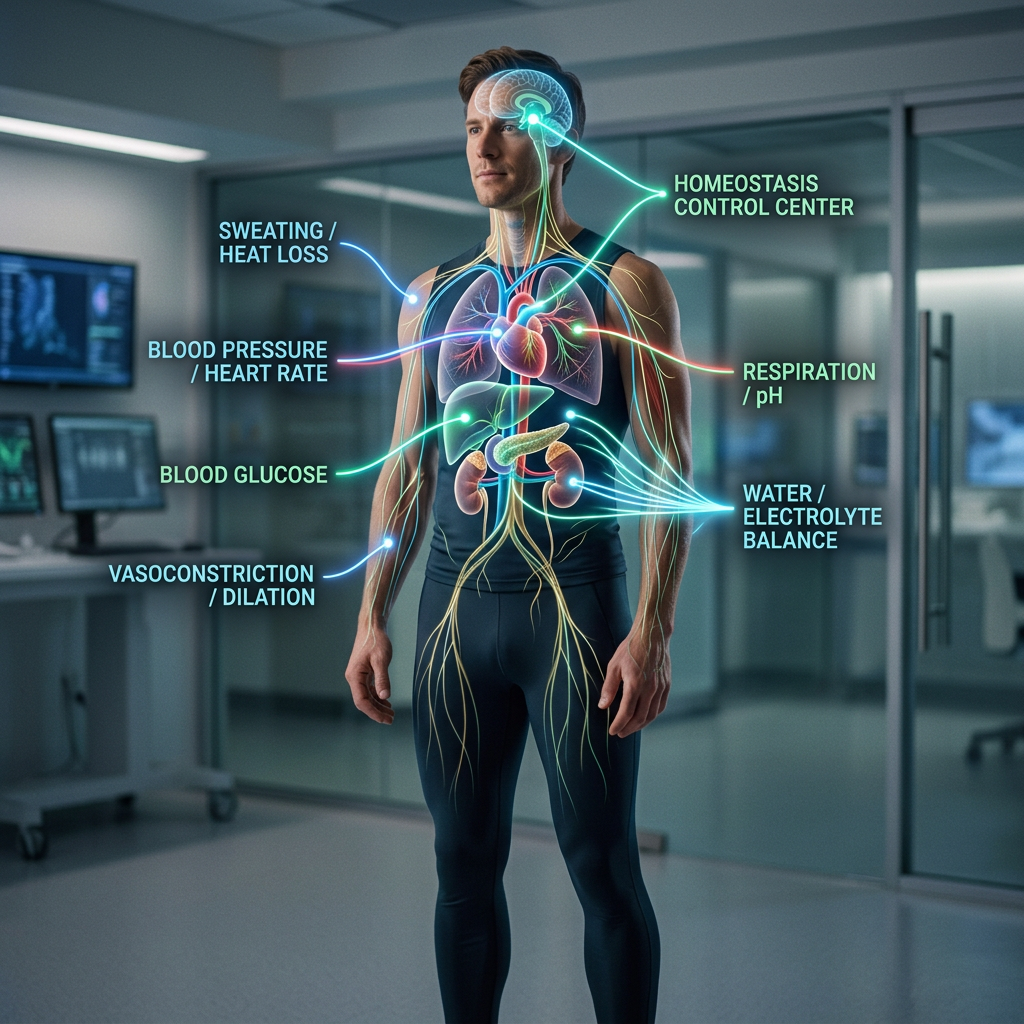
The skills you need to understand, explain, and apply Homeostasis & Response with confidence.
The B5 posts teach the thinking skills behind one of the most application‑heavy Biology topics. Instead of just memorising hormone names or reflex pathways, B5 shows students how to reason through control systems, negative feedback, neural pathways, fertility treatments, and thermoregulation and how to handle the multi‑step questions examiners love.
This summary brings together the Core, Higher, Mastery, and Required Practical posts into one clear overview.
What B5 Helps You, Master
1. Understanding Homeostasis Properly
Students learn:
- What homeostasis is
- Why internal conditions must stay stable
- Which conditions are controlled (temperature, glucose, water)
Mastery links homeostasis directly to enzyme function and survival.
2. Explaining the Nervous System Clearly
B5 builds the skill of explaining:
- Receptors → sensory neurons → CNS → motor neurons → effectors
- How impulses travel
- Why responses are fast
Higher Tier adds:
- Synapses and neurotransmitters
- Why reflexes are faster (fewer synapses, spinal cord pathway)
Mastery teaches students to link structure → speed → survival.
3. Reflexes and Rapid Responses
Students learn:
- The reflex arc
- Why reflexes bypass the conscious brain
- How reflexes prevent injury
Higher Tier adds:
- Synaptic transmission
- Relay neuron function
Mastery pushes students into multi‑step reasoning about protective responses.
4. The Brain and the Eye
Students learn:
- Key brain regions (cortex, cerebellum, medulla)
- Eye structures (cornea, lens, iris, retina, optic nerve)
- Accommodation for near and distant objects
Higher Tier adds:
- MRI and brain investigation
- Myopia vs hyperopia
- Concave vs convex lenses
Mastery links sensory processing to behaviour and survival.
5. Hormones and the Endocrine System
B5 teaches:
- How hormones travel
- Why hormonal responses are slower but longer lasting
- The roles of major glands
Higher Tier adds:
- Negative feedback (thyroxine, temperature, glucose)
- Adrenaline and “fight or flight”
Mastery explains why hormonal control is essential for long‑term regulation.
6. Blood Glucose Control & Diabetes
Students learn:
- Insulin lowers blood glucose
- Glucagon raises blood glucose
- Glycogen storage in the liver
Higher Tier adds:
- Negative feedback loops
- Autoimmune destruction in Type 1
- Insulin resistance in Type 2
Mastery explains why Type 2 can be reversed but Type 1 cannot.
7. The Menstrual Cycle & Fertility
Students learn:
- FSH, oestrogen, LH, progesterone
- Ovulation
- Lining changes
Higher Tier adds:
- Hormone interactions
- Inhibition and stimulation
- IVF evaluation
Mastery teaches students to write high‑quality 6‑mark fertility explanations.
8. Thermoregulation
Students learn:
- Vasodilation
- Vasoconstriction
- Sweating
- Shivering
Higher Tier adds:
- Thermoregulatory centre
- Negative feedback
- Hair erector muscles
Mastery links temperature control to enzyme stability and survival.
9. Required Practical Skills
B5 includes two major practicals:
Reaction Time Practical
Students learn:
- Ruler drop method
- Computer‑based tests
- Controlling variables
- Improving reliability
- Interpreting reaction‑time data
Higher Tier adds:
- Synaptic reasoning
- Evaluation of human‑error sources
Plant Responses (Auxins & Tropisms)
Students learn:
- Phototropism
- Gravitropism
- Auxin distribution
- How to set up directional light experiments
Higher Tier adds:
- Auxin inhibition in roots
- Evaluating experimental design
10. Avoiding Common Misconceptions
B5 highlights the mistakes examiners see every year:
- “Hormones are faster than nerves”
- “Insulin adds glucose to the blood”
- “Reflexes involve the brain”
- “Type 2 diabetes always needs injections”
- “Auxin makes roots grow faster” (it inhibits root growth)
Fixing these earns easy marks.
11. Building Exam‑Ready Explanations
Mastery Tier teaches students how to:
- Link negative feedback loops
- Explain multi‑step hormonal interactions
- Interpret glucose and temperature graphs
- Justify IVF decisions
- Write 6‑mark extended responses
This is where Grades 8–9 are earned.
Why B5 Matters
Homeostasis & Response is one of the most application‑heavy topics in GCSE Biology. B5 gives students the skills to:
- Understand control systems
- Explain neural and hormonal pathways
- Interpret graphs and data
- Evaluate practical methods
- Write high‑quality, long answers
It turns homeostasis from “lots of processes” into a coherent control‑system model.
What Comes Next
B5 is the fifth block in the B‑Series. Next, you’ll move into:
- B6 – Genetics & Evolution Skills
- B7 – Ecology Skills
Each one builds the exam‑ready reasoning students need across the whole course.
GCSE Biology Complete Exam Pack Coming Soon
The full GCSE Biology Complete Exam Pack (300+ exam questions, full mark schemes, worked solutions, higher‑tier questions, and printable worksheets) will be released once all Biology exam‑question posts are complete.
This ensures:
- Every topic is fully covered
- Every question is aligned with the final structure
- Every mark scheme is consistent
- The pack is complete, polished, and exam‑ready
Updates will be posted on the Biology hub.