

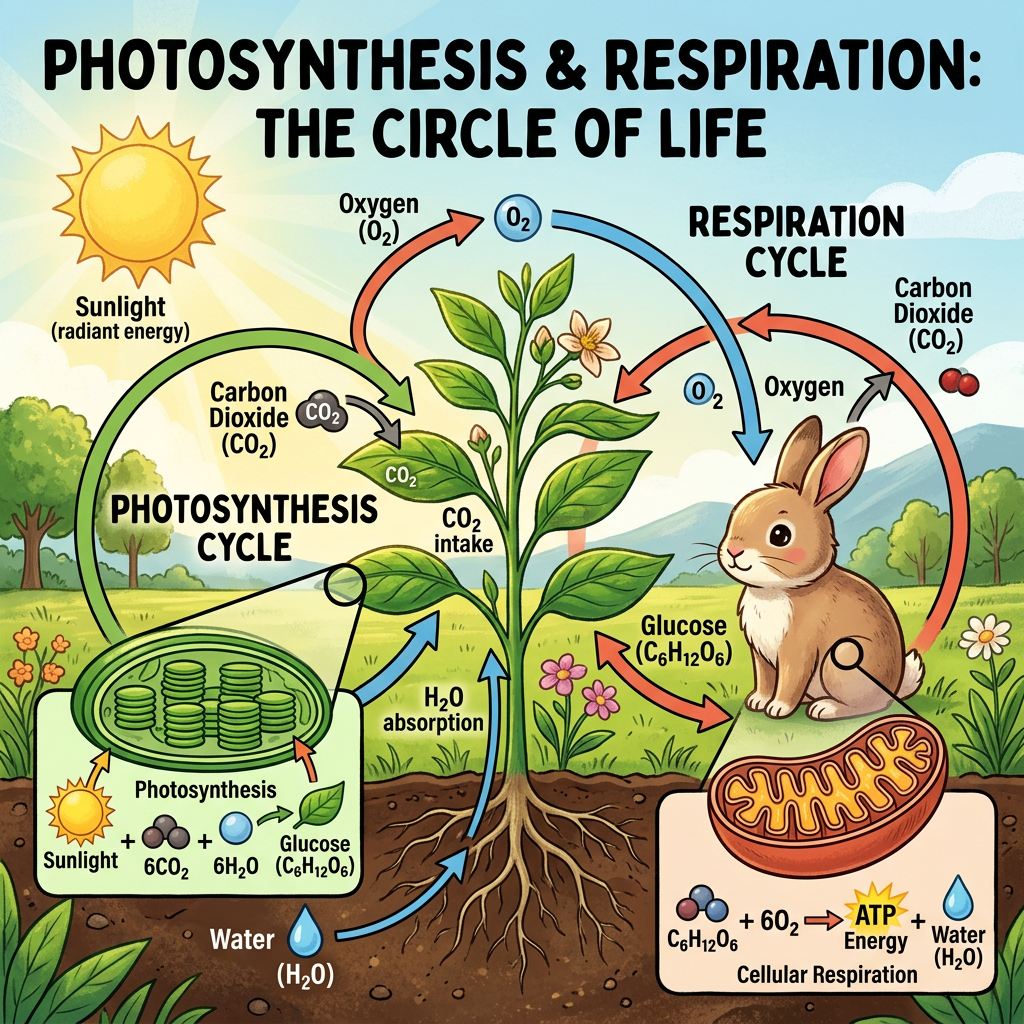
The skills you need to understand, explain, and apply Photosynthesis & Respiration with confidence.
The B4 posts teach the thinking skills behind one of the most fundamental Biology topics. Instead of just memorising equations, B4 shows students how to reason through limiting factors, energy transfer, respiration pathways, and the data‑heavy graphs examiners love.
This summary brings together the Core, Higher, Mastery, and Required Practical posts into one clear overview.
What B4 Helps You, Master
1. Understanding Photosynthesis Properly
Students learn:
- The word and symbol equations
- Where photosynthesis happens
- The role of chlorophyll
- How light, CO₂, and temperature affect the rate
Higher Tier adds:
- How chlorophyll absorbs specific wavelengths
- How limiting factors interact
- How to interpret photosynthesis graphs
Mastery pushes students into energy‑transfer reasoning and multi‑factor analysis.
2. Explaining Limiting Factors Clearly
B4 builds the skill of explaining:
- Why photosynthesis increases with light
- Why it plateaus
- Why temperature causes a sharp drop after the optimum
- How to identify the limiting factor from a graph
Higher Tier adds:
- Inverse square law calculations
- Multi‑factor interactions
- Greenhouse optimisation
Mastery teaches students to reason dynamically across changing conditions.
3. Understanding How Plants Use Glucose
Students learn the five major uses:
- Respiration
- Starch storage
- Cellulose for cell walls
- Amino acids (with nitrates)
- Lipids
Mastery links glucose use to growth, metabolism, and long‑term energy storage.
4. Respiration: Aerobic vs Anaerobic
B4 teaches:
- The word equations
- Where respiration happens
- Why aerobic releases more energy
- Why anaerobic produces lactic acid
Higher Tier adds:
- ATP yield differences
- Oxygen debt
- Phosphocreatine stores
- Athlete physiology
Mastery explains why respiration is continuous, but photosynthesis is not.
5. Exercise Physiology
Students learn:
- Why breathing rate increases
- Why heart rate increases
- What oxygen debt is
- Why muscles switch to anaerobic respiration
Higher Tier adds:
- Trained athlete adaptations
- Lactic acid accumulation
- Fatigue curves
Mastery links respiration → energy → performance → recovery.
6. Metabolism
B4 covers:
- The definition of metabolism
- Examples of metabolic pathways
- Synthesis and breakdown reactions
Higher Tier adds:
- Urea formation
- Glycogen/lipid/protein synthesis
- Respiration pathways
Mastery ties metabolism to energy flow across the whole organism.
7. Required Practical Skills
B4 includes two major practicals:
Photosynthesis (Pondweed Practical)
Students learn:
- How to measure oxygen production
- How to change light intensity
- How to control variables
- How to calculate 1/d²
- How to interpret bubble‑rate graphs
Higher Tier adds:
- Gas syringes
- Heat‑shielding
- Evaluating reliability
Respiration Practical
Students learn:
- CO₂ indicator method
- Respirometer method
- How to measure oxygen uptake
- How to control temperature
- How to interpret colour changes or liquid movement
Higher Tier adds:
- Soda lime use
- Pressure changes
- Rate calculations
8. Avoiding Common Misconceptions
B4 highlights the mistakes examiners see every year:
- “Photosynthesis happens at night”
- “Respiration only happens in animals”
- “Anaerobic respiration is just breathing less oxygen”
- “Light intensity has units” (it doesn’t in GCSE)
Fixing these earns easy marks.
9. Building Exam‑Ready Explanations
Mastery Tier teaches students how to:
- Link limiting factors
- Explain energy transfer
- Interpret multi‑factor graphs
- Justify greenhouse optimisation
- Write 6‑mark extended responses
This is where Grades 8–9 are earned.
Why B4 Matters
Bioenergetics appears in every exam series. B4 gives students the skills to:
- Understand processes
- Explain mechanisms
- Interpret graphs
- Evaluate practical methods
- Write high‑quality, long answers
It turns photosynthesis and respiration from “two equations” into a complete energy‑transfer system.
What Comes Next
B4 is the fourth block in the B‑Series. Next, you’ll move into:
- B5 – Homeostasis Skills
- B6 – Genetics & Evolution Skills
- B7 – Ecology Skills
Each one builds the exam‑ready reasoning students need across the whole course.
GCSE Biology Complete Exam Pack Coming Soon
The full GCSE Biology Complete Exam Pack (300+ exam questions, full mark schemes, worked solutions, higher‑tier questions, and printable worksheets) will be released once all Biology exam‑question posts are complete.
This ensures:
- Every topic is fully covered
- Every question is aligned with the final structure
- Every mark scheme is consistent
- The pack is complete, polished, and exam‑ready
Updates will be posted on the Biology hub.