

The skills you need to understand, explain, and apply Organisation with confidence.
The B2 posts teach the thinking skills that sit underneath the Organisation topic. Instead of just memorising the digestive system or enzyme facts, B2 shows students how to use the knowledge to break down processes, interpret graphs, structure long answers, and evaluate required practicals.
This summary brings together the Core, Higher, Mastery, and Required Practical posts into one clear overview.
What B2 Helps You, Master
1. Understanding Biological Organisation Properly
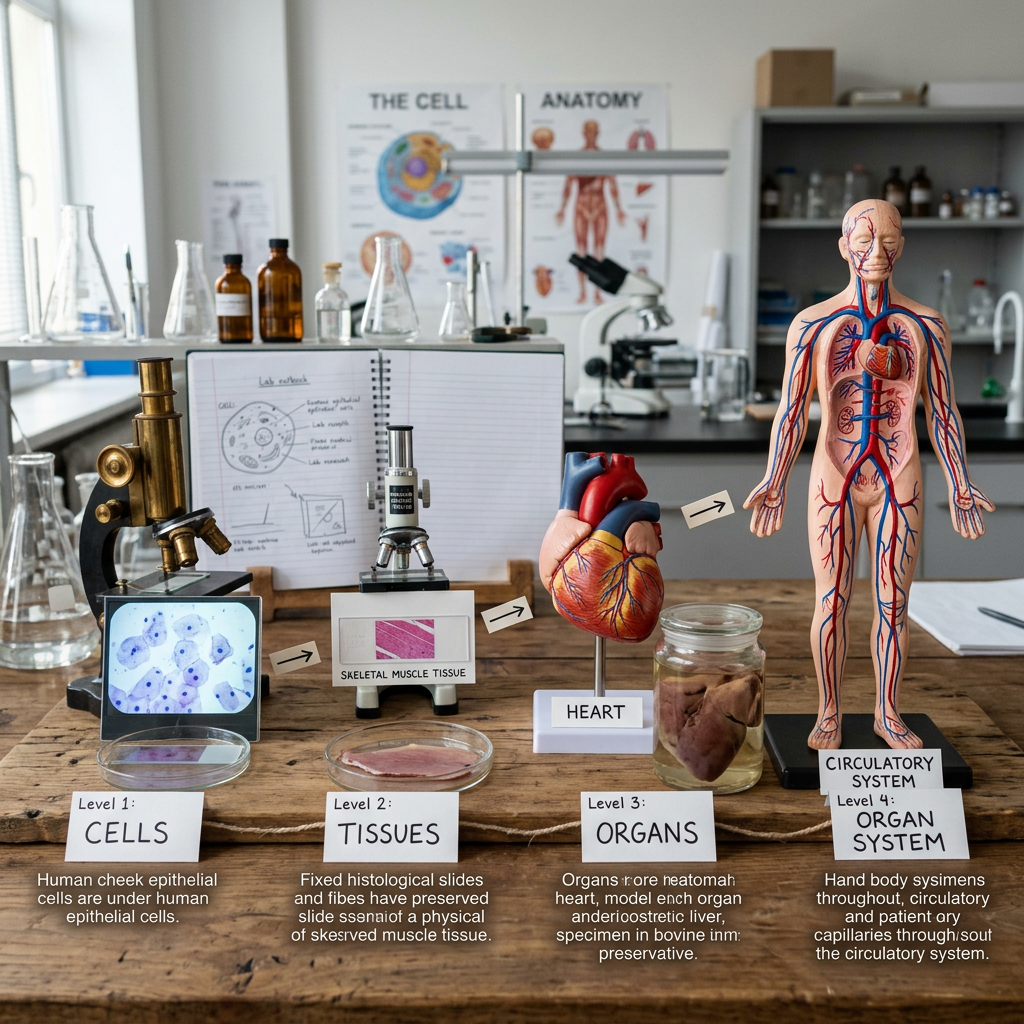
Students learn how to explain the hierarchy:
- Cells → tissues → organs → organ systems
- How structure links to function
- How systems work together
This is a guaranteed 3‑mark question every year.
2. Explaining Enzymes Clearly and Correctly
B2 builds the skill of explaining:
- What enzymes are
- The lock‑and‑key model
- Why enzymes are specific
- How temperature and pH affect activity
- What denaturation actually means
Higher Tier adds:
- The induced fit model
- Enzyme graphs (rate vs temp, pH, substrate concentration)
- Saturation and limiting factors
Mastery pushes students into multi‑step reasoning about metabolic pathways.
3. Understanding Digestion as a System
Students learn:
- The role of carbohydrases, proteases, and lipases
- Where each enzyme is produced
- How bile emulsifies fats and neutralises acid
- How the small intestine absorbs nutrients
Higher Tier adds:
- Peristalsis
- Villi and microvilli adaptations
- Lacteals and lipid absorption
Mastery explains why digestion requires multiple enzymes and coordinated processes.
4. Explaining the Circulatory System
B2 teaches:
- Double circulation
- Heart structure
- Why the left ventricle is thicker
- The role of coronary arteries
Higher Tier adds:
- Artery vs vein vs capillary structure
- CHD mechanisms and treatments
- Gas exchange in alveoli
Mastery links structure → function → survival.
5. Blood Components and Their Adaptations
Students learn:
- Red blood cells (biconcave, no nucleus, haemoglobin)
- White blood cells
- Platelets
- Plasma
These are easy 4‑mark adaptation questions.
6. Health, Disease, and Risk Factors
B2 covers:
- Communicable vs non‑communicable disease
- Lifestyle risk factors
- Cancer biology (HT)
- Benign vs malignant tumours
Mastery explains how cancer develops from normal cells.
7. Required Practical Skills
B2 includes two major practicals:
Food Tests (RP3)
Students learn:
- Iodine test
- Benedict’s test
- Biuret test
- Ethanol emulsion test
- Variables, errors, improvements
- Interpreting results
Enzymes (RP4)
Students learn:
- How to investigate amylase activity
- How to control variables
- How to calculate the rate
- How to evaluate methods
Higher Tier adds colourimeters, sampling intervals, and reliability.
8. Avoiding Common Misconceptions
B2 highlights the mistakes examiners see every year:
- “Enzymes work at any pH”
- “Enzymes die when denatured”
- “All blood vessels are the same”
- “Bile digests fat” (it doesn’t, it emulsifies)
Fixing these earns easy marks.
9. Building Exam‑Ready Explanations
Mastery Tier teaches students how to:
- Link ideas across digestion, enzymes, circulation, and disease
- Interpret unfamiliar graphs
- Justify conclusions
- Write 6‑mark extended responses
This is where Grades 8–9 are earned.
Why B2 Matters
Organisation is one of the most heavily tested topics in GCSE Biology. B2 gives students the skills to:
- Understand processes
- Explain mechanisms
- Interpret data
- Evaluate methods
- Write high‑quality, long answers
It turns the digestive and circulatory systems from “lots of facts” into a set of repeatable thinking patterns.
What Comes Next
B2 is the second block in the B‑Series. Next, you’ll move into:
- B3 – Infection & Response Skills
- B4 – Bioenergetics Skills
- B5 – Homeostasis Skills
- B6 – Genetics & Evolution Skills
- B7 – Ecology Skills
Each one builds the exam‑ready reasoning students need across the whole course.
GCSE Biology Complete Exam Pack Coming Soon
The full GCSE Biology Complete Exam Pack (300+ exam questions, full mark schemes, worked solutions, higher‑tier questions, and printable worksheets) will be released once all Biology exam‑question posts are complete.
This ensures:
- Every topic is fully covered
- Every question is aligned with the final structure
- Every mark scheme is consistent
- The pack is complete, polished, and exam‑ready
Updates will be posted on the Biology hub.