

Core idea
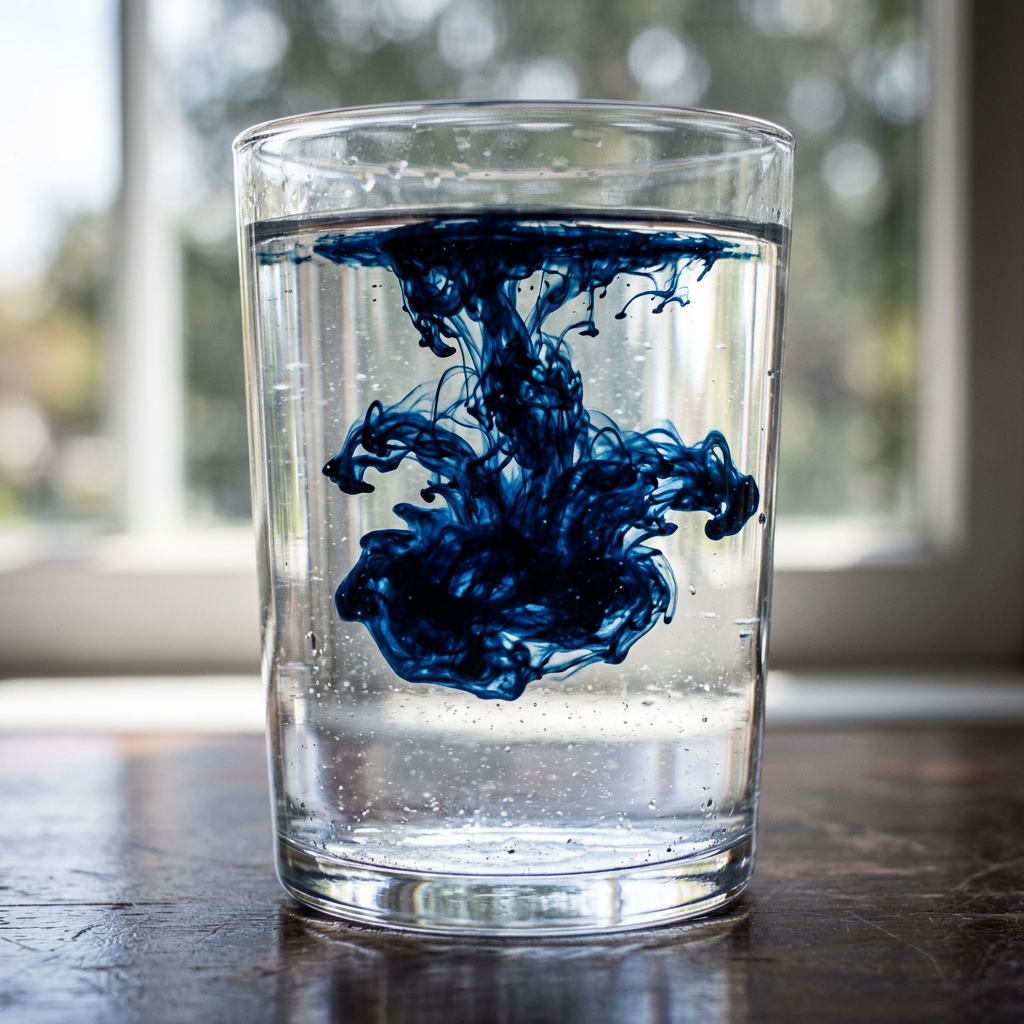
Diffusion is a passive transport system where particles move from regions of high concentration to low concentration due to random motion, gradually producing an even distribution without any external force or directional control.
Experiment: Diffusion Visualisation System
Materials:
- Glass of water
- Food colouring (or ink)
- Still environment (no stirring)
Method:
1. Initial drop test
Add a drop of food colouring to still water.
Observe:
- Colour stays concentrated at the first point
2. Natural spread phase
Leave undisturbed.
Observe:
- Colour slowly spreads outward
- Gradients form and fade over time
3. Time comparison extension
Repeat in warm vs cold water.
Observe:
- Faster spreading in warm water
What is actually happening (pre-A-level explanation)
Particles in liquids and gases are always moving randomly.
Because of this:
- Particles collide constantly
- They spread out over time
- No external force directs the movement
So, diffusion is:
Random motion producing structured spreading patterns.
What is a concentration gradient?
A concentration gradient is:
a difference in particle concentration between two regions
So:
- High concentration = many particles in a small space
- Low concentration = fewer particles in a larger space
Particles naturally move toward:
Equilibrium distribution.
Why do particles move from high to low concentration
This happens because:
- Particles are constantly moving randomly
- More particles in one region increase the outward movement probability
- Fewer particles in another region means less inward return flow
So, the system naturally shifts toward:
Balance across space.
Why does temperature affect diffusion?
When the temperature increases:
- Particles gain kinetic energy
- Movement becomes faster
- Collisions occur more frequently
So, diffusion rate increases because:
Particle motion intensity increases.
Diffusion is not a directed movement
Important distinction:
- Diffusion is not “particles trying to spread”
- It is a random motion producing a statistical redistribution
So, direction emerges from:
Imbalance in particle density, not intention or force.
Diffusion vs flow
| Diffusion | Flow |
| Random motion | Directional movement |
| No external force | Pressure-driven |
| Slow mixing | Fast transport |
| Microscopic process | Macroscopic movement. |
System interpretation
Diffusion can be understood as:
A concentration gradient transport system where random particle motion leads to statistically driven redistribution from high-density regions to low-density regions until equilibrium is reached across the system.
Key properties:
- Stochastic particle motion
- Gradient-driven distribution change
- Passive equalisation process
- Entropy-increasing transport mechanism
Real-world systems, this explains
Smell spreading in the air
Odours diffuse from the source to the surrounding space.
Oxygen exchange in lungs
Oxygen diffuses into the blood across membranes.
Ink spreading in water
Pigments disperse without stirring.
Nutrient movement in soil
Minerals diffuse through the water in the ground.
Cell membrane transport
Molecules move across membranes via diffusion.
Extension experiments
1. Hot vs cold diffusion test
Compare the spreading speed at different temperatures.
2. Density layering + diffusion test
Observe diffusion across layered liquids.
3. Distance gradient measurement
Track the spread radius over time.
Common misunderstanding
❌ “Particles move because they want to spread out”
Incorrect.
✔ Correct interpretation:
Diffusion occurs due to the random motion of particles combined with a statistical imbalance between regions of different concentration.
Key conceptual takeaway
Diffusion is not a force-driven process.
It is:
A passive transport system where random particle motion produces net movement from high to low concentration until equilibrium is reached across space.