

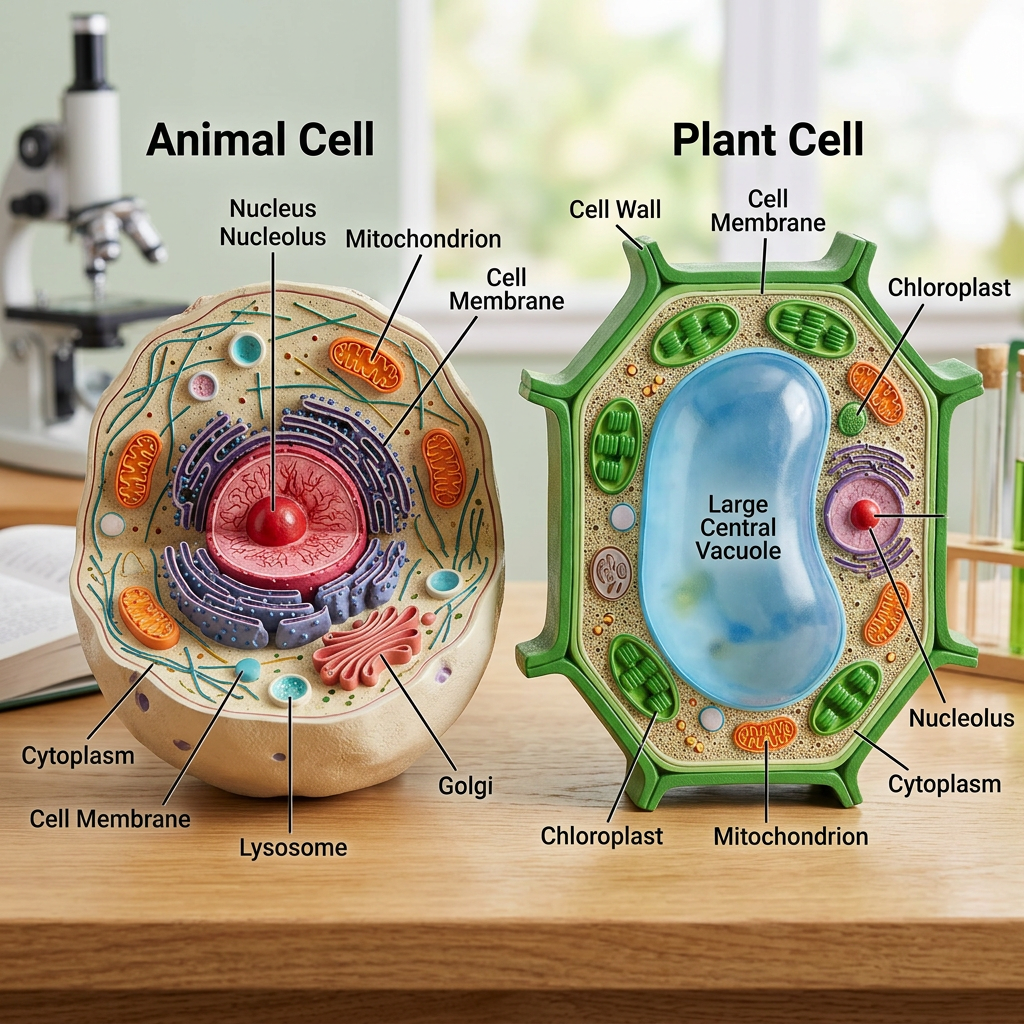
Cell Biology is the foundation of GCSE Biology. Every organism is built from cells, and understanding how they work unlocks the rest of the course. This topic includes core knowledge, higher‑tier ideas, required practicals, and exam‑style questions with full mark breakdowns.
1.1 Types of Cells
Animal Cells
Key structures:
- Nucleus – controls the cell
- Cytoplasm – site of reactions
- Cell membrane – controls movement
- Mitochondria – respiration
- Ribosomes – protein synthesis
Exam Q (2 marks)
Question: Name two structures found in both plant and animal cells. Answer: nucleus, cytoplasm, cell membrane, mitochondria, ribosomes (any two). Mark breakdown:
• 1 mark per correct structure (max 2)
Plant Cells
Contain everything in animal cells plus:
- Cell wall
- Chloroplasts
- Vacuole
Exam Q (3 marks)
Question: Give three structures found in plant cells but not in animal cells. Answer: cell wall, chloroplasts, vacuole. Mark breakdown:
• 1 mark each correct structure (max 3)
Bacterial Cells (Prokaryotes)
- No nucleus
- Circular DNA
- Plasmids
- Cell wall
- Flagella (sometimes)
Exam Q (2 marks)
Question: Explain why bacteria are described as prokaryotic. Answer: They have no nucleus; DNA is free in the cytoplasm. Mark breakdown:
• 1 mark: is not in the nucleus
• 1 mark: DNA is free in the cytoplasm
1.2 Specialised Cells
Examples:
- Sperm cell – tail, mitochondria, acrosome
- Nerve cell – long, branched connections
- Muscle cell – many mitochondria
- Root hair cell – large surface area
- Xylem – hollow tubes
- Phloem – sieve plates
Exam Q (4 marks)
Question: Describe how a sperm cell is adapted for its function. Model answer: Tail for swimming; many mitochondria for energy; streamlined head; acrosome with enzymes. Mark breakdown:
• 1 mark: tail
• 1 mark: mitochondria
• 1 mark: streamlined shape
• 1 mark: acrosome enzymes
1.3 Microscopy
Light vs Electron Microscopes
- Light: lower magnification, living cells
- Electron: higher magnification and resolution
Magnification Formula

Exam Q (3 marks)
Question: A cell image is 50 mm wide. The real cell is 0.05 mm wide. Calculate magnification. Answer: 50 ÷ 0.05 = 1000 Mark breakdown:
• 1 mark: correct substitution
• 1 mark: correct calculation
• 1 mark: correct final answer
1.4 Cell Division
Mitosis
Used for:
- growth
- repair
- asexual reproduction
Produces two identical daughter cells.
Stem Cells
- Embryonic – any cell
- Adult – limited types
- Plant meristems – differentiate throughout life
Exam Q (4 marks)
Question: Explain one medical use of stem cells and one risk. Model answer: Use: replace damaged cells (e.g., spinal injury). Risk: rejection or viral infection. Mark breakdown:
• 1 mark: correct medical use
• 1 mark: explanation
• 1 mark: correct risk
• 1 mark: explanation of risk
1.5 Transport in Cells
Diffusion
High → low concentration.
Osmosis
Diffusion of water through a partially permeable membrane.
Active Transport
Low → high concentration, requires energy.
Exam Q (3 marks)
Question: Describe the difference between diffusion, osmosis, and active transport. Model answer: Diffusion = high to low; osmosis = water only; active transport = low to high using energy. Mark breakdown:
• 1 mark: diffusion
• 1 mark: osmosis
• 1 mark: active transport
1.6 Surface Area to Volume Ratio
Large organisms have a small SA:V ratio, so diffusion is too slow. They need specialised exchange surfaces.
Adaptations:
- thin membranes
- large surface area
- good blood supply
- ventilation
Exam Q (4 marks)
Question: Explain why large organisms need specialised exchange surfaces. Model answer: Small SA:V ratio; diffusion too slow; need efficient transport; adaptations improve exchange. Mark breakdown:
• 1 mark: small SA:V ratio
• 1 mark: diffusion too slow
• 1 mark: need for transport systems
• 1 mark: adaptation explanation
1.7 Required Practicals
Microscopy Practical
Steps:
- prepare slide
- add stain
- lower coverslip
- focus low → high power
- measure cell size
- calculate magnification
Exam Q (6 marks)
Question: Describe how to prepare and observe a slide of onion cells. Model answer: Peel epidermis; place on slide; add iodine; lower coverslip; start low power; focus; move to high power. Mark breakdown:
• 1 mark: peel epidermis
• 1 mark: place on slide
• 1 mark: add iodine
• 1 mark: coverslip technique
• 1 mark: low power focus
• 1 mark: high power focus
Osmosis Practical
Steps:
- cut equal cylinders
- measure mass
- place in sugar solutions
- dry and re‑weigh
- calculate % change
- plot graph
Exam Q (6 marks)
Question: Describe how to investigate osmosis in potatoes and interpret results. Model answer: Cut equal cylinders; measure mass; place in solutions; dry; re‑weigh; calculate % change; graph; isotonic point = no change. Mark breakdown:
• 1 mark: equal cylinders
• 1 mark: initial mass
• 1 mark: sugar solutions
• 1 mark: final mass
• 1 mark: % change
• 1 mark: isotonic point
1.8 Common Misconceptions
- Bacteria do not have a nucleus
- Osmosis is only water
- Active transport is not diffusion
- Mitosis produces identical cells
- Root cells do not have chloroplasts
1.9 Quick Check Questions (with marks)
- Name two organelles found in plant cells but not in animal cells. (2)
- What is the function of ribosomes? (1)
- Write the formula for magnification. (1)
- What is mitosis used for? (2)
- Define osmosis. (2)
- Give one example of active transport in humans. (1)