

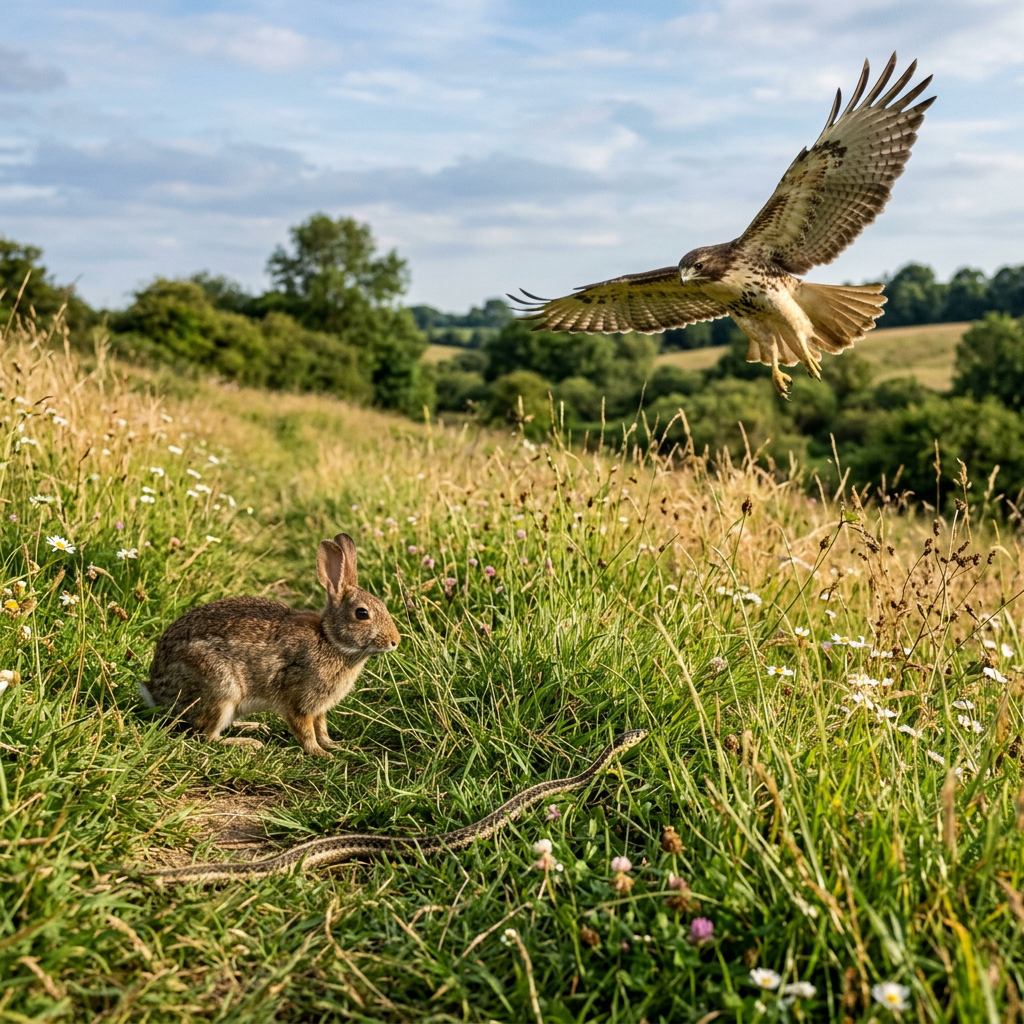
How organisms interact with each other and their environment, and how ecosystems stay in balance
Ecology explains how living things depend on each other and on the physical environment. It brings together ideas from every earlier topic: cells, energy, homeostasis, and inheritance and applies them to whole ecosystems.
This topic also connects strongly to sustainability, climate change, and human impact.
GCSE Exam Essentials
Students must be able to:
- Define ecosystems, communities, populations, and habitats
- Describe biotic and abiotic factors
- Explain adaptations (structural, behavioural, functional)
- Understand food chains, food webs, and trophic levels
- Describe the carbon cycle and water cycle
- Explain biodiversity and why it matters
- Understand human impacts on ecosystems
- Interpret ecological data, graphs, and sampling methods
These points appear across AQA, Edexcel, and OCR GCSE Biology specifications.
1. Ecosystems and Interdependence
Ecosystem
A community of organisms interacting with the environment.
Community
All the living organisms in an area.
Population
All the individuals of one species in an area.
Habitat
The place where an organism lives.
Organisms depend on each other for:
- Food
- Shelter
- Pollination
- Seed dispersal
If one species is removed, the whole system can be affected.
2. Biotic and Abiotic Factors
Biotic (living) factors
- Predators
- Competition
- Disease
- Food availability
Abiotic (non‑living) factors
- Temperature
- Light intensity
- Water availability
- soil pH
- Mineral content
Changes in these factors can alter population sizes.
3. Adaptations
Organisms have adaptations that help them survive.
Structural adaptations
Physical features (e.g., thick fur, large surface area of leaves)
Behavioural adaptations
Actions or behaviours (e.g., migration, nocturnal activity)
Functional adaptations
Internal processes (e.g., antifreeze proteins in Arctic fish)
Adaptations link directly to natural selection.
4. Food Chains, Food Webs and Trophic Levels
Food chains
Show the transfer of energy from one organism to another.
Food webs
Show how food chains interconnect more realistically.
Trophic levels
- Level 1: Producers (plants)
- Level 2: Primary consumers
- Level 3: Secondary consumers
- Level 4: Tertiary consumers
Energy is lost at each level through:
- Movement
- Heat
- Waste
This explains why food chains rarely exceed four or five levels.
5. The Carbon Cycle
Describes how carbon moves through the environment.
Key processes:
- Photosynthesis
- Respiration
- Combustion
- Decomposition
This links ecology to bioenergetics and climate change.
6. The Water Cycle
Describes how water moves through the environment.
Key processes:
- Evaporation
- Condensation
- Precipitation
- Transpiration
Essential for maintaining life on Earth.
7. Biodiversity and Human Impact
Biodiversity
The variety of living organisms in an ecosystem.
High biodiversity increases stability.
Threats to biodiversity
- Deforestation
- Pollution (air, water, land)
- Climate change
- Overfishing
- Habitat destruction
Conservation methods
- Breeding programmes
- Habitat protection
- Reducing waste
- Reforestation
- Legal protection of species
This is a major exam theme.
8. Common Misconceptions (GCSE‑specific)
Students often:
- Think food chains show all feeding relationships (food webs are needed)
- Confuse adaptations with evolution
- Believe energy is “recycled” (it is lost, not recycled)
- Mix up biotic and abiotic factors
- Think biodiversity only refers to the number of species
“Confusing food chains with food webs” “Thinking energy is recycled in ecosystems”
9. Quick Check Questions
Use these for active recall:
- What is an ecosystem?
- Give one biotic and one abiotic factor.
- What is a structural adaptation?
- Why is energy lost at each trophic level?
- Why is biodiversity important?
10. Summary
Ecology explains how organisms interact with each other and the environment. Understanding ecosystems, adaptations, cycles, and biodiversity provides the foundation for environmental science and sustainability.