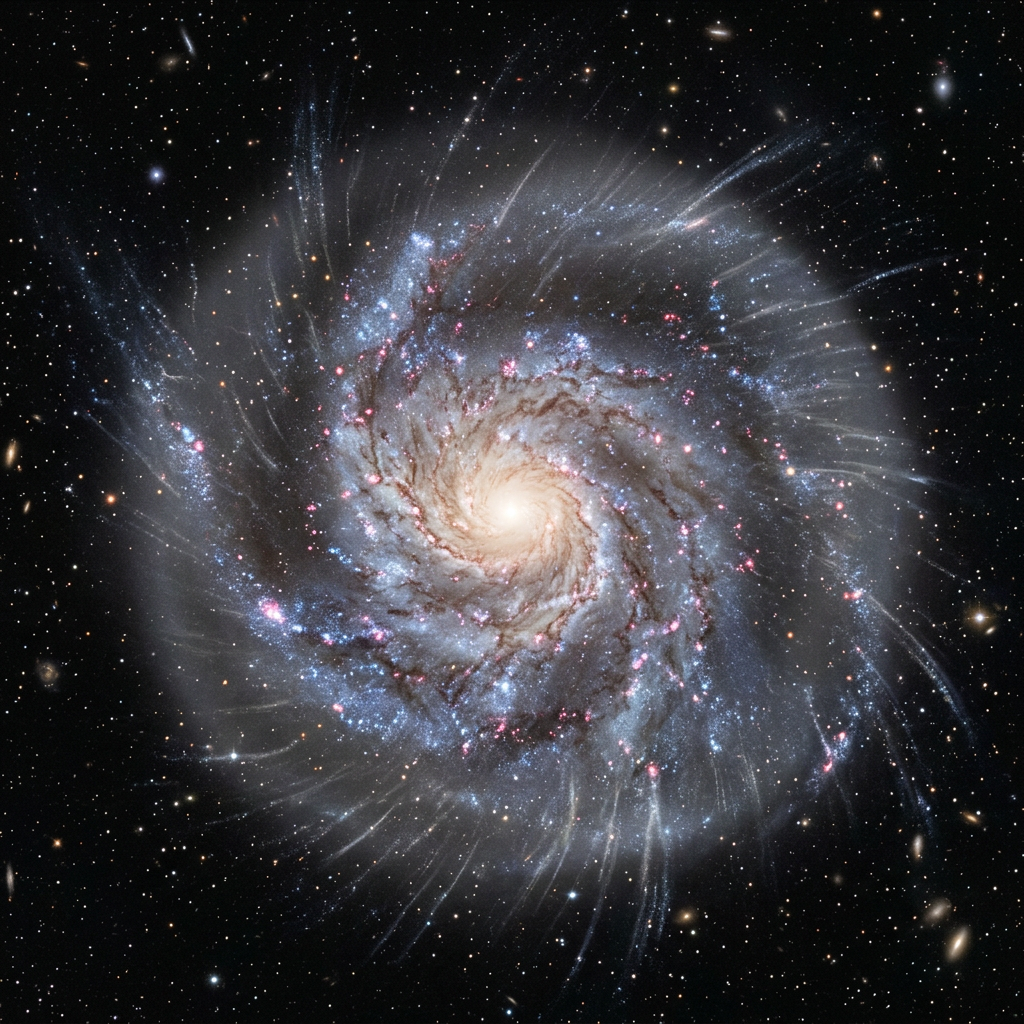
Dark matter is one of the biggest mysteries in modern physics. We can’t see it, touch it, or directly detect it, yet scientists are confident it exists because of the way it affects galaxies.
So, what is it?
1. Dark matter is invisible, but it has gravity
We can’t observe dark matter using light or telescopes because it doesn’t interact with electromagnetic radiation (light, radio waves, etc.).
But we can detect its presence because it:
- Influences how galaxies rotate
- Affects how galaxy clusters form
- Bends light through gravity (gravitational lensing)
In short, we can’t see it, but we can see what it does.
2. The galaxy rotation problem
One of the first clues came from studying how galaxies spin.
According to visible matter alone:
- Outer stars should rotate more slowly
- Galaxies should fall apart
But in reality:
- Stars on the edges move too fast to be held together by visible mass alone
Something invisible must be providing extra gravitational pull; this is dark matter.
3. So, what is it made of?
This is still unknown.
Leading ideas include:
- Wimps (weakly interacting massive particles)
- Axions (hypothetical ultra-light particles)
- Other exotic particles beyond the standard model
So far, none have been directly detected
4. Why can’t we see it?
Dark matter likely:
- Does not emit light
- Does not absorb light
- Does not reflect light
This makes it completely invisible to all current telescopes.
We only infer it through gravity.
5. How much of the universe is dark matter?
Current estimates suggest:
- ~5% normal matter (stars, planets, gas)
- ~27% dark matter
- ~68% dark energy (another mystery entirely)
Most of the universe is something we cannot directly observe.
6. How scientists are trying to find it
Researchers are using:
- Underground detectors (to avoid interference)
- Particle accelerators (like CERN)
- Space telescopes observing gravitational effects
- Sensitive detectors searching for rare interactions
So far, dark matter remains undetected directly but strongly supported indirectly.
The simple takeaway
Dark matter is:
- An invisible form of matter
- Detected only through gravity
- Essential for explaining how galaxies hold together
- Still one of the biggest unsolved problems in physics
Final thought
We don’t yet know what dark matter is, but we are confident it exists because the universe behaves as if something invisible is shaping it.
Sometimes in science, the absence of evidence becomes evidence of something deeper at work.