

Atoms, particles, and the foundations of all chemistry
Atomic structure is the first topic in GCSE Chemistry because everything else depends on it. Once you understand how atoms are built, bonding, reactions, the periodic table, and even organic chemistry become far easier to follow.
GCSE Exam Essentials
Students must be able to:
- Describe the structure of an atom
- Know the charges and relative masses of protons, neutrons, and electrons
- Define atomic number and mass number
- Explain isotopes
- Work out electron configurations using the 2,8,8 model
- Link electron structure to reactivity and periodic table position
These points appear in AQA, Edexcel, and OCR GCSE Chemistry specifications.
1. What an Atom Is
An atom is the smallest particle of an element that still behaves like that element.
Atoms contain three subatomic particles:
- Protons: positive charge
- Neutrons: no charge
- Electrons: negative charge
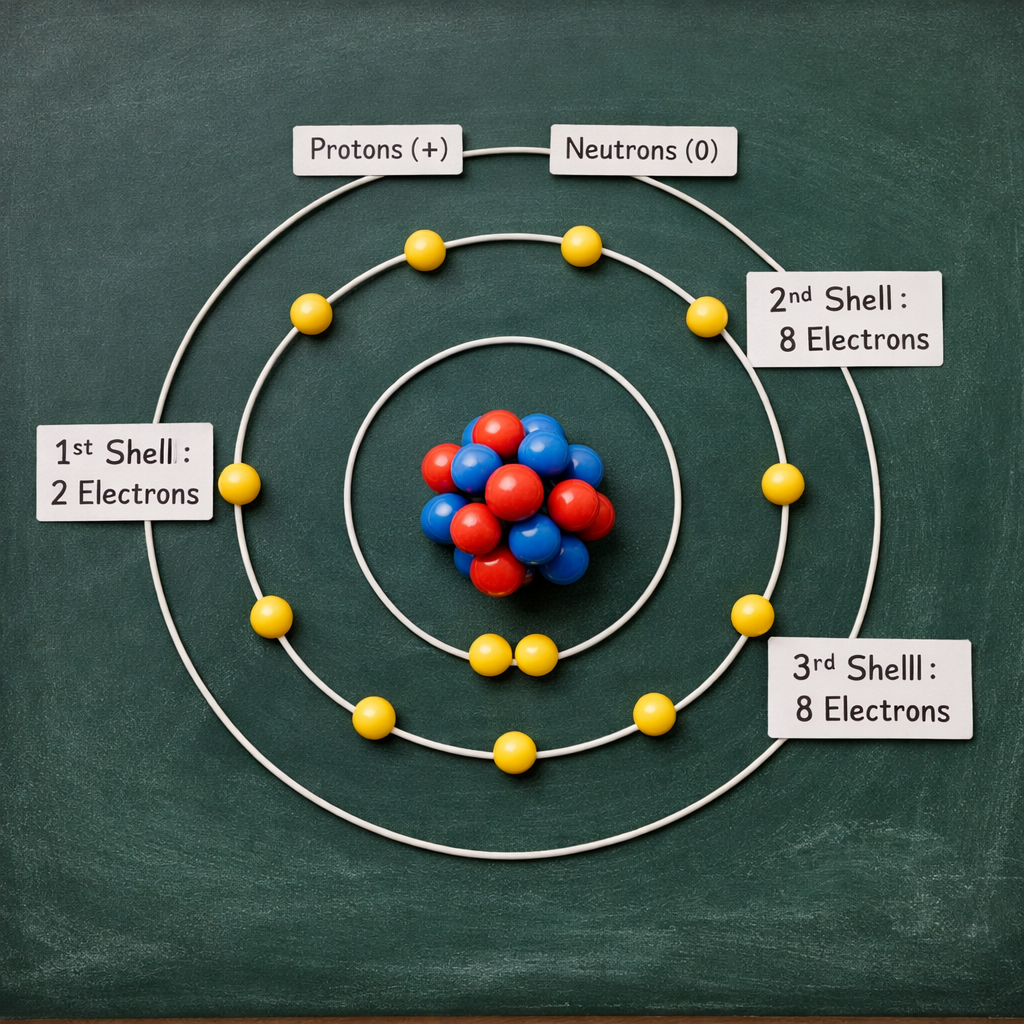
The nucleus (centre) contains protons and neutrons. Electrons move around the nucleus in energy levels (shells).
“Atoms are the foundation of all chemistry.”
2. Key Definitions (GCSE Core Knowledge)
Atomic Number
Number of protons in an atom. This defines the element.
Mass Number
Total number of protons + neutrons.
Isotopes
Atoms of the same element with different numbers of neutrons. They have the same chemical behaviour because they have the same number of electrons.
3. Electron Arrangement (2,8,8 Model)
Electrons fill shells in a fixed pattern:
- 1st shell → 2 electrons
- 2nd shell → 8 electrons
- 3rd shell → 8 electrons (GCSE model)
Electron configuration explains:
- Reactivity
- Bonding behaviour
- Position in the periodic table
For example: Sodium (Na) = 2,8,1 → very reactive Neon (Ne) = 2,8 → stable
4. Why Atomic Structure Matters
Understanding atoms unlocks the rest of chemistry:
- Bonding (ionic, covalent, metallic)
- Chemical reactions
- Periodic table trends
- Quantitative chemistry
- Organic chemistry
This is why GCSE Chemistry always begins here.
5. Common Misconceptions (GCSE‑specific)
Students often:
- Confuse atomic number with mass number
- Think electrons orbit like planets (they don’t; this is a simplified model)
- Believe isotopes behave differently chemically
- Forget that protons = atomic number
- Mix up electrons gained/lost with charge on ions (later topic)
“Thinking electrons orbit like planets” “Assuming isotopes behave differently chemically”
6. Quick Check Questions
Use these for active recall:
- What is the atomic number of an atom?
- What particles are found in the nucleus?
- Why do isotopes have the same chemical properties?
- Write the electron configuration for magnesium (Mg).
- Which particle determines the element: proton, neutron, or electron?
7. Summary
Atomic structure is the foundation of chemistry. Understand the particles, the numbers, and the electron shells, and the rest of the subject becomes far more logical.