

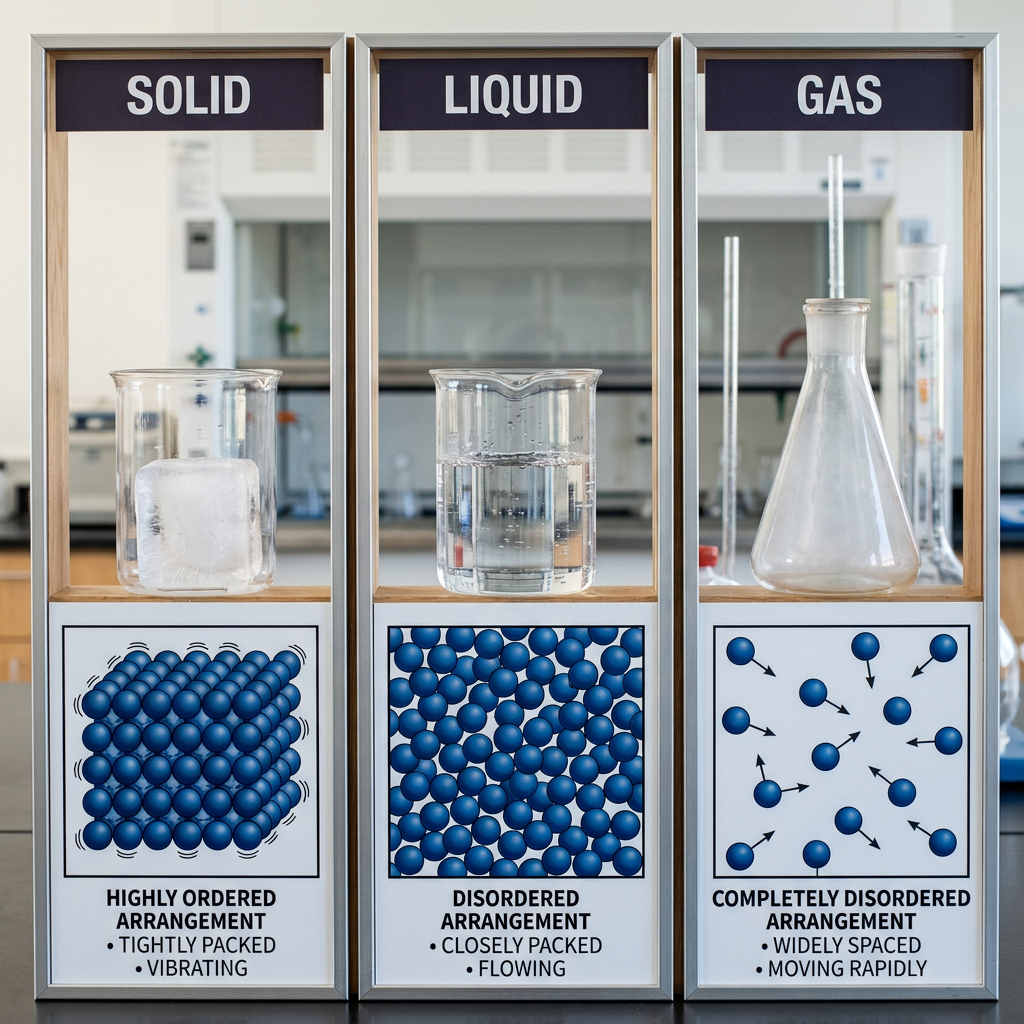
How particles behave in solids, liquids and gases and how this explains density, pressure and changes of state
The particle model is one of the most powerful ideas in physics. It explains why materials behave the way they do, why gases exert pressure, and how heating and cooling change the internal energy of a substance.
Once students understand particle behaviour, the rest of thermal physics becomes far more intuitive.
GCSE Exam Essentials
Students must be able to:
- Describe particle arrangement in solids, liquids, and gases
- Explain density and use the density equation
- Describe internal energy, heating, and changes of state
- Interpret heating curves
- Explain gas pressure and the effect of temperature and volume
- Use the equation pV = constant for gases
- Understand specific latent heat and specific heat capacity
These appear across AQA, Edexcel, and OCR GCSE Physics specifications.
1. Solids, Liquids and Gases
Solids
- Particles tightly packed
- Vibrate around fixed positions
- High density
- Fixed shape and volume
Liquids
- Particles are close but can move past each other
- Medium density
- No fixed shape, fixed volume
Gases
- Particles far apart
- Move randomly and quickly
- Low density
- No fixed shape or volume
“Particle spacing and movement explain the properties of solids, liquids and gases.”
2. Density
Density tells us how much mass is packed into a given volume.

Measured in kg/m³.
Why gases have low density
Particles are far apart → large volume → low density.
Required practical
Students must measure the density of:
- Regular solids
- Irregular solids (using displacement)
- Liquids
3. Internal Energy and Heating
Internal energy = total kinetic + potential energy of particles.
Heating a substance:
- Increases kinetic energy → temperature rises
- Increases potential energy → changes of state
This explains why the temperature stays constant during melting/boiling.
4. Changes of State
When a substance changes state:
- Mass stays the same
- The temperature stays constant during the change
- Energy is used to break or form bonds between particles
Specific Latent Heat
Energy needed to change state without changing temperature.
Two types:
- Fusion (melting/freezing)
- Vaporisation (boiling/condensing)

5. Gas Pressure and Temperature
Gas pressure is caused by particles colliding with the walls of a container.
Increasing temperature
- Particles move faster
- More frequent, harder collisions
- Pressure increases
Decreasing volume
- Particles collide more often
- Pressure increases
6. The Gas Law (pV = constant)
For a fixed mass of gas at constant temperature:

If volume decreases → pressure increases. If volume increases → pressure decreases.
This is a core GCSE calculation.
7. Common Misconceptions (GCSE‑specific)
Students often:
- Think particles expand when heated (they move faster, but do not get bigger)
- Confuse temperature with internal energy
- Believe mass changes during state changes
- Forget that pressure comes from particle collisions
- Mix up latent heat and specific heat capacity
“Thinking particles get bigger when heated” “Confusing temperature with internal energy”
8. Quick Check Questions
Use these for active recall:
- Why do gases have low density?
- What happens to internal energy when a substance is heated?
- Why does the temperature stay constant during melting?
- What is the equation linking pressure and volume?
- How does increasing temperature affect gas pressure?
9. Summary
The particle model explains the behaviour of matter at a microscopic level. Understanding density, internal energy, and gas pressure provides the foundation for thermal physics, energy transfer, and atomic structure.