

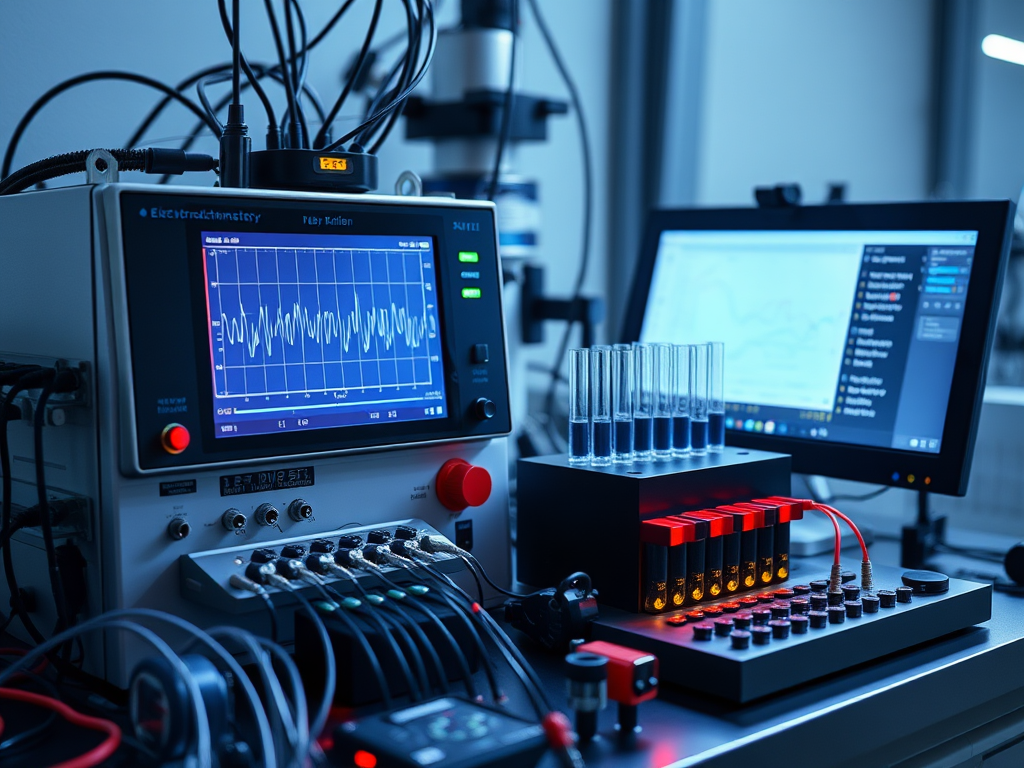
A modular guide to voltammetry, impedance, and chronoamperometry in redox analysis
1. Introduction
Electrochemical instrumentation enables the real-time study of redox reactions, allowing quantification of reaction rates, analysis of mechanisms, and characterisation of electrode performance. These techniques are essential for:
- Optimising catalysts
- Monitoring corrosion
- Designing sensors and fuel cells
By combining precise control of voltage and current with sensitive measurement, we can extract kinetic and thermodynamic information from electrochemical systems.
References:
2. Voltammetry: Current vs Voltage
Voltammetry measures current as a function of applied voltage, revealing:
- Redox potentials
- Reversibility of reactions
- Electron transfer kinetics
Types of Voltammetry:
- Cyclic Voltammetry (CV): Voltage swept forward and backwards; provides redox peaks and peak separation.
- Linear Sweep Voltammetry (LSV): Voltage increased linearly; simpler kinetics analysis.
- Differential Pulse Voltammetry (DPV): Voltage pulses superimposed; higher sensitivity for trace analysis.
Example: CV of Fe²⁺/Fe³⁺ exhibits symmetric anodic and cathodic peaks, indicating a reversible one-electron redox reaction:

Applications: catalyst screening, sensor calibration, and mechanistic studies.
Reference: Pine Research – Cyclic Voltammetry
3. Electrochemical Impedance Spectroscopy (EIS)
EIS applies a small AC voltage over a range of frequencies and measures the system’s response. It provides insight into:
- Charge transfer resistance (R₍ct₎)
- Double-layer capacitance (C₍dl₎)
- Diffusion processes
Data are plotted as:
- Nyquist plots: Imaginary vs. real impedance
- Bode plots: Magnitude and phase vs. frequency
Applications: battery diagnostics, fuel cell characterisation, corrosion monitoring.
Reference: Gamry Instruments – EIS Primer
4. Chronoamperometry: Current vs Time
Chronoamperometry applies a constant potential and measures current over time:

Features:
- Initial current spike followed by decay due to diffusion limitation
- Evaluates reaction kinetics and electrode stability
Example: Step potential applied to a sensor, where current decay indicates diffusion-controlled electrolysis.
Applications: sensor response, electrode fouling, reaction monitoring
5. Chronopotentiometry: Voltage vs Time
Chronopotentiometry applies a constant current and measures voltage over time:
- Used to study deposition/dissolution reactions
- Monitors overvoltage and electrode degradation
Example: Constant current drives metal plating; voltage rises as surface resistance increases.
Applications: electroplating, corrosion analysis
6. Typical Instrumentation Setup
A basic electrochemical cell includes:
- Working electrode (WE): site of redox reaction
- Reference electrode (RE): maintains constant potential (e.g., Ag/AgCl)
- Counter electrode (CE): completes circuit
- Potentiostat: controls voltage, measures current
Advanced setups:
- Rotating disk electrodes (RDE) for controlled mass transport
- Flow cells for continuous operation
- Microelectrodes for localised measurements
7. Data Interpretation and Modelling
Electrochemical data can be analysed using:
- Voltammetry: peak position, shape, and separation indicate reversibility and kinetics
- EIS: equivalent circuit models extract resistances and capacitances
- Chronoamperometry: decay curves relate to diffusion coefficients
Software tools (e.g., EC-Lab, Nova) enable:
- Curve fitting
- Parameter extraction
- Mechanism identification
8. Summary
Electrochemical measurement techniques allow in-depth analysis of redox reactions, providing data on kinetics, mechanisms, and electrode performance. Mastery of:
- Voltammetry
- Impedance spectroscopy
- Time-based methods
…is essential for sensor development, energy systems, and catalytic research.
Support the Archive
This archive is freely shared as a communal act of care.
If you’d like to support its continuation, consider purchasing a companion PDF set for £1 per lecture via Payhip, with the final price depending on the number of lectures in the set, available only once the full series is complete.