

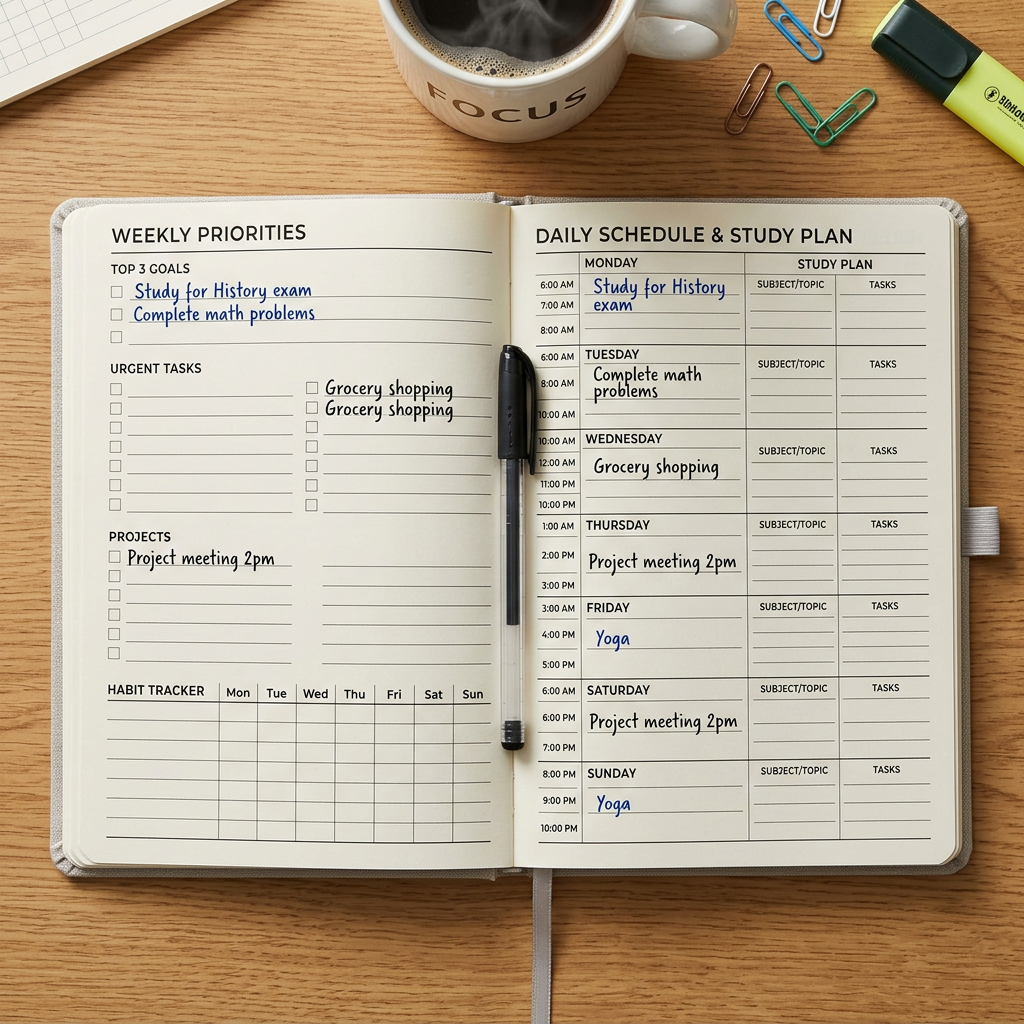
Study Resources → Revision Planners
A revision planner isn’t just a timetable. It’s a tool for organising your learning, tracking your progress, and keeping your revision realistic and sustainable.
Most students either avoid planners completely or create ones that collapse after a week. A good revision planner does the opposite; it supports you, adapts with you, and keeps you moving even when motivation dips.
This post explains how to use a revision planner properly and what makes a good one work.
1. What a Revision Planner Is (and isn’t)
A revision planner is:
- A weekly overview of what you’ll study
- A way to prioritise subjects
- A record of what you’ve completed
- A tool for balancing workload
- A safety net for busy weeks
A revision planner is not:
- A rigid timetable
- A minute‑by‑minute schedule
- A punishment tool
- A guilt generator
- A perfection test
A good planner bends without breaking.
2. Why Revision Planners Fail (and How to Avoid It)
Most planners fail because they’re:
- Too detailed
- Too ambitious
- Too rigid
- Too unrealistic
- Too guilt‑driven
A planner that works is:
- Simple
- Flexible
- Weekly, not daily
- Built around your real life
- Designed for recovery
The goal is sustainability, not intensity.
3. The Core Structure of a Good Revision Planner
A strong planner includes:
1. Weekly Priorities
Your top three subjects or topics for the week.
2. Study Blocks
Short, focused sessions (30–45 minutes).
3. A Catch‑Up Block
A built‑in safety net for missed work.
4. A Review Section
What worked, what didn’t, what to adjust.
5. A Progress Tracker
Tick‑off boxes, colour coding, or a simple “done / not done”.
This structure keeps you organised without overwhelming you.
4. How to Use a Revision Planner Effectively
Step 1: Set Your Weekly Priorities
Choose:
- One priority subject
- One maintenance subject
- One rotating subject
This keeps your workload focused.
Step 2: Add 3–5 Study Blocks
Place them where your energy is highest.
Step 3: Add One Catch‑Up Block
This prevents the “I’ve ruined everything” spiral.
Step 4: Review at the End of the Week
Ask:
- What did I complete?
- What needs more time?
- What can I drop?
Weekly reviews keep the planner alive.
5. What Makes a Planner Useful for Students
A good planner should:
- Reduce stress
- Increase clarity
- Make revision feel manageable
- Help you see progress
- Adapt to your life
- Support consistency
If your planner doesn’t make revision easier, it’s the wrong planner.
6. The Takeaway
A revision planner is a tool for:
- Focus
- Balance
- Progress
- Adaptability
- Confidence
Use it weekly, keep it simple, and let it support you, not control you.