

The building blocks of life, how cells work, and why they matter
Cell biology is the foundation of all biology. Every organism, from bacteria to humans, begins with cells. Once students understand cell structure, specialisation, and transport, the rest of biology becomes far more logical.
GCSE Exam Essentials
Students must be able to:
- Describe the structure of animal, plant, and bacterial cells
- Compare differences between cell types
- Explain the function of key organelles
- Understand specialised cells and how structure links to function
- Describe diffusion, osmosis, and active transport
- Explain mitosis and the cell cycle
- Use microscopes and calculate magnification
These appear across AQA, Edexcel, and OCR GCSE Biology specifications.
1. What Cells Are
Cells are the smallest units of life. All living organisms are made of one or more cells.
“All living organisms are made of cells. Cells carry out all life processes.”
There are three main types at GCSE:
- Animal cells
- Plant cells
- Bacterial cells (prokaryotes)
2. Animal and Plant Cell Structure
Animal Cells
Key organelles:
- Nucleus: controls the cell
- Cytoplasm: where chemical reactions occur
- Cell membrane: controls movement in and out
- Mitochondria: release energy (respiration)
- Ribosomes: protein synthesis
Plant Cells
Contain all animal cell structures plus:
- Cell wall: support and strength
- Chloroplasts: photosynthesis
- Large vacuole: storage and pressure
These differences link directly to plant function.
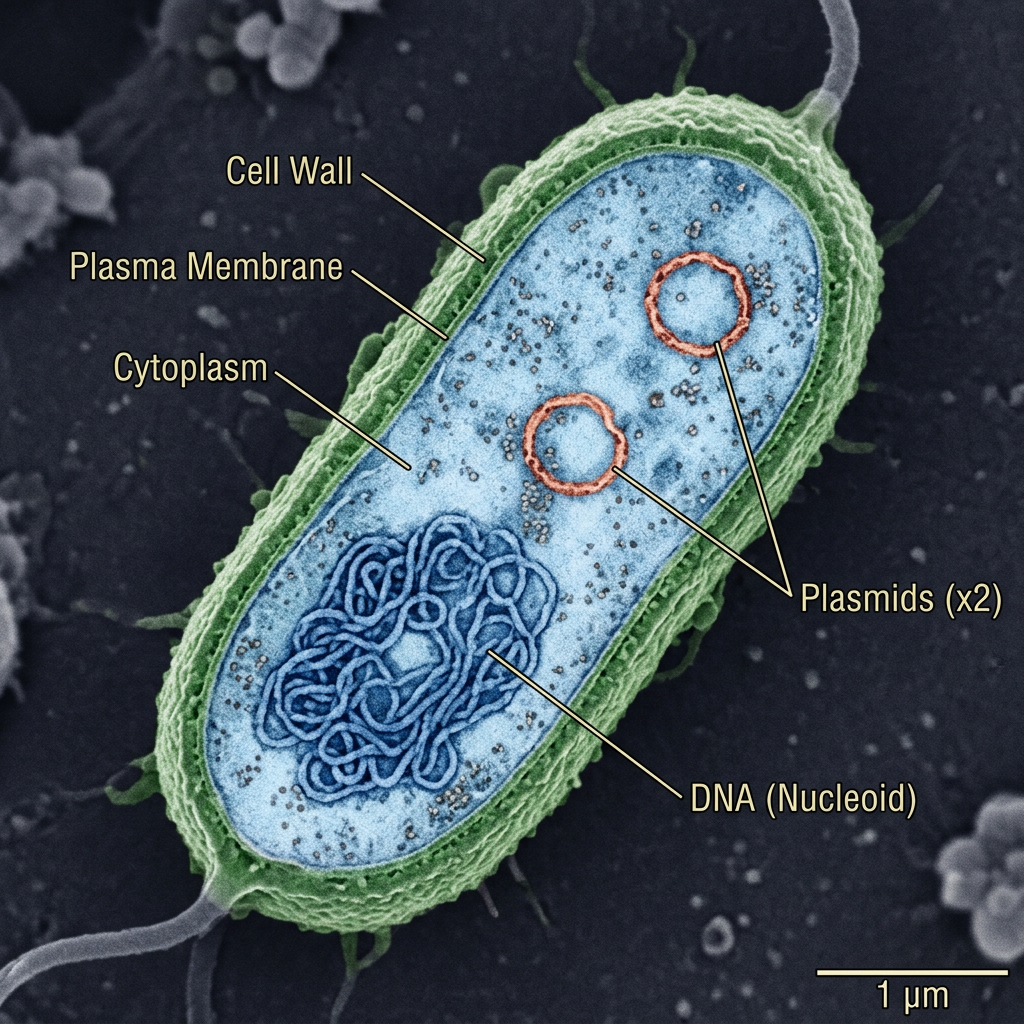
3. Bacterial Cells (Prokaryotes)
Bacteria are simpler and smaller.
They contain:
- Cell membrane
- Cell wall
- Cytoplasm
- DNA loop (no nucleus)
- Plasmids (small DNA rings)
Understanding this difference is essential for later topics like antibiotics and genetics.
4. Specialised Cells
Cells adapt their structure to their function.
Examples:
- Nerve cells: long, insulated for fast signalling
- Muscle cells: packed with mitochondria for contraction
- Root hair cells: large surface area for absorption
- Sperm cells: tail for movement, enzymes to enter the egg
GCSE exams often ask students to explain how structure links to function.
5. Cell Transport
Substances move in and out of cells by:
Diffusion
Movement of particles from high to low concentration.
Examples: oxygen into blood, carbon dioxide out of cells.
Osmosis
Diffusion of water across a partially permeable membrane.
Water moves from dilute → concentrated solutions.
Active Transport
Movement against the concentration gradient. Requires energy from respiration.
Example: root hair cells absorbing minerals.
6. Cell Division (Mitosis)
Cells divide for:
- Growth
- Repair
- Replacement
Mitosis produces two identical daughter cells.
Stages include:
- DNA replication
- Chromosomes separating
- Cell splitting
This links to genetics and cancer biology later in the course.
7. Common Misconceptions (GCSE‑specific)
Students often:
- Think all cells are identical
- Mix up plant and animal cell structures
- Confuse diffusion and osmosis
- Forget that mitochondria release energy
- Believe bacteria have a nucleus (they don’t)
- Think mitosis produces different cells (it produces identical ones)
“Confusing plant and animal cell structures” “Mixing up diffusion and osmosis”
8. Quick Check Questions
Use these for active recall:
- Name three structures found in both plant and animal cells.
- What is the function of mitochondria?
- How is a root hair cell adapted to its function?
- What is the difference between diffusion and active transport?
- Why does mitosis produce identical cells?
9. Summary
Cell biology explains how living organisms are built and how they function. Understanding cell structure, transport, and division provides the foundation for every other topic in GCSE Biology.