

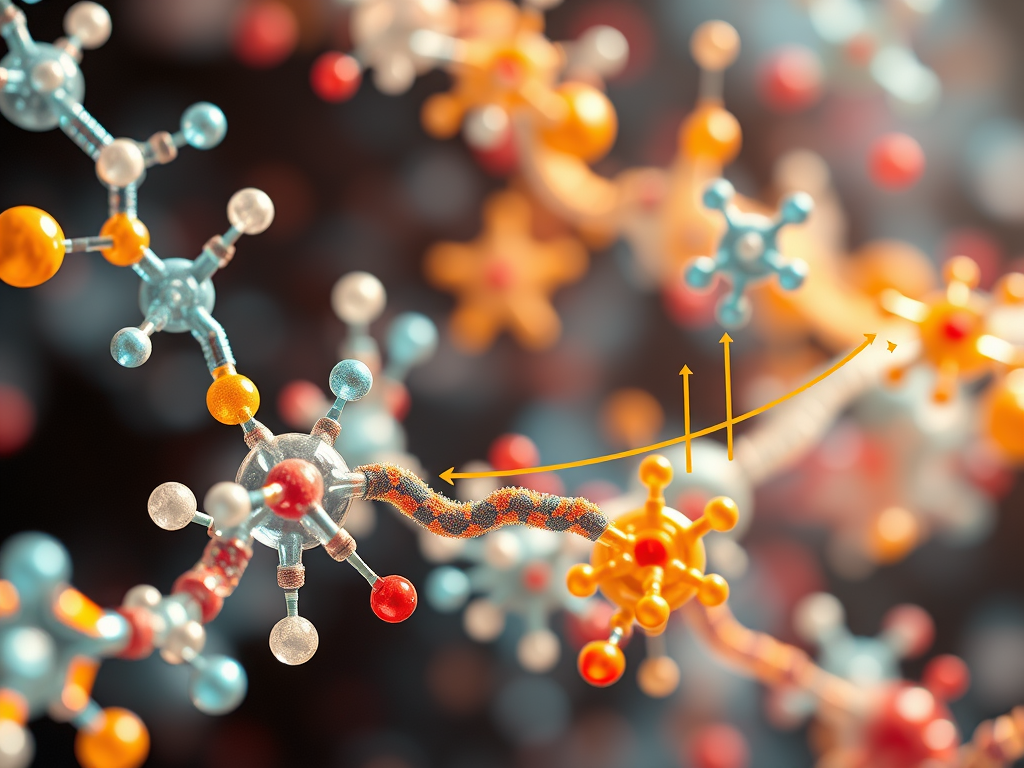
Dive into the catalytic logic and dynamic balance that underpins life’s chemistry. This modular six-lecture series offers a companionable, scaffolded journey through enzyme kinetics, reaction rates, and chemical equilibrium, perfect for learners, educators, and science communicators.
Why this series matters:
Enzymes accelerate reactions with elegance, and understanding how substrate concentration, temperature, pH, and environmental factors affect activity is essential for biochemistry, pharmacology, and physical chemistry. Likewise, mastering reaction equilibria and Le Chatelier’s Principle allows you to predict and manipulate chemical systems in both lab and real-world contexts.
Start Learning
Begin with Lecture 1: Enzyme-Catalysed Reactions and Rate Dependence (03/03/2026)
Access the Full Lecture Here
What you’ll explore:
- Lecture 1: Enzyme-Catalysed Reactions & Rate Dependence – ES complexes, reaction velocity, saturation effects
- Lecture 2: Michaelis-Menten Kinetics – Understanding Km, Vmax, and Catalytic Efficiency
- Lecture 3: Experimental Determination of Km & Vmax – Measuring enzyme activity, plotting Michaelis-Menten and Lineweaver-Burk data
- Lecture 4: Environmental Effects – Temperature, pH, denaturation, and optimum conditions
- Lecture 5: Reaction Equilibria & Dynamic Balance – Reversible reactions, equilibrium constants, and concentration changes
- Lecture 6: Le Chatelier’s Principle & Equilibrium Shifts – Predicting system responses to changes in concentration, pressure, temperature, and volume
Bonus features:
- Live links to trusted resources (Khan Academy, ChemLibreTexts, RSC, Nature Education, Biochemia Medica)
- Outreach-ready formatting for flashcards, handouts, or teaching posts
- Modular design for standalone study or sequential learning
- Companionable tone and scaffolded explanations for deeper understanding
Learning outcomes:
- Model enzyme-substrate interactions and understand reaction velocity
- Use Michaelis-Menten kinetics to interpret Km and Vmax
- Design and analyse enzyme kinetics experiments
- Predict how environmental conditions affect enzyme activity
- Apply equilibrium expressions and Le Chatelier’s Principle to chemical systems
- Visualise and manipulate reaction dynamics in real-world and industrial contexts
Unlock the logic of catalysis and the dance of equilibrium, one lecture, one concept, one insight at a time.
Learn more and access resources at: ScienceDeconvolution.com
Accessibility Notes
- All lecture materials are delivered as modular posts, with supporting links for clarity, rhythm-aware pacing, and neurodivergent-friendly engagement.
- All posts are freely available. Subscribe to receive new content directly in your inbox.
- Each set includes one consolidated PDF download, formatted for Word, email, and print compatibility via a £1 per lecture purchase at Payhip, with the final price depending on the number of lectures in the set.
- Feedback and remixing are always welcome. This archive is a communal act of care, repair, and scholarly generosity.
Support the Archive
This archive is freely shared as a communal act of care.
If you’d like to support its continuation, consider purchasing a companion PDF set for £1 per lecture, with an associated quiz, via Payhip, with the final price depending on the number of lectures in the set, available only once the full series is complete.
Explore more with us:
- Read our Informal Blog for relaxed insights
- Discover Deconvolution and see what’s happening
- Visit Gwenin for a curated selection of frameworks
- Browse Spiralmore collections