

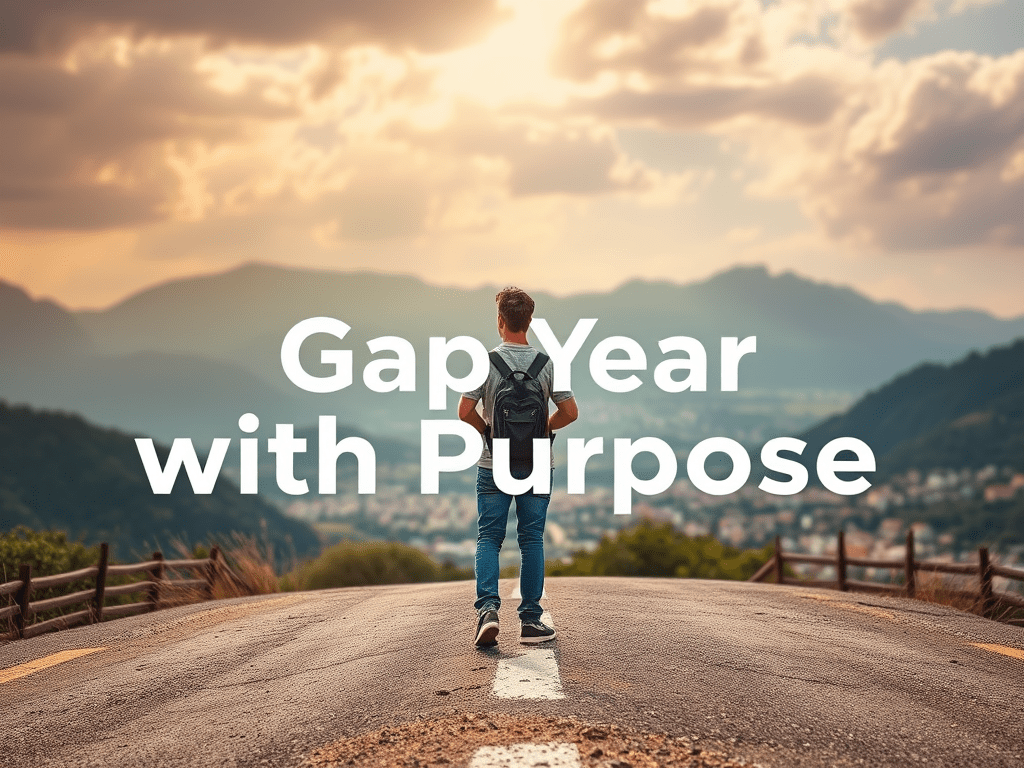
A step-by-step guide to pausing with intention, not just drifting
Let’s talk about the pause that isn’t passive
A gap year is often framed as a break, a pause between school and university, or between one phase of life and the next. But it’s not just a detour. It’s a formative space for growing up, slowing down, and figuring out what really matters before jumping into the next round of deadlines and decisions.
For many students, a gap year is the first time they get to design their own time. To explore, reflect, travel, earn, rest, volunteer, or simply recalibrate. It can spark maturity not because it looks good on a CV, but because it helps clarify who you are when no one’s grading you. It’s a chance to grow the skills that don’t fit into a classroom, like resilience, agency, emotional awareness, and the ability to navigate ambiguity with care.
This guide helps you design a gap year that isn’t just about filling time. It’s about growing intentionally.
Define Your Why
Before you plan activities, get clear on your purpose.
☑ Ask yourself:
- Am I burnt out and need to recover?
- Am I unsure about my next step and need time to explore?
- Do I want to gain experience, skills, or perspective?
✍ The reason I’m considering a gap year is ____________________________
and I hope it helps me ____________________________.
Choose Your Focus
Gap years can be structured or fluid, but they benefit from a guiding theme.
☑ Possible focuses include:
- Travel and cultural immersion
- Volunteering or service
- Paid work or internships
- Creative or personal projects
- Health and wellbeing
- Academic preparation or skill-building
✍ The focus I’m most drawn to is ____________________________
because it connects to ____________________________.
Plan with Flexibility
Structure helps, but so does space to adapt.
☑ Consider:
- A loose timeline with milestones
- A mix of solo and collaborative activities
- Time for rest, reflection, and recalibration
✍ One thing I’ll build into my plan is ____________________________
to help me stay grounded and responsive.
Think About Money
Gap years aren’t free, but they don’t have to be expensive.
☑ Try:
- Budgeting for travel, living costs, and emergencies
- Exploring scholarships or paid placements
- Earning money through part-time work or freelancing
✍ To support my gap year financially, I’ll ____________________________.
Document and Reflect
Your gap year is a story in progress. Capture it.
☑ Try:
- Journaling or blogging
- Creating a portfolio or scrapbook
- Setting monthly reflection prompts
✍ One way I’ll track my growth is by ____________________________.
Prepare for Re-entry
The end of a gap year is a beginning, too.
☑ Consider:
- How you’ll transition back into study or work
- What you’ve learned and how it shapes your next step
- How to talk about your gap year in applications or interviews
✍ When I return, I want to carry forward ____________________________
and leave behind ____________________________.
Final Reflection: What Does a Gap Year Make Possible?
A gap year isn’t a detour, it’s a deep breath. A chance to ask better questions, build new skills, and reconnect with what matters. What would it mean to treat this time as a form of care, not just a delay?
✍ If I could describe my ideal gap year in three words, they’d be ____________________________, ____________________________, and ____________________________.
For a full framework, please see the PDF below

Explore more with us:
- Browse Spiralmore collections
- Read our Informal Blog for relaxed insights
- Discover Deconvolution and see what’s happening
- Visit Gwenin for a curated selection of frameworks
 Deconvolution