

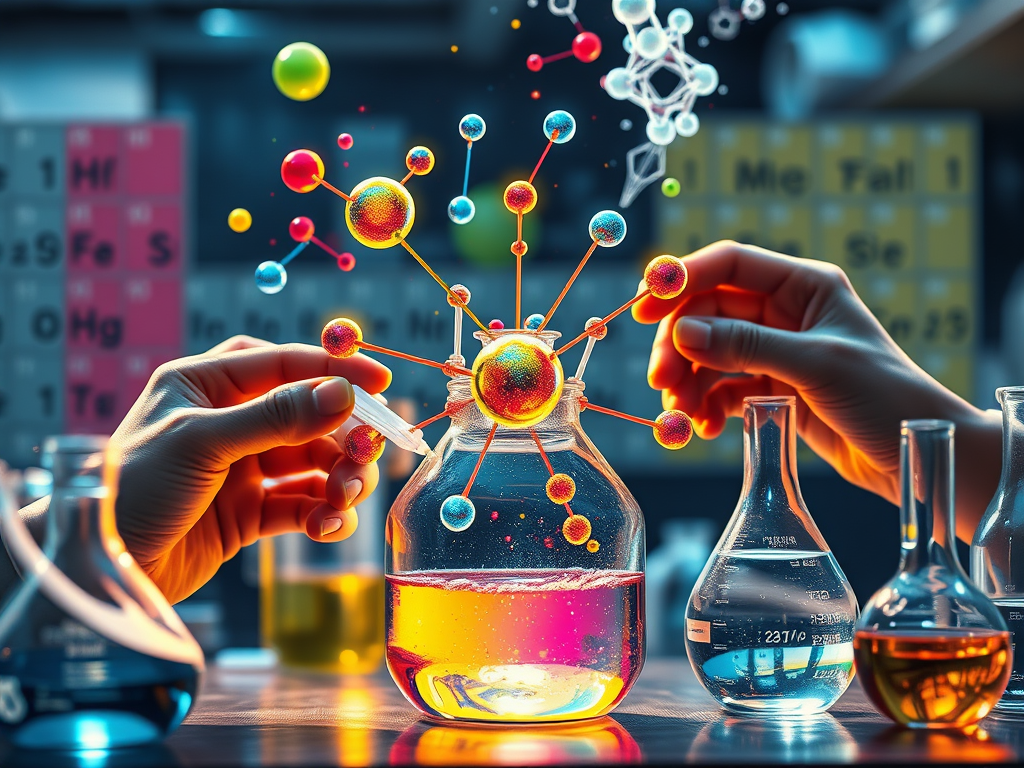
A step-by-step guide to exploring the building blocks of matter and the transformations that shape our world
Let’s talk about the science of change
Chemistry is often called the central science because it is, or more seriously, because it connects physics, biology, medicine, engineering, and even environmental studies. At its heart, chemistry is the study of matter (everything that has mass and takes up space) and how it changes.
From cooking and cleaning to breathing and healing, chemistry explains the invisible processes that shape everyday life. Learning its basics helps you understand the world more deeply and opens doors to careers, creativity, and critical thinking. In short, it’s amazing!
Know What Chemistry Is
Chemistry explores the composition, structure, and properties of matter and how substances interact, combine, and transform.
☑ Key ideas:
- Matter is made of atoms, tiny particles that form elements
- Atoms combine to form molecules and compounds
- Chemical reactions rearrange atoms to create new substances
✍ One thing I’m curious about in chemistry is ____________________________.
Learn the Language of Chemistry
Chemistry has its own vocabulary – but it’s learnable.
☑ Start with:
- Elements: Pure substances like hydrogen, oxygen, carbon
- The Periodic Table: A map of all known elements
- Chemical formulas: Symbols that show how atoms combine (e.g. H₂O)
✍ An element I want to learn more about is ____________________________
because it’s used in ____________________________.
Explore States of Matter
Matter exists in different forms—each with unique properties.
☑ The main states:
- Solid: Fixed shape and volume (e.g. ice)
- Liquid: Fixed volume, flexible shape (e.g. water)
- Gas: No fixed shape or volume (e.g. oxygen)
- Plasma: High-energy state found in lightning and stars
✍ One everyday example of a chemical change is ____________________________.
Understand Chemical Reactions
Reactions happen when substances interact and transform.
☑ Common types:
- Combustion: Burning (e.g. wood + oxygen → carbon dioxide)
- Synthesis: Building new compounds
- Decomposition: Breaking down substances
- Neutralisation: Acid + base → salt + water
✍ A reaction I’ve seen in real life is ____________________________
and it involved ____________________________.
Get Hands-On (Safely!)
Chemistry is best learned through experiments and observation.
☑ Try:
- Using a chemistry kit or household items (e.g. vinegar + baking soda)
- Watching reaction videos or simulations
- Practising lab safety: goggles, gloves, clear labels
✍ One experiment I’d like to try is ____________________________
because I want to see ____________________________.
Final Reflection: Chemistry is, by definition, Curiosity
Chemistry isn’t just about formulas; it’s about asking questions. Why does metal rust? How does soap clean? What makes fireworks colourful? Every answer begins with atoms, energy, and transformation.
✍ If I could describe chemistry in three words, they’d be ____________________________, ____________________________, and ____________________________.
Pop over to Gwenin for a selection of frameworks, or pop over to Spiralmore’s collections. You’re also welcome to explore our more relaxed corner: the informal blog.
